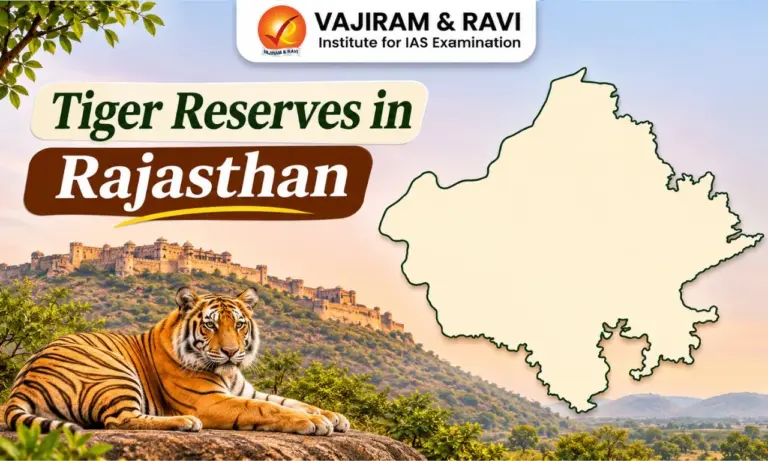
Tiger Reserves in Rajasthan play an important role in protecting Bengal tigers, endangered wildlife and the diverse biodiversity of the Aravalli and Vindhyan landscapes. Rajasthan has five tiger reserves, covering dry deciduous forests, rocky hills, grasslands and river valleys. These reserves support tiger conservation, wildlife corridors, ecological balance and sustainable tourism, making Rajasthan an important state under Project Tiger.
How Many Tiger Reserves Are There in Rajasthan?
As of 2026, Rajasthan has five tiger reserves under Project Tiger, managed by the Rajasthan Forest Department with guidance from the National Tiger Conservation Authority (NTCA). These reserves protect important tiger habitats across the Aravalli Hills, Vindhyan ranges and Chambal River basin.
- Total Tiger Reserves: Rajasthan has five tiger reserves, namely Ranthambore, Sariska, Mukundara Hills, Ramgarh Vishdhari and Dholpur-Karauli.
- Largest Tiger Reserve: Ramgarh Vishdhari Tiger Reserve, covering approximately 1,501.89 sq. km, based on the NTCA’s core and buffer area figures.
- Smallest Tiger Reserve: Dholpur-Karauli Tiger Reserve, covering approximately 1,057.88 sq. km, including its notified core and buffer areas.
- Oldest Tiger Reserve: Ranthambore Tiger Reserve, included among India’s first nine reserves under Project Tiger in 1973.
- Newest Tiger Reserve: Dholpur-Karauli Tiger Reserve, notified in 2023 as Rajasthan’s fifth tiger reserve.
- Tiger Population: According to the 2022 All India Tiger Estimation, Rajasthan’s tiger population increased from 69 in 2018 to 88 in 2022.
- Conservation Significance: These reserves protect Bengal tigers, leopards, sloth bears, deer, forest ecosystems and important wildlife corridors.
How Are Tiger Reserves in India Governed and Managed?
Tiger Reserves in India are governed jointly by the Central and State Governments under Project Tiger and the Wild Life (Protection) Act, 1972. The National Tiger Conservation Authority (NTCA) provides statutory oversight, while State Forest Departments manage conservation activities.
Legal and Institutional Framework
- Wild Life (Protection) Act, 1972: Provides the legal framework for tiger conservation. The 2006 amendment introduced provisions under Section 38V for the notification and management of tiger reserves.
- Ministry of Environment, Forest and Climate Change (MoEFCC): Oversees Project Tiger, a Centrally Sponsored Scheme launched in 1973, providing policy guidance and financial support.
- National Tiger Conservation Authority (NTCA): A statutory body chaired by the Union Environment Minister that approves tiger conservation plans, establishes guidelines and coordinates conservation efforts.
- State Governments: Responsible for notifying tiger reserves, forest protection, wildlife monitoring, anti-poaching operations and day-to-day management.
- Boundary Alteration: Under Section 38W, changing tiger reserve boundaries requires an NTCA recommendation and National Board for Wild Life approval. De-notification requires approval from both bodies and must be in the public interest.
Core and Buffer Zones of Tiger Reserves in India
As of November 2026, India has 58 tiger reserves across 18 states, covering approximately 84,487 sq. km. Each reserve consists of core and buffer zones to balance wildlife conservation with sustainable human activities.
- Core Zone (Critical Tiger Habitat): A legally notified area managed to protect tigers, prey species and natural habitats with minimal human disturbance. Creating inviolate areas must follow prescribed legal safeguards.
- Buffer Zone (Peripheral Area): Surrounds or adjoins the core zone and supports wildlife movement, community livelihoods, eco-development and human-wildlife conflict management.
- Conservation Management: The NTCA, State Forest Departments and local communities work together on habitat protection, monitoring and sustainable conservation practices.


List of Tiger Reserves in Rajasthan
Rajasthan’s five tiger reserves are spread across the eastern and southeastern parts of the state. Each reserve has distinct forest habitats, wildlife species and ecological importance.
|
Tiger Reserve |
Districts |
Total Area (sq. km) |
|
Ranthambore Tiger Reserve |
Sawai Madhopur, Karauli, Bundi and Tonk |
1,411.29 |
|
Sariska Tiger Reserve |
Alwar and adjoining districts |
1,213.34 |
|
Mukundara Hills Tiger Reserve |
Kota, Bundi, Chittorgarh and Jhalawar |
759.99 |
|
Ramgarh Vishdhari Tiger Reserve |
Bundi, Kota and Bhilwara |
1,501.89 |
|
Dholpur-Karauli Tiger Reserve |
Dholpur and Karauli |
1,057.88 |
Key Features of Tiger Reserves in Rajasthan
The Tiger Reserves in Rajasthan are known for their dry deciduous forests, rocky landscapes, rich wildlife, historic forts and important river ecosystems. These reserves protect Bengal tigers and other endangered species while maintaining ecological connections across the Aravalli and Vindhyan regions.
1. Ranthambore Tiger Reserve
- Location and Establishment: Located primarily in Sawai Madhopur district, Ranthambore was included under Project Tiger in 1973, while Ranthambore National Park was established in 1980.
- Total Area: Covers approximately 1,411.29 sq. km.
- Flora and Vegetation: The reserve contains dry deciduous forests, grasslands, rocky hills and scrub vegetation, with around 320 plant species, including banyan and dhok trees.
- Major Wildlife: Home to Bengal tigers, leopards, sloth bears, sambar, chital, nilgai, chinkara, striped hyenas, marsh crocodiles and numerous bird species.
- River Systems: The landscape lies between the Banas and Chambal rivers and contains important lakes such as Padam Talao, Raj Bagh Talao and Malik Talao.
- Historical Significance: The Ranthambore Fort, located within the park, is part of the UNESCO-listed Hill Forts of Rajasthan, combining cultural heritage with wildlife conservation.
- Special Features: Famous for the legendary tigress Machli, Ranthambore is one of India’s best-known tiger habitats and plays an important role in supporting tiger dispersal to neighbouring forests.
2. Sariska Tiger Reserve
- Location and Establishment: Located in the Aravalli Hills of Alwar district, Sariska was declared a wildlife sanctuary in 1958 and brought under Project Tiger in 1978-79.
- Total Area: Covers approximately 1,213.34 sq. km.
- Flora and Vegetation: The reserve supports dry deciduous forests, thorn scrublands, rocky hills and grasslands, dominated by dhok, arjun, tendu, ber, khair and bamboo.
- Major Wildlife: Important species include Bengal tigers, leopards, sambar, chital, nilgai, four-horned antelopes, wild boars, hyenas and jungle cats.
- Tiger Reintroduction: After the disappearance of its tiger population due to poaching in 2004-2005, tigers were reintroduced from Ranthambore in 2008, beginning a major conservation recovery programme.
- Historical Significance: The reserve contains Kankwari Fort, Pandupol Hanuman Temple and other historical structures, reflecting the cultural heritage of the Alwar region.
- Special Features: Sariska is internationally recognised for its tiger reintroduction programme, supported by wildlife monitoring, anti-poaching measures and habitat management.
3. Mukundara Hills Tiger Reserve
- Location and Establishment: Located in southeastern Rajasthan, near Kota, Mukundara Hills became Rajasthan’s third tiger reserve in 2013. The landscape was historically associated with the royal hunting grounds of Kota.
- Total Area: The NTCA lists 759.99 sq. km.
- Geographical Features: Situated within the Vindhyan hill system, the reserve features two parallel hill ranges, Mukundara and Gargola, separated by forested valleys.
- River Systems: The landscape is influenced by the Chambal River and its tributaries, including the Kali, Ahu and Ramzan rivers, which support local water resources.
- Flora and Vegetation: The reserve consists mainly of dry deciduous forests, rocky slopes, dense woodland and river valleys, providing habitats for a wide range of wildlife.
- Major Wildlife: Supports Bengal tigers, leopards, sloth bears, wolves, hyenas, wild boars, deer and freshwater crocodiles in the Chambal ecosystem.
- Special Features: The reserve landscape includes protected areas associated with Darrah, Jawahar Sagar and the Chambal, making it important for both terrestrial and aquatic biodiversity.
4. Ramgarh Vishdhari Tiger Reserve
- Location and Establishment: Located mainly in Bundi district, extending into Kota and Bhilwara, Ramgarh Vishdhari was notified in May 2022 as Rajasthan’s fourth tiger reserve.
- Total Area: Covers approximately 1,501.89 sq. km, making it the largest tiger reserve of Rajasthan.
- Flora and Vegetation: The reserve contains dry deciduous forests, rugged hills and scrublands, dominated by dhok, khair, amaltas, tendu, salar, jamun and ber trees.
- Major Wildlife: Home to tigers, leopards, sloth bears, jungle cats, palm civets, chital, sambar, wild boars, nilgai and langurs, along with more than 150 bird species.
- River Systems: The Mez River, a tributary of the Chambal, flows through the reserve and supports the surrounding forest ecosystem.
- Ecological Connectivity: Located between Ranthambore Tiger Reserve and Mukundara Hills Tiger Reserve, it provides an important habitat connection for tiger dispersal.
- Special Features: The reserve combines Aravalli and Vindhyan landscape characteristics and offers important opportunities for tiger habitat restoration and conservation.
5. Dholpur-Karauli Tiger Reserve
- Location and Establishment: Located in Dholpur and Karauli districts of eastern Rajasthan, it was notified in 2023 as Rajasthan’s fifth and newest tiger reserve.
- Total Area: According to the NTCA listing, the reserve covers approximately 1,057.88 sq. km, making it the smallest tiger reserve of Rajasthan.
- Flora and Vegetation: The reserve supports dry deciduous forests, thorn scrublands, grasslands and riverine vegetation, with important species such as dhok, khair, palash and salar.
- Major Wildlife: Supports Bengal tigers, leopards, wolves, striped hyenas, sloth bears, nilgai, wild boars, sambar and chital, along with diverse bird species.
- River Systems: The reserve lies within the Chambal River basin, characterised by ravines, sandstone hills, rocky valleys and riverine ecosystems.
- Ecological Connectivity: Provides an important forest connection between Ranthambore Tiger Reserve and the Kuno landscape of Madhya Pradesh, supporting natural tiger movement.
- Special Features: The wider Chambal landscape supports endangered aquatic wildlife, including gharials and Gangetic river dolphins, making the region important for both terrestrial and freshwater biodiversity.
Challenges Faced by Tiger Reserves in Rajasthan
Despite conservation initiatives, Tiger Reserves in Rajasthan face several challenges, including habitat fragmentation, human-wildlife conflict, poaching and increasing pressure on forest resources. Addressing these threats is essential for ensuring long-term tiger conservation.
- Habitat Fragmentation: Roads, settlements, agricultural expansion and infrastructure development disrupt wildlife corridors and restrict tiger movement between protected areas.
- Human-Wildlife Conflict: Tigers dispersing beyond reserve boundaries may encounter villages, agricultural fields and livestock, increasing the risk of conflict with local communities.
- Poaching and Illegal Activities: Illegal hunting, wildlife trafficking and forest encroachment threaten tiger populations, as demonstrated by the historical disappearance of tigers from Sariska.
- Water Scarcity: Rajasthan’s hot and semi-arid climate, seasonal droughts and limited water availability create challenges for wildlife, particularly during summer.
- Tourism Pressure: Increasing safari tourism, vehicle movement and human disturbance, especially in Ranthambore and Sariska, can affect wildlife behaviour and natural habitats.
- Conservation Management: Maintaining healthy prey populations, protecting core habitats, restoring wildlife corridors and strengthening community participation remain major challenges for sustainable tiger conservation.
Conservation Efforts for Tiger Reserves in Rajasthan
The Tiger Reserves in Rajasthan are protected through Project Tiger, wildlife monitoring, tiger reintroduction programmes and habitat conservation initiatives. These efforts aim to strengthen tiger populations, restore degraded ecosystems and maintain wildlife corridors across the state’s forest landscapes.
- Tiger Monitoring: Regular camera trapping, wildlife surveys, radio tracking and forest patrolling help monitor tiger populations, track their movements and prevent poaching.
- Tiger Reintroduction Programmes: The 2008 Sariska Tiger Reintroduction Project involved relocating tigers from Ranthambore, helping restore a population that had disappeared due to poaching.
- Wildlife Corridor Protection: Conservation of the Ranthambore-Ramgarh Vishdhari-Mukundara landscape and Dholpur-Karauli-Kuno linkages supports natural tiger dispersal and habitat connectivity.
- Anti-Poaching Measures: Surveillance systems, thermal cameras, drone monitoring and dedicated forest patrols strengthen protection against illegal hunting and wildlife trafficking.
- Habitat Conservation: Protection of dry deciduous forests, rocky hills, grasslands and Chambal River ecosystems helps maintain suitable habitats for tigers and their prey.
- Community Participation: Eco-development programmes, alternative livelihoods and responsible wildlife tourism encourage local communities to support tiger conservation and reduce forest dependence.

 Last updated on Nov, 2026
→ UPSC Interview 2026 is scheduled from 7 December 2026 to 12 February 2027.
→ UPSC Interview Guidance Programme (IGP) 2026 by Vajiram & Ravi helps aspirants prepare confidently for the UPSC Personality Test.
→ UPSC DAF 2026 application form is available from 11 to 25 November 2026, till 6:00 PM.
→ UPSC 2027 Notification will be released on 13 January 2027 at upsconline.nic.in.
→ Download PIB PRiSM Monthly Magazine 2026 here.
→ Check UPSC Monthly Current Affairs Magazine The Recitals here.
→ Check out the latest UPSC Syllabus here.
→ UPSC Calendar 2027 has been released.
→ Enroll in Vajiram & Ravi’s UPSC Mains Test Series 2027 for structured answer writing practice, expert evaluation, and exam-oriented feedback.
→ Join Vajiram & Ravi’s UPSC Mentorship Program 2027 for personalized guidance, strategy planning, and one-to-one support from experienced mentors.
→ Go through the UPSC Mains Previous Year Papers to enhance your preparation.
→ UPSC has released UPSC Toppers List 2025 with the Civil Services final result on its official website.
→ Also check Best UPSC Coaching in India
Tiger Reserves in Rajasthan FAQs
Q1. How many tiger reserves are there in Rajasthan in 2026?+
Q2. Which is the largest tiger reserve in Rajasthan?+
Q3. Which is the smallest tiger reserve in Rajasthan?+
Q4. Which is the oldest tiger reserve in Rajasthan?+
Q5. Which is the newest tiger reserve in Rajasthan?+
Q6. What is the tiger population of Rajasthan?+
Q7. Which tiger reserve in Rajasthan is famous for tiger reintroduction?+
Tags: tiger reserves tiger reserves in india tiger reserves in rajasthan