


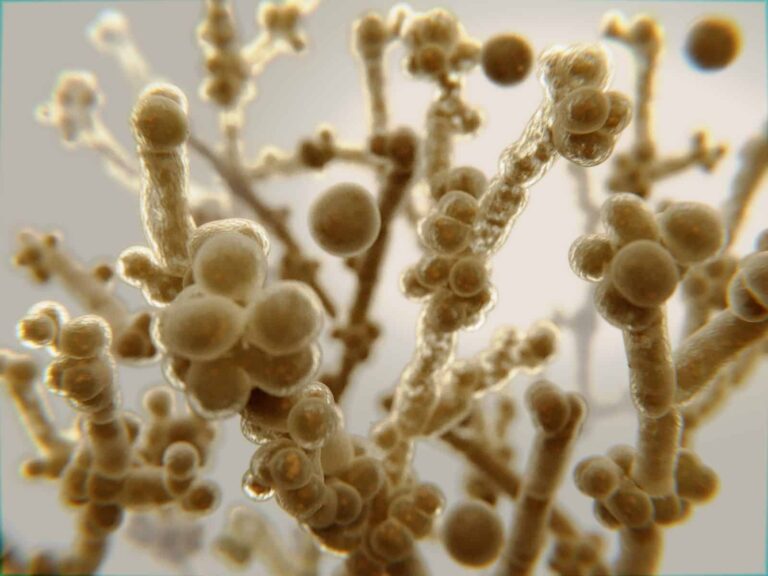
Candida albicans Latest News
Scientists at CSIR-Centre for Cellular and Molecular Biology (CCMB) recently identified two compounds that prevent Candida albicans from changing into its infection-associated filamentous form without stopping its growth.
About Candida albicans
- Candida albicans, a type of yeast, is a fungus that naturally lives in and on your body.
- It’s typically found in small amounts on your skin and in your mouth and intestines.
- It is the most common species of Candida yeast.
- Normally, healthy bacteria in your body (your microbiome) control the balance of Candida albicans.
- But, if something disrupts the balance of healthy bacteria, the yeast can overgrow and cause a fungal infection.
- A fungal infection caused by an overgrowth of yeast is called candidiasis.
- Candida albicans can cause different types of infection, depending on where it affects your body. Types include:
- Cutaneous (skin) candidiasis: Yeast grows in the folds of your skin, like under your breasts or near your buttocks (diaper rash). It causes raised, red patches.
- Candidal paronychia: Yeast collects in your nail folds or cuticles. It causes skin discoloration, pain and swelling around your nails.
- Thrush: An overgrowth of yeast forms inside your mouth and throat. It causes raised, white bumps that are painful and irritating.
- Vaginal yeast infection: Yeast multiplies inside your vagina. It causes redness, itching and burning, as well as abnormal vaginal discharge.
- Symptoms:
- In normal situations, Candida albicans won’t cause any symptoms.
- Symptoms will only develop if you have an overgrowth of yeast.
- Depending on the location of the infection, symptoms may include:
- Skin rash
- Itching
- Blisters
- Small, raised bumps or patches
- Pain, soreness or discomfort
- Burning sensation
- Abnormal vaginal discharge
- Loss of taste (ageusia)
- Difficulty swallowing (dysphagia)
- Is Candida albicans contagious?
- Normally, yeast infections aren’t contagious.
- But Candida albicans can spread if you have a weakened immune system or you’re taking certain medications.
- If you’re healthy, it’s unlikely Candida albicans will spread to you.
- Treatment: If you have an infection, Candida albicans treatment involves antifungal medication.
News: TOI


 Last updated on Nov, 2026
→ UPSC Interview 2026 is scheduled from 7 December 2026 to 12 February 2027.
→ UPSC Interview Guidance Programme (IGP) 2026 by Vajiram & Ravi helps aspirants prepare confidently for the UPSC Personality Test.
→ UPSC DAF 2026 application form is available from 11 to 25 November 2026, till 6:00 PM.
→ UPSC 2027 Notification will be released on 13 January 2027 at upsconline.nic.in.
→ Download PIB PRiSM Monthly Magazine 2026 here.
→ Check UPSC Monthly Current Affairs Magazine The Recitals here.
→ Check out the latest UPSC Syllabus here.
→ UPSC Calendar 2027 has been released.
→ Enroll in Vajiram & Ravi’s UPSC Mains Test Series 2027 for structured answer writing practice, expert evaluation, and exam-oriented feedback.
→ Join Vajiram & Ravi’s UPSC Mentorship Program 2027 for personalized guidance, strategy planning, and one-to-one support from experienced mentors.
→ Go through the UPSC Mains Previous Year Papers to enhance your preparation.
→ UPSC has released UPSC Toppers List 2025 with the Civil Services final result on its official website.
→ Also check Best UPSC Coaching in India
Candida albicans FAQs
Q1. What is Candida albicans?+
Q2. Where is Candida albicans normally found in the human body?+
Q3. What normally controls the growth of Candida albicans in the human body?+
Q4. What are the common symptoms of Candida albicans infection?+
Q5. How is Candida albicans infection treated?+
Tags: candida albicans prelims pointers upsc current affairs upsc prelims current affairs








