Tangail Saree Latest News
The Madras High Court recently held that Bangladesh’s petition challenging India’s Geographical Indication (GI) registration of the ‘Tangail Saree of Bengal’ is maintainable.
About Tangail Saree
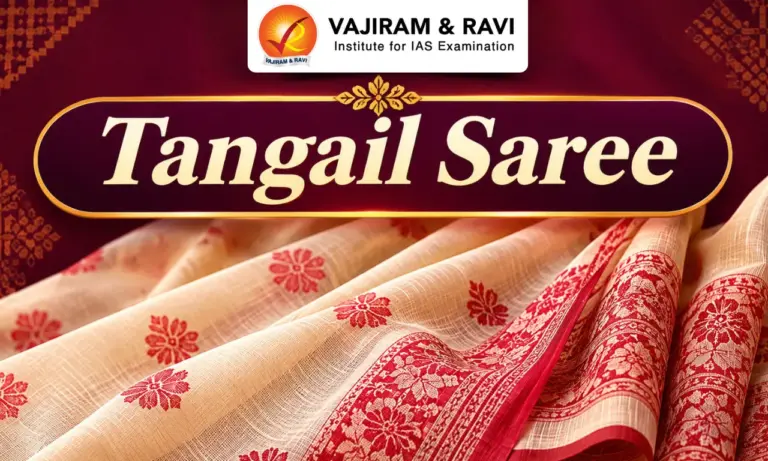
- It is a traditional handwoven cotton saree from Bengal.
- It began in the Tangail district in present-day Bangladesh, and after Partition, many of its weavers settled in Phulia and nearby villages of West Bengal, so today it is woven on both sides of the border.
- Features:
- Tangail sarees are characterized by their fine texture, detailed designs and local patterns, making each piece a work of art that reflects local social and cultural practices.
- It has a fine body scattered with small woven motifs called buti and a decorated border and pallu.
- A typical Tangail feels light, smooth, and slightly crisp, because the yarn is fine and the cloth is starched during weaving.
- The body is often a soft or pale colour, the buti are spaced across it, and the border and pallu carry most of the colour and pattern.
- Silk, tussar, and blended versions exist too, but cotton is what most people mean by a Tangail.
- The sarees hold strong cultural value and are often worn during major festivals, weddings, and celebrations.
- Men generally lead the main weaving process, including designing, dyeing the yarn, and crafting the fabric using the traditional handloom.
- The Tangail Saree of Bengal was officially granted a Geographical Indication (GI) tag on January 2, 2024, by the Indian GI Registry in Chennai, registered in favor of the West Bengal State Handloom Weavers Co-Operative Society Limited.
- However, the registration triggered opposition in Bangladesh, which subsequently secured a separate GI registration for ‘Tangail Sari’ under its domestic law in 2024.
- In December 2025, UNESCO also inscribed Bangladesh’s traditional saree weaving art of Tangail on its Representative List of the Intangible Cultural Heritage of Humanity.
News: BAR


 Last updated on Nov, 2026
→ UPSC Interview 2026 is scheduled from 7 December 2026 to 12 February 2027.
→ UPSC Interview Guidance Programme (IGP) 2026 by Vajiram & Ravi helps aspirants prepare confidently for the UPSC Personality Test.
→ UPSC DAF 2026 application form is available from 11 to 25 November 2026, till 6:00 PM.
→ UPSC 2027 Notification will be released on 13 January 2027 at upsconline.nic.in.
→ Download PIB PRiSM Monthly Magazine 2026 here.
→ Check UPSC Monthly Current Affairs Magazine The Recitals here.
→ Check out the latest UPSC Syllabus here.
→ UPSC Calendar 2027 has been released.
→ Enroll in Vajiram & Ravi’s UPSC Mains Test Series 2027 for structured answer writing practice, expert evaluation, and exam-oriented feedback.
→ Join Vajiram & Ravi’s UPSC Mentorship Program 2027 for personalized guidance, strategy planning, and one-to-one support from experienced mentors.
→ Go through the UPSC Mains Previous Year Papers to enhance your preparation.
→ UPSC has released UPSC Toppers List 2025 with the Civil Services final result on its official website.
→ Also check Best UPSC Coaching in India
Tangail Saree FAQs
Q1. What is the Tangail Saree?+
Q2. Where did the Tangail Saree originate?+
Q3. Where is the Tangail Saree traditionally woven today?+
Q4. What are the distinctive features of Tangail sarees?+
Q5. Why do Tangail sarees have a light, smooth and slightly crisp texture?+
Tags: tangail saree