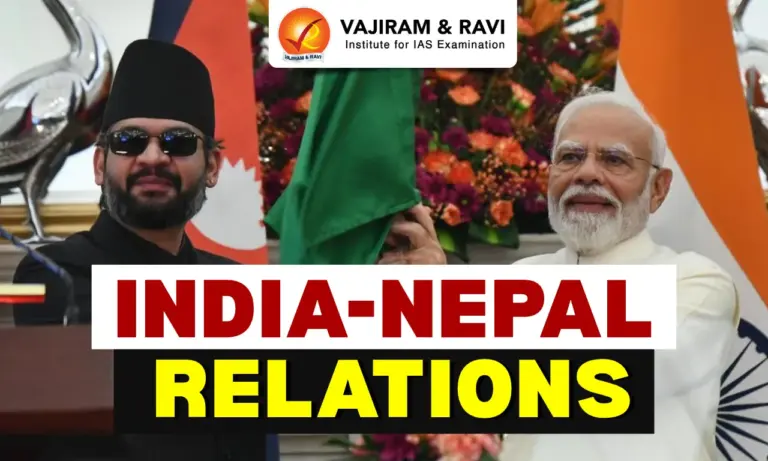
India-Nepal Relations Latest News
- India and Nepal have sought to revitalise bilateral relations after a period of diplomatic strain, particularly over the boundary dispute involving Kalapani, Lipulekh and Limpiyadhura.
- During Nepal PM Balendra Shah’s first bilateral visit to India, the Indian PM announced a 24,000 crore Nepalese rupee (approximately $1.63 billion or Rs 15,000 crore) development cooperation package.
- The two countries also signed eight MoUs and adopted a 10-pillar Joint Vision Document titled Viksit Bharat and Samunnat Nepal: Re-imagining the Partnership.
- The initiative aims to transform traditional cultural and geographical ties into a modern, mutually beneficial development partnership.
Economic Partnership – From Aid to Shared Growth
- Development package: Includes grant assistance and a line of credit, focusing on reconstruction, infrastructure and energy-sector development.
- Cross-border economic zones: Cooperation to establish Special Economic Zones (SEZs), export-oriented manufacturing facilities and IT parks near the border.
- Trade and transit: India will facilitate Nepal’s access to its Kandla and Paradip ports, strengthening Nepal’s connectivity with international markets.
- Air connectivity: Agreement to operationalise the Kathmandu–Bhairahawa–Lucknow route as a two-way air corridor.
- Significance: Promotes Nepal’s economic diversification, trade competitiveness and regional economic integration.


Phygital (Physical+Digital) Connectivity – Backbone of Cooperation
- Initiatives:
- Saryu-Kamala Express: Connects Ayodhya with Janakpur, promoting religious tourism.
- Dharchula–Darchula bridge: Strengthens cross-border road connectivity.
- Banbasa Integrated Check Post: Facilitates smoother movement of goods and people. Both sides also agreed to expedite Integrated Check Posts at Bhairahawa, Sunauli, and Dodhara Chandani.
- Jayanagar–Bardibas and Jogbani–Biratnagar rail links: Strengthen cross-border railway connectivity.
- Siliguri–Jhapa pipeline: Expands petroleum infrastructure.
- UPI linkage: Facilitates cross-border digital payments.
- Significance: Reduces trade costs, improves logistical efficiency and strengthens people-to-people connectivity.
Energy Partnership – Turning Rivers into Economic Assets
- Nepal’s enormous hydropower potential complements India’s growing energy demand.
- Major initiatives include:
-
- Lower Arun Hydroelectric Project: Foundation stone laid for the 669-MW project.
- Arun-3 Project: Commitment to its timely completion.
- Petroleum security: Inauguration of Phase II of the Motihari–Amlekhgunj petroleum pipeline and advancement of the Jhapa petroleum terminal.
- New pipeline: Proposed Siliguri–Jhapa petroleum pipeline.
- Other supplies: India also reiterated its commitment to maintaining supplies of fuel, fertilisers and essential commodities to Nepal.
- Significance: Creates an interdependent energy ecosystem through hydropower development, electricity trade and energy security.
Beyond Traditional Diplomacy – Emerging Areas of Cooperation
- The 10-pillar vision document expands bilateral cooperation into newer domains.
- For example,
-
- Technology and AI: Startup partnerships, digital parks, data centres and AI cooperation.
- Space: Satellite development, remote sensing and disaster management.
- Education: Exploring an IIT campus in Nepal, scholarships and academic exchanges.
- Healthcare: Jan Aushadhi Kendras, medical institutional linkages and laboratory upgradation.
- Agriculture: Agro-Industrial Park in Chitwan and ICAR Centre of Excellence.
- Sports: Cricket academy and sports infrastructure development.
- Governance: Training of Nepali civil servants and exchange of administrative practices.
- Additionally, cooperation between Nalanda University and Lumbini Buddhist University will be strengthened through a Nalanda Centre at Lumbini.
Culture and Tourism – Leveraging Civilisational Bonds
- India and Nepal share deep religious and cultural connections associated with Ram, Sita and Buddha.
- Both countries will develop three major religious tourism circuits, for instance, Ramayana Circuit (Ayodhya–Janakpur), Buddhist Circuit (Lumbini–Bodh Gaya–Sarnath–Kushinagar), and Shiv-Shakti Circuit [Kathmandu (Pashupatinath)–Varanasi].
- These initiatives can strengthen cultural diplomacy, tourism revenues and cross-border social ties.
Unresolved Issues – Managing Differences through Dialogue
- Despite renewed cooperation, certain structural challenges remain, for instance,
- Boundary dispute: Kalapani, Lipulekh and Limpiyadhura remain contentious.
- 1950 Treaty of Peace and Friendship: Both sides recognise the need to review the existing bilateral legal framework in accordance with contemporary realities.
- Water-sharing issues: Differences concerning water resources and hydropower projects require sustained negotiations.
- Trust deficit: Nepal’s concerns regarding sovereignty, unequal economic dependence and India’s perceived interference need sensitivity.
- Trade asymmetry: Nepal’s dependence on Indian transit infrastructure and trade (India accounts for ~62% of Nepal’s total merchandise trade) highlights the need for greater economic diversification.
- Institutional mechanism: A High-Level Monitoring Group, led by Nepal’s Foreign Secretary and India’s Ambassador to Nepal, will meet at least once every six months to monitor implementation.
Way Forward – From Neighbourhood to Interdependence
- Respect sovereignty: Address Nepal’s concerns through equality, mutual trust and non-interference.
- Resolve disputes: Institutionalise dialogue on boundary and water-sharing issues.
- Deliver projects: Ensure timely completion of cross-border infrastructure and energy projects.
- Promote economic integration: Encourage private investment, manufacturing and regional value chains.
- Strengthen people-to-people ties: Expand educational, cultural and youth exchanges.
Conclusion
- India–Nepal relations are rooted in geography, history and civilisational bonds but must evolve through economic interdependence and mutual respect.
- The success of the new vision will depend not merely on announcements and agreements but on their timely implementation.
- A prosperous Nepal and a developed India can emerge as complementary partners in building a peaceful, connected and economically integrated South Asia.

 Last updated on Nov, 2026
→ UPSC Interview 2026 is scheduled from 7 December 2026 to 12 February 2027.
→ UPSC Interview Guidance Programme (IGP) 2026 by Vajiram & Ravi helps aspirants prepare confidently for the UPSC Personality Test.
→ UPSC DAF 2026 application form is available from 11 to 25 November 2026, till 6:00 PM.
→ UPSC 2027 Notification will be released on 13 January 2027 at upsconline.nic.in.
→ Download PIB PRiSM Monthly Magazine 2026 here.
→ Check UPSC Monthly Current Affairs Magazine The Recitals here.
→ Check out the latest UPSC Syllabus here.
→ UPSC Calendar 2027 has been released.
→ Enroll in Vajiram & Ravi’s UPSC Mains Test Series 2027 for structured answer writing practice, expert evaluation, and exam-oriented feedback.
→ Join Vajiram & Ravi’s UPSC Mentorship Program 2027 for personalized guidance, strategy planning, and one-to-one support from experienced mentors.
→ Go through the UPSC Mains Previous Year Papers to enhance your preparation.
→ UPSC has released UPSC Toppers List 2025 with the Civil Services final result on its official website.
→ Also check Best UPSC Coaching in India
India-Nepal Relations FAQs
Q1. How does the India-Nepal Joint Vision Document seek to transform bilateral relations?+
Q2. Why is hydropower cooperation strategically important for India and Nepal?+
Q3. What is the significance of cross-border connectivity in India-Nepal relations?+
Q4. What are the major challenges in India–Nepal bilateral relations?+
Q5. How can cultural diplomacy strengthen India–Nepal relations?+
Tags: india nepal relations