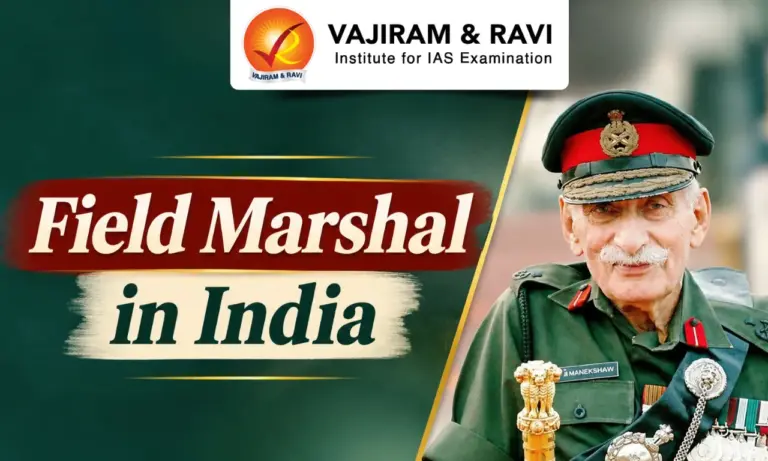
The Field Marshal in India is the highest military rank in the Indian Army, placed above the four-star rank of General. It is a prestigious five-star rank awarded for exceptional military leadership and distinguished service to the nation. Unlike regular military ranks, it is honorary, ceremonial and held for life. Since Independence, only two Indian Army officers, Sam Manekshaw (1973) and K. M. Cariappa (1986), have been awarded this rank. It represents the highest recognition of military excellence and outstanding contributions to India’s defence and national security.
Field Marshal in India History
The Field Marshal rank originated in Europe during the 16th century and was formally introduced into the British Army in 1736. India retained this military rank structure after Independence in 1947.
- British India: Several British military officers, including Lord Kitchener, Lord Roberts and Sir Claude Auchinleck, held this rank.
- First Indian Field Marshal: Sam Manekshaw was awarded the rank on January 1, 1973, for his outstanding leadership during the 1971 Indo-Pakistan War.
- Second Indian Field Marshal: K. M. Cariappa was awarded the rank on January 15, 1986, in recognition of his exceptional contribution to the Indian Army.
- Rare Military Honour: Since 1986, no other Indian Army officer has been awarded this prestigious rank.
Field Marshal in India Appointment and Eligibility
The Field Marshal in India is appointed by the President of India on the recommendation of the Central Government. It is a special military honour awarded for exceptional leadership and distinguished service.
- Constitutional Basis: Under Article 53(2) of the Indian Constitution, the President is the Supreme Commander of the Indian Armed Forces.
- Appointment Authority: The President confers the rank on the recommendation of the government.
- Eligibility Criteria: There are no specific statutory eligibility criteria for appointment as a Field Marshal.
- Military Leadership: Historically, the rank has been awarded to officers who served as Army Chiefs and demonstrated exceptional military leadership.
- Outstanding Contribution: Distinguished service during major wars and significant contributions to the development of the Indian Army are important considerations.
- Lifetime Appointment: A Field Marshal holds the rank for life and never formally retires.


Field Marshal in India Rank and Insignia
The Field Marshal is the highest rank in the Indian Army, placed above the four-star rank of General. It is primarily an honorary and ceremonial military rank.
- Rank: Five-star military rank.
- Insignia: The National Emblem of India above a crossed baton and sabre, enclosed within a lotus-blossom wreath.
- Ceremonial Baton: A specially designed baton represents the officer’s distinguished military status.
- Uniform: Field Marshals are entitled to wear their military uniform on ceremonial occasions.
- Tenure: The rank is retained throughout the officer’s lifetime.
Five-Star Ranks in the Indian Armed Forces
| Armed Force | Five-Star Rank | Officers Awarded |
|
Indian Army |
Field Marshal |
Sam Manekshaw and K. M. Cariappa |
|
Indian Air Force |
Marshal of the Indian Air Force |
Arjan Singh (2002) |
|
Indian Navy |
Admiral of the Fleet |
Never conferred |
Field Marshal in India List
India has awarded the rank of Field Marshal to only two Army officers since Independence. Both played an important role in strengthening India’s military capabilities and national security.
| Particulars | Sam Manekshaw | K. M. Cariappa |
|
Full Name |
Sam Hormusji Framji Jamshedji Manekshaw |
Kodandera Madappa Cariappa |
|
Rank Conferred |
January 1, 1973 |
January 15, 1986 |
|
Position |
First Indian Field Marshal |
Second Indian Field Marshal |
|
Tenure as Army Chief |
1969-1973 |
1949-1953 |
|
Major Contribution |
Leadership during the 1971 Bangladesh Liberation War |
Leadership during the 1947-48 Kashmir operations and Indianisation of the Army |
|
Nickname |
Sam Bahadur |
Kipper |
|
Death |
June 27, 2008 |
May 15, 1993 |
Army Day in India is celebrated annually on January 15 to commemorate K. M. Cariappa taking charge as the first Indian Commander-in-Chief of the Indian Army in 1949.
Field Marshal in India Powers and Responsibilities
Although the Field Marshal holds the highest military rank in the Indian Army, it does not carry independent operational or administrative command. The rank is mainly ceremonial and recognises exceptional military service.
- Ceremonial Role: Represents the Indian Army at important military and national occasions.
- Lifetime Status: Retains military rank and associated privileges throughout life.
- Pay and Allowances: Entitled to pay and allowances associated with the rank of a serving General.
- Operational Authority: Does not exercise active command over the Indian Army by virtue of the rank.
- Military Representation: Symbolises military excellence, leadership and distinguished service.
Difference Between Field Marshal, CDS and Army Chief
| Particulars | Field Marshal | Chief of Defence Staff (CDS) | Chief of the Army Staff (COAS) |
|
Rank |
Five-star |
Four-star |
Four-star |
|
Nature |
Honorary and ceremonial |
Functional appointment |
Operational and administrative appointment |
|
Tenure |
Lifetime |
Fixed tenure |
Fixed tenure |
|
Role |
Recognition of exceptional military service |
Promotes tri-service integration and heads the Department of Military Affairs |
Commands the Indian Army |
Field Marshal in India Significance
The Field Marshal rank in India represents the highest recognition of military leadership, courage and dedication to national security.
- Military Excellence: Recognises extraordinary leadership and distinguished service in the Indian Army.
- National Security: Honours officers who have made significant contributions to India’s defence and territorial integrity.
- Military Heritage: Preserves the traditions, achievements and legacy of the Indian Armed Forces.
- Inspiration: Motivates military personnel to demonstrate courage, discipline and dedication towards the nation.
- Historical Importance: Highlights the contributions of legendary military leaders in shaping India’s defence capabilities.
- Prestigious Honour: Its rare conferment reflects the exceptional nature of the rank and its importance in India’s military history.

 Last updated on Nov, 2026
→ UPSC Interview 2026 is scheduled from 7 December 2026 to 12 February 2027.
→ UPSC Interview Guidance Programme (IGP) 2026 by Vajiram & Ravi helps aspirants prepare confidently for the UPSC Personality Test.
→ UPSC DAF 2026 application form is available from 11 to 25 November 2026, till 6:00 PM.
→ UPSC 2027 Notification will be released on 13 January 2027 at upsconline.nic.in.
→ Download PIB PRiSM Monthly Magazine 2026 here.
→ Check UPSC Monthly Current Affairs Magazine The Recitals here.
→ Check out the latest UPSC Syllabus here.
→ UPSC Calendar 2027 has been released.
→ Enroll in Vajiram & Ravi’s UPSC Mains Test Series 2027 for structured answer writing practice, expert evaluation, and exam-oriented feedback.
→ Join Vajiram & Ravi’s UPSC Mentorship Program 2027 for personalized guidance, strategy planning, and one-to-one support from experienced mentors.
→ Go through the UPSC Mains Previous Year Papers to enhance your preparation.
→ UPSC has released UPSC Toppers List 2025 with the Civil Services final result on its official website.
→ Also check Best UPSC Coaching in India
Field Marshal in India FAQs
Q1. What is the rank of Field Marshal in India?+
Q2. Who was the first Field Marshal of India?+
Q3. How many Field Marshals are there in Indian history?+
Q4. Who appoints the Field Marshal in India?+
Q5. Does a Field Marshal retire in India?+
Q6. What are the equivalent ranks of Field Marshal in the Indian Navy and Air Force?+
Q7. What is the difference between a Field Marshal and the Chief of the Army Staff?+
Tags: field marshal in india