About Gulf Stream:
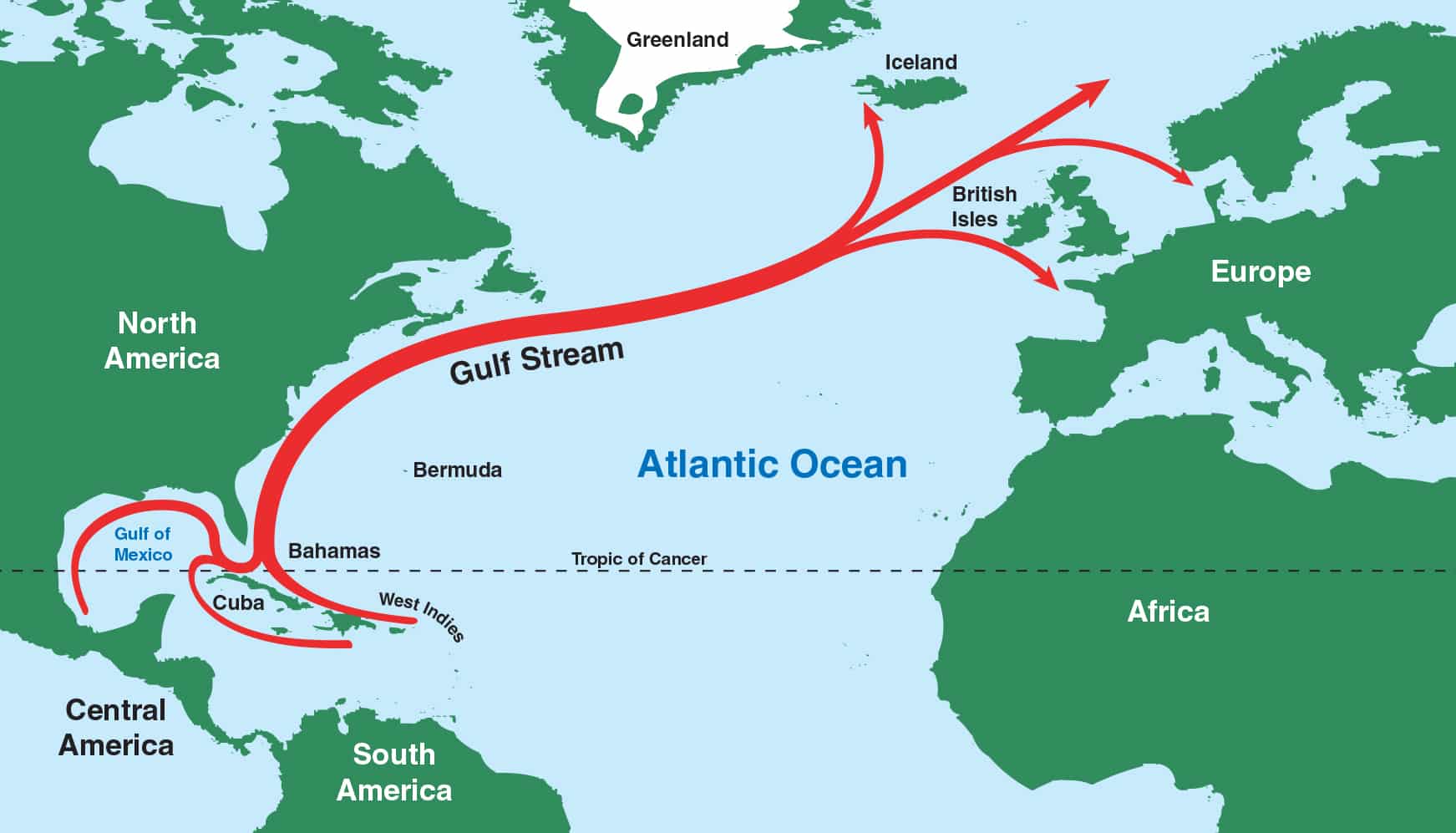
What is it? The Gulf Stream is a swift and warm ocean current that flows along the eastern coast of North America and crosses the Atlantic Ocean towards Europe.
Key characteristics:
- Location: It originates in the Gulf of Mexico and is primarily formed by the convergence of warm waters from the Caribbean Sea and the Gulf of Mexico. It then travels northward along the eastern coast of the United States.
- Direction: It follows a northeastward path across the western North Atlantic Ocean.
- Warmth: The current carries warm water from the tropics (around 25 to 28°C or 77 to 82°F) to higher latitudes.
- Width and Speed: The Gulf Stream is several hundred kilometers wide and can flow at an average speed of about 2.5 meters per second. However, its speed can vary depending on the location and other factors.
- Depth: The current is also very deep, extending to depths of up to 1,000 meters.
Importance and Impact:
- Climate Regulation: It moderates the temperatures along the eastern coast of North America, keeping the coastal areas warmer in winter and cooler in summer compared to inland regions at the same latitudes. Since the Gulf Stream also extends toward Europe, it warms Western European countries as well.
- Weather Patterns: The warm and moist air above the Gulf Stream can lead to the formation of low-pressure systems, which may develop into storms or hurricanes. It can also contribute to the formation of fog in certain areas.
- Maritime Navigation: The Gulf Stream has been a crucial factor in maritime navigation for centuries. It provides a fast and efficient route for ships travelling between North America and Europe, as it aids in faster travel times due to its speed.
- Ocean Circulation: The Gulf Stream is an essential part of the larger oceanic circulation system known as the Atlantic Meridional Overturning Circulation (AMOC). The AMOC plays a vital role in redistributing heat around the Earth and regulating global climate patterns.
Key facts about Atlantic Meridional Overturning Circulation (AMOC):
- It is a large system of ocean currents operating In the Atlantic, which circulates the waters between the north and the south.
- It is characterized by a northward flow of warm, salty water in the upper layers of the Atlantic, and a southward flow of colder, deep waters that are part of the thermohaline circulation.
- How it operates:
- As warm water flows northwards in the Atlantic, it cools, while evaporation increases its salt content.
- Low temperature and a high salt content raise the density of the water, causing it to sink deep into the ocean.
- The cold, dense water deep below slowly spreads southward. Eventually, it gets pulled back to the surface and warms again, and the circulation is complete.
- Significance: AMOC ensures the oceans are continually mixed, and heat and energy are distributed around Earth.
What is an Ocean Current?
- An ocean current is a continuous, directed flow of seawater within the Earth’s oceans.
- These currents are like rivers within the ocean, moving large volumes of water in specific patterns and directions.
- They are a crucial component of the Earth’s climate system and play a vital role in regulating global climate, distributing heat around the planet, and influencing weather patterns.
- Ocean currents can be formed by various factors, including wind, temperature, salinity (salt content), and the Earth’s rotation.
Q) What is the Gulf of Mexico?
The Gulf of Mexico is a large body of water located in the southeastern part of North America. It is bordered by the United States to the north, Mexico to the west and south, and Cuba to the southeast. The Gulf of Mexico is connected to the Atlantic Ocean through the Florida Strait and the Yucatán Channel.
Source: Gulf Stream could collapse as early as 2025, study suggests


 Last updated on Sep, 2026
→ UPSC 2027 Notification will be released on 13 January 2027 at upsconline.nic.in.
→ Asian Games 2026 are being held in Aichi-Nagoya, Japan, from 19 September to 4 October.
→ Check out the latest UPSC Syllabus here.
→ Download UPSC Model Answers for Mains 2026
→ UPSC Mains Question Paper 2026 is out now for Essay & GS Paper 1, 2, 3 & 4.
→ UPSC Calendar 2027 has been released.
→ Enroll in Vajiram & Ravi’s UPSC Mains Test Series 2027 for structured answer writing practice, expert evaluation, and exam-oriented feedback.
→ Join Vajiram & Ravi’s UPSC Mentorship Program 2027 for personalized guidance, strategy planning, and one-to-one support from experienced mentors.
→ Go through the UPSC Mains Previous Year Papers to enhance your preparation.
→ UPSC has released UPSC Toppers List 2025 with the Civil Services final result on its official website.
→ Also check Best UPSC Coaching in India