Sustainable Aviation Fuel Latest News
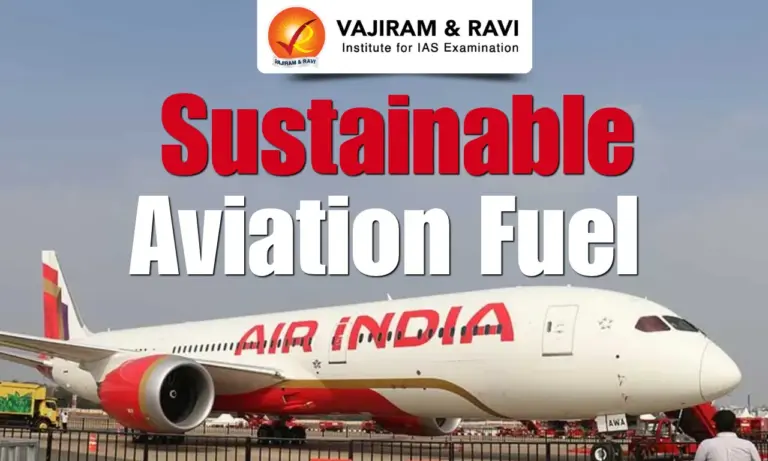
- Indian Oil Corporation’s (IOC) move to commercialise Sustainable Aviation Fuel (SAF) marks India’s first serious step toward building a domestic alternative to conventional Aviation Turbine Fuel (ATF).
- This comes as the mandatory second phase of the Carbon Offsetting and Reduction Scheme for International Aviation (CORSIA) becomes effective from January 2027, bringing a wider set of international airlines — including Indian carriers — under binding carbon-offsetting obligations.
What Is CORSIA?
- CORSIA, adopted in October 2016 by the International Civil Aviation Organisation (ICAO), is a global market-based mechanism to address carbon dioxide emissions from international aviation.
- It operates in three phases:
- Pilot phase: 2021–23
- First phase: 2024–26
- Second phase: 2027–35 (mandatory)
- Objective: Achieve carbon-neutral growth in international aviation — airlines must offset emissions exceeding prescribed baselines using eligible carbon credits, while encouraging cleaner technologies, operational efficiencies, and SAF adoption.
- India’s position: India opted out of the voluntary phases; offsetting obligations for Indian carriers begin only in January 2027.
- The applicable emissions baseline for 2024–35 is 85% of 2019 emissions.
- Since January 2019, India’s international operators have monitored and reported fuel/emissions data to the Directorate General of Civil Aviation (DGCA), which forwards this to ICAO.


The Financial Stakes for India
- An August 2026 ICCT (International Council on Clean Transportation) estimate projects Indian carriers could face cumulative offsetting needs of 31.8 million tonnes of CO₂ between 2027-35.
- Compliance cost scenarios:
- With adequate carbon-credit availability: approximately $781 million.
- Under a tighter supply scenario: could rise to as much as $2.6 billion.
India’s Growing Aviation Footprint
- Rising disposable incomes, especially among an expanding middle class, are driving strong demand from first-time flyers (as per PricewaterhouseCoopers).
- As per the IATA World Air Transport Statistics 2025, India handled 218.2 million passengers, ranking sixth among the world’s largest aviation markets.
- India’s commercial fleet of roughly 800 aircraft is expected to more than double, backed by orders for around 1,000 aircraft.
IOC’s SAF Production Pipeline
- IOC’s Panipat facility plans to produce 35,000 tonnes of SAF annually, using used cooking oil as feedstock — sufficient to meet India’s initial 1% blending target for international flights in 2027.
- In August 2025, IOC became the first Indian firm to secure International Sustainability and Carbon Certification (ISCC) CORSIA certification for SAF production.
- As part of diversification, IOC is developing an alcohol-to-jet SAF facility with U.S.-based LanzaJet, targeting an annual capacity of 86,800 tonnes, to be completed by March 2028.
India’s SAF Blending Roadmap
- The Union government has set clear blending targets for international flights:
- 1% from 2027
- 2% from 2028
- 5% by 2030
- The Ministry of Civil Aviation convened an inter-ministerial and industry-level meeting in July 2026 to review preparedness, covering:
- A national SAF registry
- Carbon accounting and traceability
- Certification
- Developing a CORSIA-compliant carbon market framework
Learning from Global SAF Leaders
- Finland’s Neste: ~1.5 million tonnes annual capacity (used cooking oil, animal-fat waste) — among the world’s largest producers.
- U.S.’s LanzaJet: 10 million gallons annual capacity.
- Italy’s ENI: 400,000 tonnes annual capacity.
- Spain’s Repsol: 250,000 tonnes of renewable fuels.
- Indonesia’s Pertamina: Produced its first SAF batch from used cooking oil at its Cilacap refinery in 2025.
Key Challenges for India
- Feedstock availability is among the biggest obstacles:
- Large-scale collection of used cooking oil, maintaining quality consistency, and ensuring traceability across fragmented supply chains remains difficult.
- Farm residues offer an alternative, but face competing uses, high collection costs, and seasonal availability issues.
- Economics: SAF is generally more expensive than conventional ATF.
- Without falling production costs or financial incentives, airlines operating on thin margins may struggle to absorb higher blending requirements — costs could eventually be passed on to consumers.
- Certification rigor: SAF must meet both technical specifications and CORSIA sustainability criteria. India needs robust lifecycle emissions assessment, independent verification, and a transparent registry to prevent double-counting — elements India’s proposed SAF framework has factored in.
The Way Forward
- An integrated SAF ecosystem — bringing together refiners, airlines, airports, agricultural organisations, waste-management agencies, and financial institutions — is essential.
- Key enablers include:
- Long-term offtake agreements
- Predictable blending targets
- Incentives for feedstock collection
- Investment in production technologies
Conclusion
- India stands at a critical juncture: building indigenous SAF capacity isn’t just about climate compliance, but about securing competitive advantage in the world’s fastest-growing aviation market.
- Success will hinge on solving the feedstock-economics puzzle through coordinated action across government, industry, and finance — turning a regulatory deadline into a long-term strategic opportunity.
Source: TH

 Last updated on Nov, 2026
→ UPSC Interview 2026 is scheduled from 7 December 2026 to 12 February 2027.
→ UPSC Interview Guidance Programme (IGP) 2026 by Vajiram & Ravi helps aspirants prepare confidently for the UPSC Personality Test.
→ UPSC DAF 2026 application form is available from 11 to 25 November 2026, till 6:00 PM.
→ UPSC 2027 Notification will be released on 13 January 2027 at upsconline.nic.in.
→ Download PIB PRiSM Monthly Magazine 2026 here.
→ Check UPSC Monthly Current Affairs Magazine The Recitals here.
→ Check out the latest UPSC Syllabus here.
→ UPSC Calendar 2027 has been released.
→ Enroll in Vajiram & Ravi’s UPSC Mains Test Series 2027 for structured answer writing practice, expert evaluation, and exam-oriented feedback.
→ Join Vajiram & Ravi’s UPSC Mentorship Program 2027 for personalized guidance, strategy planning, and one-to-one support from experienced mentors.
→ Go through the UPSC Mains Previous Year Papers to enhance your preparation.
→ UPSC has released UPSC Toppers List 2025 with the Civil Services final result on its official website.
→ Also check Best UPSC Coaching in India
Sustainable Aviation Fuel FAQs
Q1. What is the significance of CORSIA for Sustainable Aviation Fuel in India? +
Q2. What are India's Sustainable Aviation Fuel blending targets? +
Q3. What is IOC's contribution to Sustainable Aviation Fuel in India? +
Q4. What are the major challenges facing Sustainable Aviation Fuel in India? +
Q5. How can India strengthen its Sustainable Aviation Fuel ecosystem? +
Tags: mains articles sustainable aviation fuel upsc current affairs upsc mains current affairs