Front-of-pack Warning Labels in India Latest News
- The Supreme Court has cleared the way for packaged food items to carry front-of-package nutrition labelling (FoPNL), indicating whether a product is high in fat, sugar, or salt.
- The ruling, delivered by a bench of Justices J B Pardiwala and K Vinod Chandran, sharply departs from the FSSAI’s earlier star-rating proposal, instead mandating separate warning labels for each nutrient of concern — a major win for public health advocates.
What the Supreme Court Has Ordered
- The Court has laid down detailed implementation directions to prevent the labelling’s purpose from being diluted:
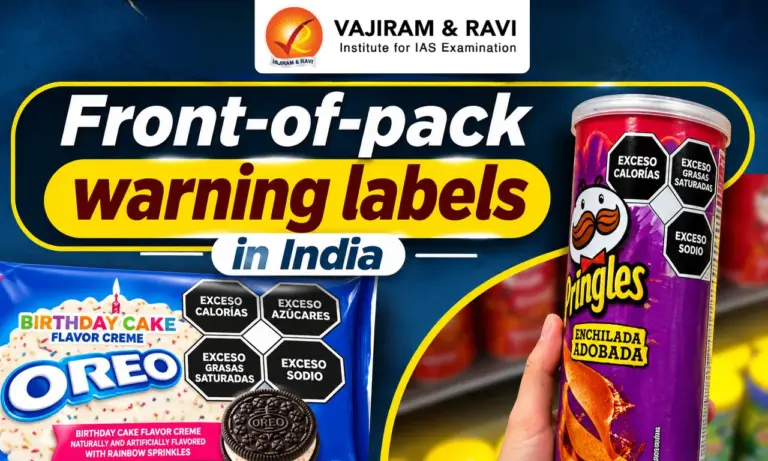
- Pictorial Representation: Each hexagonal warning must carry a pictorial symbol alongside the words “High Fat,” “High Sugar,” or “High Salt” — ensuring accessibility across varying literacy and education levels.
- Separate Hexagons: Unlike FSSAI’s proposal of a single hexagon for multiple warnings, the Court mandated separate hexagons per nutrient — meaning a product could carry one, two, or three hexagons depending on how many nutrients of concern it is high in.
- Total Sugars and Saturated Fat, Not Added Sugar/Fat: The Court ruled that thresholds must be based on “total sugars” and “saturated fat”, not “added sugar” and “added fat” as FSSAI had proposed — since “added” criteria could be misused (e.g., manufacturers using fruit concentrate to sweeten products while technically avoiding “added sugar” labelling).
- Scientific Threshold-Setting: FSSAI must reformulate thresholds based on evidence — neither too low (causing “label fatigue” if nearly all products get warnings) nor too high (letting harmful products escape labelling).
- Proportional Label Size: Hexagon size must be proportional to the package’s display panel, occupying not less than 4-5% of it, in line with international practice.
- No Deceptive Beverage Category Labels: Beverages not high in sugar must not carry labels resembling warning hexagons used for high-sugar beverages.
- Exempted Foods List: FSSAI must prepare a clear, reasoned list of exempted foods — typically single-ingredient packages like sugar, salt, or oil.
- Preventing Circumvention via Additives: FSSAI must act if industry responds to warning labels by introducing preservatives/additives that defeat the label’s purpose.
- Implementation Timeline: FSSAI’s stated four-month timeline must be adhered to, with safeguards against businesses flooding the market with unlabelled products during the transition period.


Why This Ruling Matters: The Court’s Reasoning
- The Court held that an interpretive FoPNL is a reasonable measure to protect fundamental and statutory rights, given India’s public health crisis linked to non-communicable diseases (NCDs) and consumption of HFSS (High Fat, Sugar, Salt) foods/Ultra-Processed Foods (UPFs).
- The Supreme Court has reminded the State that public health is not a bargaining chip… consensus is not a prerequisite for public health.
- The judgment explicitly bars FSSAI from letting industry objections delay regulation.
How This Differs from FSSAI’s Original Proposal
- FSSAI’s regulatory journey went through several shifts:
- 2022: Proposed a star-rating system (like electrical appliances), based on a study — heavily opposed by health experts who feared even unhealthy products with 0.5 stars would appear “positive.”
- 2025: Proposed a fact-based FoPNL, showing nutrient content as a percentage of Recommended Dietary Allowance — criticised as merely repackaging existing back-of-pack information without clear harm signalling.
- Final FSSAI proposal (before Court): A single red hexagon with textual warning, to be rolled out in two phases — first for foods high in two of three harmful nutrients, later extended to foods high in even one nutrient.
- It did not propose pictorial warnings, separate hexagons, or total-sugar/fat-based thresholds, and gave no implementation timeline.
- The Supreme Court’s order overrides these gaps, mandating a more rigorous, consumer-friendly framework.
Why India Needs Warning Labels: The Public Health Case
- Non-communicable diseases (NCDs) cause around 6 million deaths annually in India — nearly 63% of all deaths — projected to rise to 75% by 2030.
- Key disease burden figures:
- 101 million people living with diabetes.
- 136 million with pre-diabetes.
- 315 million with hypertension.
- 254 million with generalised obesity.
- India’s ultra-processed food (UPF) sector grew 13.37% in retail sales value between 2011 and 2021, intensifying the need for regulatory intervention.
Global Context: Do Warning Labels Work?
- At least 44 countries have implemented front-of-pack labelling.
- Two broad label types exist:
- Interpretive labels: Convey an at-a-glance score/star (considered more effective).
- Non-interpretive labels: Display raw nutritional data without interpretation.
- Global models:
- Australia/New Zealand: Health Star Rating.
- Netherlands, Czech Republic, Singapore: Healthier-choice symbols.
- UK: Traffic-light system (red/yellow/green for salt, sugar, fat).
- Chile and others: Black “stop sign” warnings.
- 10 countries — including Chile, Peru, Israel, Mexico, Uruguay, Brazil, Argentina, Colombia, Venezuela, and Canada — use warning labels similar to what India has now adopted.
- Evidence of impact: Chile saw a 24% drop in sugary drink consumption after implementing warning labels, according to a position paper by the Public Health Foundation of India, Centre for Science and Environment, and Indian Academy of Paediatrics.
Conclusion
- By mandating separate, pictorial, science-based warning labels, the Supreme Court has decisively shifted India’s food labelling debate from industry-friendly ambiguity toward consumer-first clarity.
- With the real battle now moving to threshold-setting, how FSSAI defines “high” sugar, salt, and fat will determine whether this judgment translates into genuine public health gains.

 Last updated on Nov, 2026
→ UPSC Interview 2026 is scheduled from 7 December 2026 to 12 February 2027.
→ UPSC Interview Guidance Programme (IGP) 2026 by Vajiram & Ravi helps aspirants prepare confidently for the UPSC Personality Test.
→ UPSC DAF 2026 application form is available from 11 to 25 November 2026, till 6:00 PM.
→ UPSC 2027 Notification will be released on 13 January 2027 at upsconline.nic.in.
→ Download PIB PRiSM Monthly Magazine 2026 here.
→ Check UPSC Monthly Current Affairs Magazine The Recitals here.
→ Check out the latest UPSC Syllabus here.
→ UPSC Calendar 2027 has been released.
→ Enroll in Vajiram & Ravi’s UPSC Mains Test Series 2027 for structured answer writing practice, expert evaluation, and exam-oriented feedback.
→ Join Vajiram & Ravi’s UPSC Mentorship Program 2027 for personalized guidance, strategy planning, and one-to-one support from experienced mentors.
→ Go through the UPSC Mains Previous Year Papers to enhance your preparation.
→ UPSC has released UPSC Toppers List 2025 with the Civil Services final result on its official website.
→ Also check Best UPSC Coaching in India
Front-of-pack Warning Labels in India FAQs
Q1. What are front-of-pack warning labels in India? +
Q2. What directions has the Supreme Court issued regarding warning labels? +
Q3. How does the Supreme Court's ruling differ from FSSAI's earlier proposal? +
Q4. Why are front-of-pack warning labels important for public health? +
Q5. What international evidence supports front-of-pack warning labels? +
Tags: Front-of-pack warning labels in India mains articles upsc current affairs upsc mains current affairs