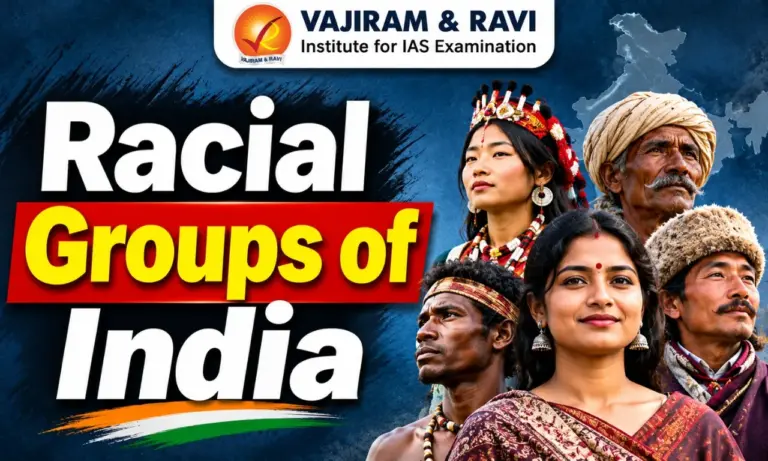
Racial Groups of India reflect the country’s rich ethnic diversity, shaped by thousands of years of migration, population intermixing and cultural interactions. Anthropologists such as B.S. Guha, Herbert Risley and J.H. Hutton historically classified the Indian population based on physical characteristics and presumed ancestral origins. However, modern anthropology and genetic studies reject rigid racial classifications and emphasise shared ancestry, genetic diversity and continuous population interaction as the foundations of India’s diverse population.
Racial Groups of India and Their Classification
India has a diverse population shaped by centuries of human migration, cultural interaction, intermixing and geographical adaptation. People from different regions entered the Indian subcontinent at different periods through land and sea routes, contributing to its rich ethnic, linguistic and cultural diversity.
Traditionally, race was defined as a group of people sharing certain inherited physical characteristics, such as skin colour, hair texture, facial features, height and head shape. Early anthropologists used anthropometry (systematic measurement of the human body) to classify human populations.
Major Racial Classifications of India
Several anthropologists attempted to classify the Indian population based on physical characteristics and presumed ancestral origins.
| Anthropologist | Racial Classification |
|
Herbert Hope Risley (1901) |
Classified the Indian population into seven racial types, including Indo-Aryan, Dravidian and Mongoloid. |
|
A. C. Haddon (1924) |
Classified the population into five major groups, including Pre-Dravidians, Dravidians, Indo-Aryans, Indo-Alpines and Mongolians. |
|
J. H. Hutton (1931) |
Classified Indian populations into different groups based on their presumed sequence of migration. |
|
Egon von Eickstedt (1934) |
Identified three principal groups: Weddid, Melanid and Indid. |
|
B. S. Guha (1935) |
Classified the Indian population into six major racial types and nine subtypes. |
These classifications are important for understanding the history of Indian anthropology. However, modern anthropology and genetics no longer recognise these categories as distinct biological races.
Racial Groups of India According to B.S. Guha
Biraja Sankar Guha (1894-1961) was an Indian physical anthropologist who developed one of the most widely studied historical racial classifications of India. His classification was based on anthropometric measurements conducted between 1930 and 1933 in connection with the 1931 Census of India.
His research covered 2,511 individuals from 39 population groups using 38 physical measurements and observations. His findings were published in 1935 and subsequently in Racial Elements in the Population in 1944.
According to B.S. Guha, the Indian population could be classified into the following six major racial types:
| Major Racial Groups | Subtypes |
|
Negrito |
No major subdivision |
|
Proto-Australoid |
No major subdivision |
|
Mongoloid |
Palaeo-Mongoloid (long-headed and broad-headed) and Tibeto-Mongoloid |
|
Mediterranean |
Palaeo-Mediterranean, Mediterranean and Oriental Mediterranean |
|
Western Brachycephals |
Alpinoid, Dinaric and Armenoid |
|
Nordic |
No major subdivision |
Guha’s classification became an important framework in traditional Indian anthropology and human geography. Nevertheless, it represents a historical anthropological classification rather than a scientifically valid division of contemporary populations.


Racial Groups of India Characteristics
Early anthropologists classified Indian populations using physical characteristics such as stature, skin colour, hair texture, facial structure and head shape. The following characteristics reflect B.S. Guha’s historical descriptions, rather than fixed biological attributes of present-day communities.
1. Negritos
- Origin: Earlier anthropologists considered them among the earliest inhabitants of the Indian subcontinent and associated them with early human migration from Africa.
- Physical Characteristics: Short stature, dark complexion, tightly curled or woolly hair, broad and flat nose, prominent forehead and slightly protruding jaws.
- Historical Significance: Older studies identified similarities among Andaman Islanders and certain communities of southern India, although the existence of a distinct Negrito element in mainland India remains disputed.
2. Proto-Australoids
- Origin: Traditional anthropologists considered them an early population group that settled in central and southern India. Different scholars proposed different geographical origins.
- Physical Characteristics: Short stature, dark brown complexion, long head, wavy or curly hair, broad nose and prominent brow ridges.
- Historical Significance: Earlier scholars associated this category with several tribal communities of central, eastern and southern India. However, claims regarding their specific migration origins remain uncertain.
3. Mongoloids
- Origin: Earlier classifications associated this group with migrations from East Asia through the northern and eastern mountain passes.
- Physical Characteristics: Straight hair, prominent cheekbones, relatively flat facial structure, sparse facial hair and an epicanthic fold of the eyelids.
- Subgroups: B.S. Guha divided this historical category into two principal groups:
- Palaeo-Mongoloids: Further divided into long-headed and broad-headed types, historically associated with the sub-Himalayan and northeastern regions.
- Tibeto-Mongoloids: Described as relatively tall, with broad heads, and historically associated with the Himalayan and Tibetan regions.
4. Mediterraneans
- Origin: Traditional anthropologists believed that these populations migrated from the eastern Mediterranean region and Southwest Asia.
- Physical Characteristics: Medium stature, relatively long head, dark hair and eyes, with varying skin tones and facial features.
- Subgroups: B.S. Guha classified them into three categories:
- Palaeo-Mediterraneans: Described as having medium stature, darker complexion and a long head.
- Mediterraneans: Described as having medium to tall stature, long head and a relatively narrow nose.
- Oriental Mediterraneans: Distinguished in older classifications by a relatively long and convex nose.
- Historical Association: Earlier scholars linked this category with the development of agriculture and the Indus Valley Civilisation, although modern research does not assign civilisations to distinct racial types.
5. Western Brachycephals
- Origin: Earlier anthropologists associated this category with migrations from western and northwestern regions of the Indian subcontinent.
- Physical Characteristics: Broad head, relatively prominent nose and varying stature, complexion and facial structure.
- Subgroups: They were classified into three major categories:
- Alpinoids: Described as having medium stature, broad head and round face.
- Dinarics: Described as relatively tall, with a broad head, long face and prominent nose.
- Armenoids: Described as sharing certain characteristics with Dinarics but differing in head and nose structure.
6. Nordics
- Origin: Traditional classifications associated this category with migrations from Central Asia and northern Eurasia during the second millennium BCE.
- Physical Characteristics: Tall stature, long head, relatively fair complexion, prominent nose and well-built body.
- Historical Association: Earlier scholars linked this category with Indo-Aryan-speaking populations. Modern anthropology, however, distinguishes linguistic identity from biological ancestry.
Racial Groups of India Geographical Distribution
According to traditional anthropological classifications, different racial elements were associated with various geographical regions of India. Migration routes, mountain ranges, river valleys, forests and geographical isolation were considered important factors influencing their distribution.
| Historical Racial Group | Geographical Distribution According to Older Classifications |
|
Negritos |
Andaman Islands and certain pockets of Kerala, Tamil Nadu and Rajmahal Hills. |
|
Proto-Australoids |
Central and southern India, particularly Jharkhand, Odisha, Chhattisgarh, Madhya Pradesh and parts of the Western Ghats. |
|
Mongoloids |
Ladakh, Sikkim, Arunachal Pradesh, Assam, Nagaland, Manipur, Mizoram, Meghalaya and Tripura. |
|
Mediterraneans |
Southern India, the Ganga Valley, Maharashtra, Bengal, Rajasthan and Punjab. |
|
Western Brachycephals |
Gujarat, Maharashtra, Karnataka, Tamil Nadu, Odisha and West Bengal. |
|
Nordics |
Northwestern India, particularly Punjab, Haryana, Rajasthan and Jammu and Kashmir. |
These geographical associations reflect historical anthropological theories. Modern genetic studies show considerable ancestral overlap and population intermixing across these regions, rather than clearly defined racial boundaries
Racial Groups of India and Ethnic Diversity
India’s ethnic diversity is the result of thousands of years of migration, cultural exchange, environmental adaptation and interaction among different communities. Its geographical location between West, Central, East and Southeast Asia made it an important centre of human settlement and cultural interaction.
- Historical Migration: Different populations entered the Indian subcontinent through northwestern mountain passes, northeastern corridors and maritime routes, contributing to its diverse ancestral composition.
- Geographical Factors: Mountains, forests, plateaus and islands influenced population settlement, while fertile river valleys encouraged migration, interaction and intermixing.
- Linguistic Diversity: India is home to several major language families, including Indo-Aryan, Dravidian, Austro-Asiatic and Tibeto-Burman, reflecting its complex cultural history.
- Cultural Assimilation: Migrant communities interacted with existing populations, leading to the development of diverse customs, traditions, languages and religious practices.
- Maritime Interactions: Historical trade and migration brought Arabs, Jews, Parsis, Africans and Europeans to India’s coastal regions, enriching its ethnic and cultural diversity.
- Social Structure and Endogamy: Marriage within particular communities over several centuries contributed to the preservation of distinct social identities and genetic variations.
- Unity in Diversity: Despite differences in language, religion, ancestry and cultural practices, India’s population shares a long history of interaction and coexistence.
Difference Between Race and Ethnicity
| Basis | Race | Ethnicity |
|
Meaning |
A historically constructed classification based largely on perceived physical differences. |
A shared cultural identity based on language, history, ancestry and traditions. |
|
Basis of Classification |
Traditionally based on skin colour, hair texture and facial characteristics. |
Based on shared customs, language, religion and cultural heritage. |
|
Nature |
Socially constructed, without distinct biological boundaries. |
Cultural, social and sometimes ancestral. |
|
Modern Perspective |
Fixed biological racial categories are scientifically outdated. |
Remains relevant for understanding cultural identity and social diversity. |
Racial Classification of India Modern Perspectives
Modern scientific research has transformed the understanding of India’s population history. Instead of dividing people into fixed racial groups, contemporary studies focus on genetic ancestry, migration, population intermixing and cultural evolution.
Genetic Ancestry of Indian Populations
Modern genetic studies have identified several ancestral components that contributed to the formation of present-day Indian populations.
- Ancestral North Indians (ANI): An ancestral population component genetically related to populations of West Asia, Central Asia and Europe.
- Ancestral South Indians (ASI): An ancestral population component formed within the Indian subcontinent, with distant genetic relationships to ancient Andamanese lineages.
- Ancient Ancestral South Indians (AASI): An ancient hunter-gatherer-related ancestry associated with early modern human settlements in the Indian subcontinent.
- Iranian-Related Ancestry: An ancient ancestral component that intermixed with AASI-related populations and contributed to the ancestry associated with the Indus Valley Civilisation.
- Steppe-Related Ancestry: Associated with migrations from the Eurasian Steppe after approximately 2000 BCE, contributing to the genetic composition of several Indian populations.
- East and Southeast Asian Ancestry: Contributed to the genetic composition of several northeastern and Himalayan communities and some Austro-Asiatic-speaking populations.
Major Genetic Studies on Indian Population
| Study | Key Findings |
|
David Reich and Others (2009) |
Identified ANI and ASI as major ancestral components contributing to the genetic diversity of many Indian populations. |
|
Priya Moorjani and Others (2013) |
Identified extensive population intermixing approximately 4,200–1,900 years ago, followed by increasing endogamy. |
|
Vagheesh Narasimhan and Others (2019) |
Used ancient DNA to explain the contribution of AASI, Iranian-related and Steppe-related ancestry to South Asian populations. |
|
Rakhigarhi Genome Study (2019) |
Found that the sampled Harappan individual possessed Iranian-related and indigenous South Asian ancestry without Steppe-related ancestry. |
|
GenomeIndia Project (2025) |
Examined India’s extensive genetic diversity and highlighted the influence of ancestral populations, founder effects and centuries of endogamy. |
Constitutional and Social Perspective on Race in India
India’s constitutional framework promotes equality and prohibits discrimination based on racial identity.
- Article 14: Guarantees equality before the law and equal protection of laws.
- Article 15: Prohibits discrimination on grounds of religion, race, caste, sex or place of birth.
- Article 16: Ensures equality of opportunity in public employment and prohibits discrimination on specified grounds, including race.
- Census of India: Independent India discontinued racial classification in the Census from 1951 onwards, reflecting its commitment to equality and national integration.
- Bezbaruah Committee (2014): Examined concerns regarding discrimination against people from northeastern India and recommended measures to strengthen their protection.
Traditional Racial Classification vs Modern Genetic Approach
| Traditional Racial Classification | Modern Genetic Approach |
|
Based primarily on physical characteristics. |
Based on DNA, genetic ancestry and population history. |
|
Assumed distinct and fixed racial groups. |
Recognises continuous genetic variation and intermixing. |
|
Often associated language with race. |
Treats linguistic identity and genetic ancestry separately. |
|
Focused on successive migrations of racial groups. |
Examines migration, intermarriage, adaptation and endogamy. |
|
Sometimes reinforced social hierarchies. |
Recognises human diversity without racial hierarchy. |
The modern understanding of India’s population highlights its shared ancestry, extensive genetic diversity and rich cultural heritage. Rather than representing separate biological races, India’s diverse communities reflect thousands of years of migration, interaction and population intermixing.
Racial Classification of India Limitations
Traditional racial classifications of India contributed to the early development of physical anthropology. However, they have several scientific and methodological limitations that make them unsuitable for explaining modern population diversity.
- Lack of Scientific Validity: Traditional classifications assumed the existence of distinct and relatively pure racial groups, whereas modern genetic studies demonstrate extensive intermixing among human populations.
- Overdependence on Physical Characteristics: Skin colour, stature, facial features and head shape are influenced by genetic variation, environmental conditions, nutrition and adaptation, making them unreliable indicators of fixed racial identity.
- Limited Sample Size: Early anthropological studies examined relatively small and selective population samples, which could not adequately represent India’s vast and diverse population.
- Differences Among Anthropologists: Scholars such as Risley, Hutton and B.S. Guha proposed different racial categories for the same population, highlighting inconsistencies in classification methods.
- Confusion Between Race and Language: Earlier classifications often treated Aryan and Dravidian as racial groups, although these terms primarily refer to linguistic and cultural identities.
- Colonial Bias and Social Discrimination: Some classifications attempted to associate physical characteristics with caste hierarchy and social status, reinforcing discriminatory assumptions without scientific justification.
- Neglect of Population Intermixing: Traditional classifications failed to adequately explain centuries of migration, intermarriage and genetic exchange that shaped India’s population.

 Last updated on Nov, 2026
→ UPSC Interview 2026 is scheduled from 7 December 2026 to 12 February 2027.
→ UPSC Interview Guidance Programme (IGP) 2026 by Vajiram & Ravi helps aspirants prepare confidently for the UPSC Personality Test.
→ UPSC DAF 2026 application form is available from 11 to 25 November 2026, till 6:00 PM.
→ UPSC 2027 Notification will be released on 13 January 2027 at upsconline.nic.in.
→ Download PIB PRiSM Monthly Magazine 2026 here.
→ Check UPSC Monthly Current Affairs Magazine The Recitals here.
→ Check out the latest UPSC Syllabus here.
→ UPSC Calendar 2027 has been released.
→ Enroll in Vajiram & Ravi’s UPSC Mains Test Series 2027 for structured answer writing practice, expert evaluation, and exam-oriented feedback.
→ Join Vajiram & Ravi’s UPSC Mentorship Program 2027 for personalized guidance, strategy planning, and one-to-one support from experienced mentors.
→ Go through the UPSC Mains Previous Year Papers to enhance your preparation.
→ UPSC has released UPSC Toppers List 2025 with the Civil Services final result on its official website.
→ Also check Best UPSC Coaching in India
Racial Groups of India FAQs
Q1. What are the major racial groups of India?+
Q2. Who classified the Indian population into six racial groups?+
Q3. What is the basis of racial classification in India?+
Q4. Which racial group was historically considered among the earliest inhabitants of India?+
Q5. What is the difference between race and ethnicity?+
Q6. What are the major factors responsible for India's ethnic diversity?+
Tags: racial groups of india