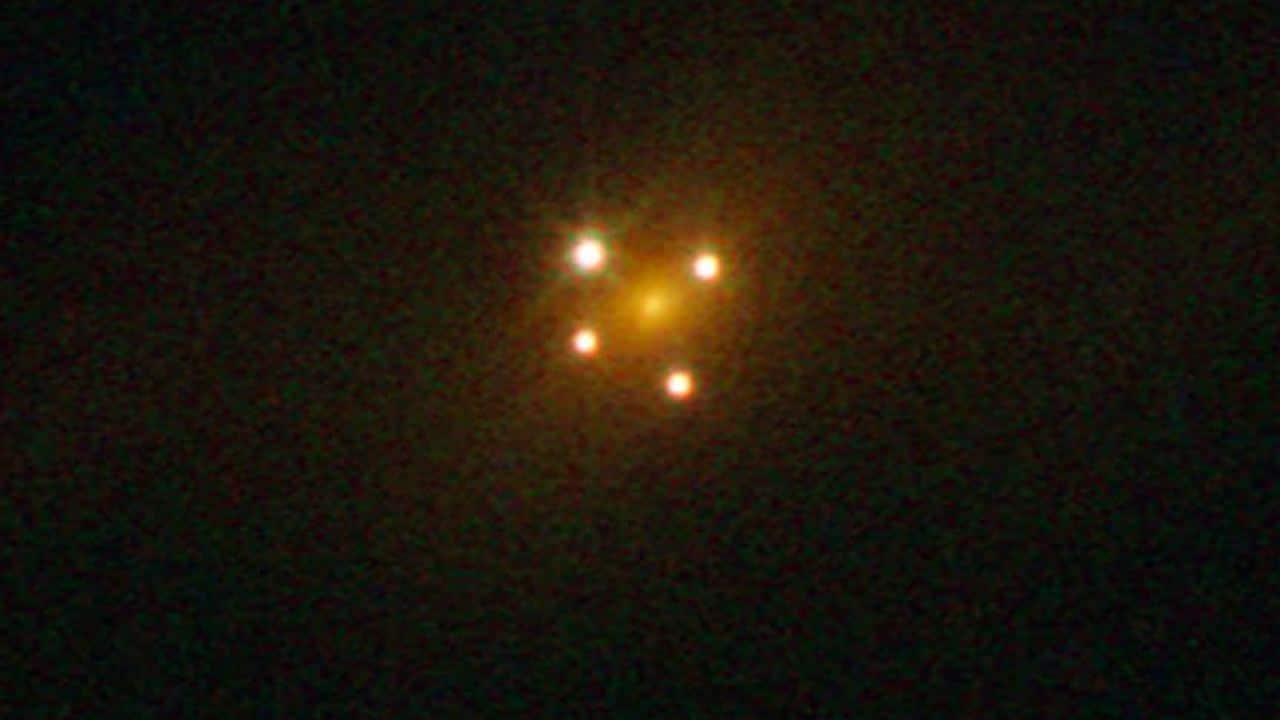
About Einstein cross:
- Einstein predicted the existence of these crosses back in 1915.
- Einstein’s theory of general relativity describes the way massive objects warp the fabric of the universe, called space-time.
- The latest Einstein Cross has some interesting statistics.
- The main galaxy doing the lensing lies about 5.998 billion light-years away. The distant galaxy that it’s lensing is more than 11.179 billion light-years away.
- Thus, the foreground lensing galaxy is giving an amazing look at a galaxy in the early Universe.
What Makes an Einstein Cross?
- When a massive galaxy sits directly “in front of” a more distant background object (such as a galaxy or a quasar) the distribution of matter around that galaxy and its gravitational effect can “bend” the light from the object as it passes by.
- In this case, Earth, the lensing galaxy and the quasar have aligned to perfectly duplicate the quasar’s light, arranging them along a so-called Einstein ring.
Why are these so rare?
- It turns out that gravitational lensing happens everywhere in the universe, mostly in the form of so-called “weak lensing”.
- Creating an Einstein Cross requires a precise alignment of the lensing body and light source and astronomers refer to this as “strong gravitational lensing”.
What is Gravitational Lensing?
- It occurs when a massive celestial body, such as a galaxy cluster, causes a sufficient curvature of spacetime for the path of light around it to be visibly bent, as if by a lens.
- The body causing the light to curve is accordingly called a gravitational lens.
- An important consequence of this lensing distortion is magnification, allowing us to observe objects that would otherwise be too far away and too faint to be seen.
Q1) What is a galaxy?
A galaxy is a vast system of stars, stellar remnants, interstellar gas, dust, and dark matter, all bound together by gravity. Galaxies can vary significantly in size, shape, and content, ranging from relatively small and irregular dwarf galaxies to massive and organized spiral or elliptical galaxies.


 Last updated on Sep, 2026
→ UPSC 2027 Notification will be released on 13 January 2027 at upsconline.nic.in.
→ Asian Games 2026 are being held in Aichi-Nagoya, Japan, from 19 September to 4 October.
→ Check out the latest UPSC Syllabus here.
→ Download UPSC Model Answers for Mains 2026
→ UPSC Mains Question Paper 2026 is out now for Essay & GS Paper 1, 2, 3 & 4.
→ UPSC Calendar 2027 has been released.
→ Enroll in Vajiram & Ravi’s UPSC Mains Test Series 2027 for structured answer writing practice, expert evaluation, and exam-oriented feedback.
→ Join Vajiram & Ravi’s UPSC Mentorship Program 2027 for personalized guidance, strategy planning, and one-to-one support from experienced mentors.
→ Go through the UPSC Mains Previous Year Papers to enhance your preparation.
→ UPSC has released UPSC Toppers List 2025 with the Civil Services final result on its official website.
→ Also check Best UPSC Coaching in India