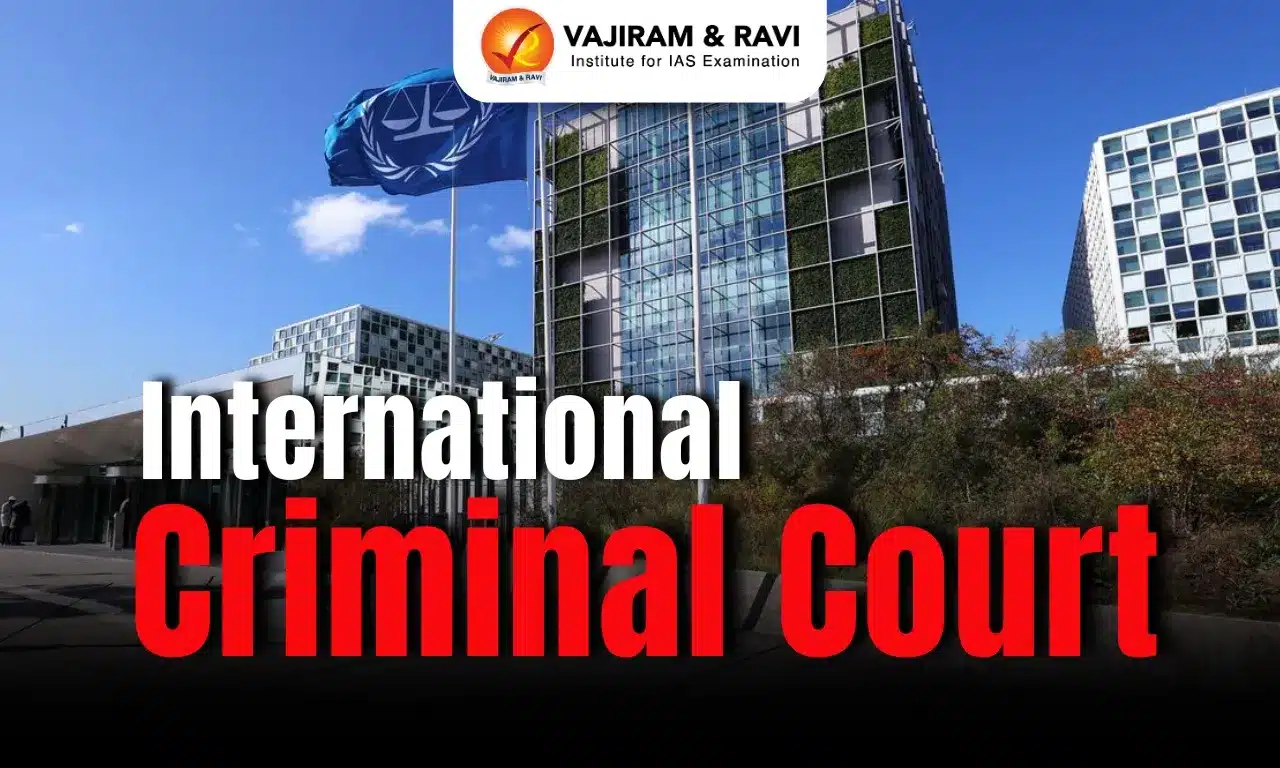
International Criminal Court
The International Criminal Court recently unsealed an arrest warrant against Senator Ronald Dela Rosa, accusing him, along with ex-President Rodrigo Duterte and other “co-perpetrators” of the “crime against humanity of murder”.
About International Criminal Court
- It is a permanent and independent criminal court established to prosecute offenders of serious crimes in the international community.
- It is the only permanent international criminal tribunal.
- It was created by the Rome Statute, which came into force on July 1, 2002.
- Mandate: ICC investigates and, where warranted, tries individuals charged with the gravest crimes of concern to the international community.
- Specifically, the ICC is intended to prosecute the following crimes:
- Genocide
- Crimes against humanity
- War crimes
- The crime of aggression
- The ICC is meant to serve as a last resort when the courts of sovereign states are unwilling to prosecute.
- Therefore, the ICC is complementary to national criminal jurisdiction and does not supersede it.
- Additionally, the ICC serves a different purpose than the International Court of Justice, which resolves conflicts between nations.
- Members: There are 125 member countries (China, India, Israel, Russia, and the United States are not ICC parties).
- Funding: The Court is funded by contributions from the States Parties and by voluntary contributions from Governments, international organizations, individuals, corporations, and other entities.


International Criminal Court Composition
- Judges: The court has eighteen judges, each from a different member country, elected to non-renewable nine-year terms.
- The Presidency:
- Consists of three judges (the President and two Vice-Presidents) elected from among the judges.
- It represents the Court to the outside world and helps with the organization of the work of the judges.
- Office of the Prosecutor (OTP):
- OTP is responsible for receiving referrals and any substantiated information on crimes within the jurisdiction of the Court.
- OTP examines these referrals and information, conducts investigations, and conducts prosecutions before the Court.
- Registry: It provides administrative and operational support to the Chambers and the Office of the Prosecutor.
International Criminal Court Jurisdiction
- The ICC is only competent to hear a case if:
- The country where the offence was committed is a party to the Rome Statute; or
- The perpetrator’s country of origin is a party to the Rome Statute.
- The ICC only has jurisdiction over offences committed after the Statute’s entry into force on 1 July 2002.
- Various parties have the right to refer a case to the ICC:
- any State Party to the Rome Statute, irrespective of any involvement in the alleged offence;
- the Prosecutor of the ICC;
- the United Nations Security Council (UNSC)
- The UNSC may ask the ICC to defer investigation of a case for a limited period if it considers that the proceedings would constitute an obstruction to its powers.
Source: TH

 Last updated on Sep, 2026
→ UPSC 2027 Notification will be released on 13 January 2027 at upsconline.nic.in.
→ Asian Games 2026 are being held in Aichi-Nagoya, Japan, from 19 September to 4 October.
→ Check out the latest UPSC Syllabus here.
→ Download UPSC Model Answers for Mains 2026
→ UPSC Mains Question Paper 2026 is out now for Essay & GS Paper 1, 2, 3 & 4.
→ UPSC Calendar 2027 has been released.
→ Enroll in Vajiram & Ravi’s UPSC Mains Test Series 2027 for structured answer writing practice, expert evaluation, and exam-oriented feedback.
→ Join Vajiram & Ravi’s UPSC Mentorship Program 2027 for personalized guidance, strategy planning, and one-to-one support from experienced mentors.
→ Go through the UPSC Mains Previous Year Papers to enhance your preparation.
→ UPSC has released UPSC Toppers List 2025 with the Civil Services final result on its official website.
→ Also check Best UPSC Coaching in India
International Criminal Court FAQs
Q1. What is the International Criminal Court (ICC)?+
Q2. Which legal instrument created the International Criminal Court (ICC)?+
Q3. What is the main mandate of the International Criminal Court (ICC)?+
Q4. Is India a member of the International Criminal Court (ICC)?+
Q5. Who can refer a case to the International Criminal Court (ICC)?+
Tags: international criminal court