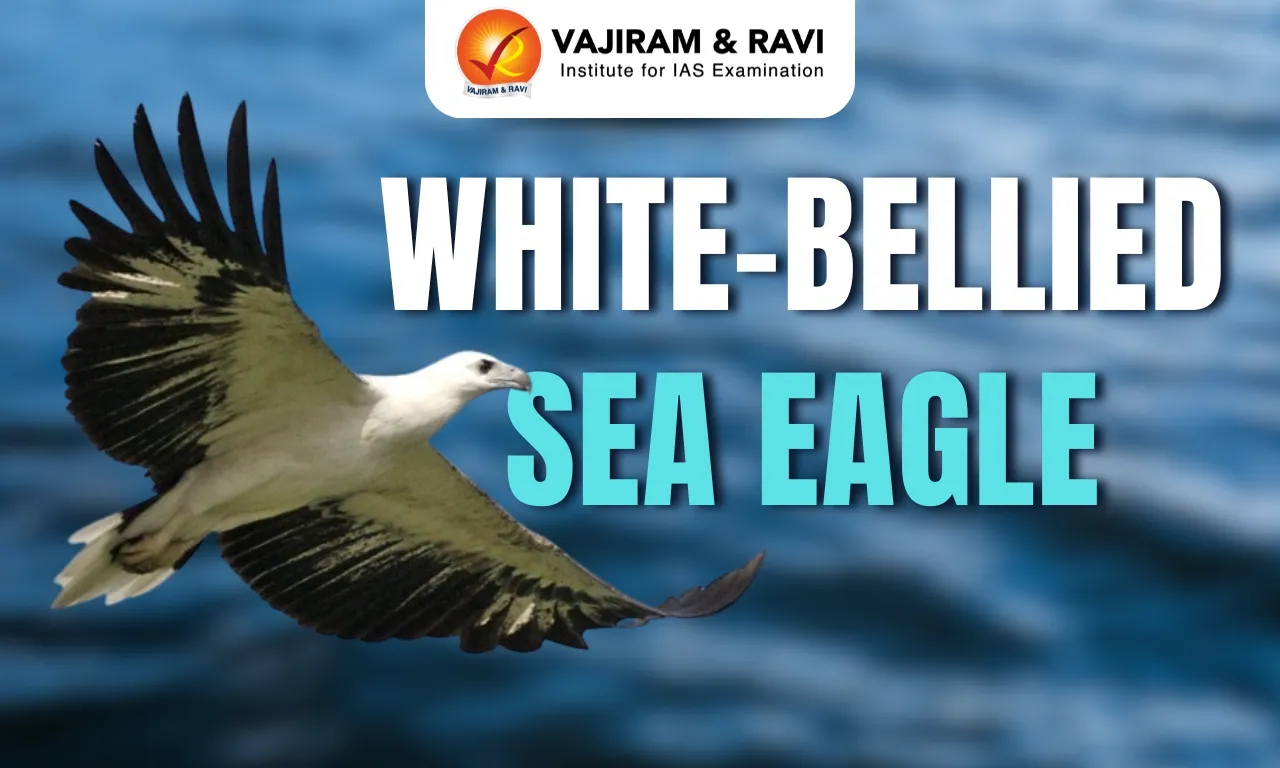
White-Bellied Sea Eagle Latest News
Recently, the annual nest monitoring survey of the White-bellied Sea Eagle recorded 17 active nesting sites in Kannur and Kasaragod districts during this season.
About White-bellied Sea Eagle
- It is also known as the white-breasted sea eagle, is a large diurnal bird of prey in the family Accipitridae.
- Habitat: It lives primarily in terrestrial habitats near the ocean, especially coasts, islands, and estuaries, but also live in forested areas with access to smaller bodies of water
- Distribution: It is found in India, Sri Lanka, Andaman Island, southern China, the Philippines, Wallacea, New Guinea, Australia, and Tasmania, among other countries.
- It exhibits sexual dimorphism, with females being slightly larger than males.
- Communication: The primary form of communication in white-bellied sea eagles is vocalizations
- Diet: They are carnivorous and primarily prey on aquatic animals, especially fish, eels, and crustaceans.
- It is an apex predator in coastal ecosystems, and is considered an indicator of marine and coastal environmental health.
- Conservation Status
- IUCN: Least Concern
Source: TH


 Last updated on Oct, 2026
→ UPSC 2027 Notification will be released on 13 January 2027 at upsconline.nic.in.
→ Asian Games 2026 are being held in Aichi-Nagoya, Japan, from 19 September to 4 October.
→ Check Nobel Prize 2026 Winners List here.
→ Download PIB PRiSM Monthly Magazine 2026 here.
→ Check UPSC Monthly Current Affairs Magazine The Recitals here.
→ Check out the latest UPSC Syllabus here.
→ Download UPSC Model Answers for Mains 2026
→ UPSC Mains Question Paper 2026 is out now for Essay & GS Paper 1, 2, 3 & 4.
→ UPSC Calendar 2027 has been released.
→ Enroll in Vajiram & Ravi’s UPSC Mains Test Series 2027 for structured answer writing practice, expert evaluation, and exam-oriented feedback.
→ Join Vajiram & Ravi’s UPSC Mentorship Program 2027 for personalized guidance, strategy planning, and one-to-one support from experienced mentors.
→ Go through the UPSC Mains Previous Year Papers to enhance your preparation.
→ UPSC has released UPSC Toppers List 2025 with the Civil Services final result on its official website.
→ Also check Best UPSC Coaching in India
White-Bellied Sea Eagle FAQs
Q1. What is the primary habitat of White-bellied Sea Eagles?+
Q2. What is the diet of White-bellied Sea Eagles?+
Tags: prelims pointers upsc current affairs upsc prelims current affairs white-bellied sea eagle