


Psoriasis Latest News
Patients with psoriasis have an increased risk for cataracts and cataract surgery, with the risks for these outcomes varying by treatment modality, according to a recent study.
About Psoriasis
- It is a chronic autoimmune condition that causes the rapid buildup of skin cells.
- This buildup of cells causes scaling on your skin’s surface.
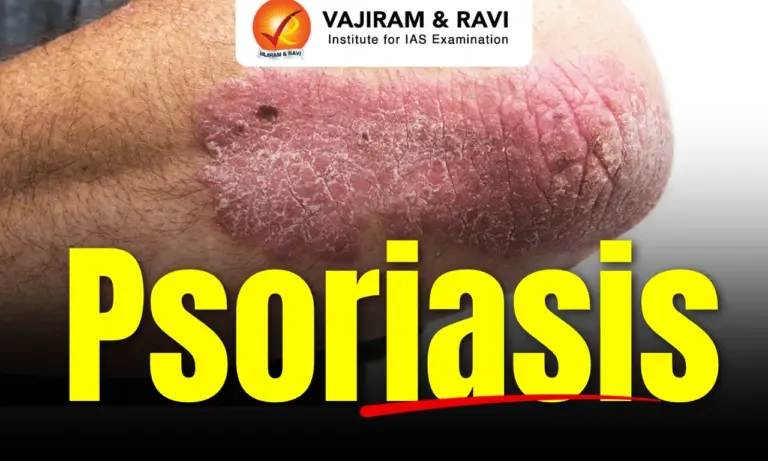
- It causes a rash with itchy, scaly patches, most commonly on the knees, elbows, trunk, and scalp.
- It can be painful, interfere with sleep, and make it hard to concentrate.
- Causes:
- The cause of psoriasis is not fully understood. It is believed to be caused by genetics, the immune system, and the environment.
- Psoriasis occurs because the overactive immune system speeds up skin cell growth.
- Normal skin cells completely grow and shed (fall off) in a month.
- With psoriasis, skin cells do this in only three or four days. Instead of shedding, the skin cells pile up on the surface of the skin.
- Common triggers for psoriasis flare-ups include:
- Emotional stress.
- An infection (streptococcal infection).
- A skin injury like cuts, scrapes, or surgery.
- Certain medications, such as lithium and beta-blockers.
- Changes in body temperature due to the weather.
- Is psoriasis hereditary?
- Yes, there is a strong family link to psoriasis.
- If you have a family member affected by psoriasis, you are more likely to be affected by it too, due to shared genes.
- The way psoriasis is inherited is complex and not completely understood.
- Is psoriasis contagious? Psoriasis is not contagious.
- Symptoms:
- The condition tends to go through cycles, flaring for a few weeks or months, then subsiding for a while.
- Symptoms of psoriasis vary from person to person, but some common ones are:
- Patches of thick, red skin with silvery-white scales that itch or burn.
- Dry, cracked skin that itches or bleeds.
- Thick, ridged, pitted nails.
- Poor sleep quality.
- Some patients have a related condition called psoriatic arthritis, which can be characterized by stiff, swollen, or painful joints; neck or back pain; or Achilles heel pain.
- Treatment:
- It has no cure. Treatments aim to
- reduce inflammation and scales;
- slow the growth of skin cells;
- remove plaques;
- Common psoriasis treatments include:
- Steroid creams.
- Moisturizers for dry skin.
- Medication to slow skin cell production (anthralin).
- Medicated lotions or shampoos.
- Vitamin D3 ointment.
- Vitamin A or retinoid creams.
- It has no cure. Treatments aim to
News: MED


 Last updated on Nov, 2026
→ UPSC 2027 Notification will be released on 13 January 2027 at upsconline.nic.in.
→ Check Nobel Prize 2026 Winners List here.
→ Download PIB PRiSM Monthly Magazine 2026 here.
→ Check UPSC Monthly Current Affairs Magazine The Recitals here.
→ Check out the latest UPSC Syllabus here.
→ Download UPSC Model Answers for Mains 2026
→ UPSC Mains Question Paper 2026 is out now for Essay & GS Paper 1, 2, 3 & 4.
→ UPSC Calendar 2027 has been released.
→ Enroll in Vajiram & Ravi’s UPSC Mains Test Series 2027 for structured answer writing practice, expert evaluation, and exam-oriented feedback.
→ Join Vajiram & Ravi’s UPSC Mentorship Program 2027 for personalized guidance, strategy planning, and one-to-one support from experienced mentors.
→ Go through the UPSC Mains Previous Year Papers to enhance your preparation.
→ UPSC has released UPSC Toppers List 2025 with the Civil Services final result on its official website.
→ Also check Best UPSC Coaching in India
Psoriasis FAQs
Q1. What is psoriasis?+
Q2. Which parts of the body are most commonly affected by psoriasis?+
Q3. How does an overactive immune system contribute to psoriasis?+
Q4. Is psoriasis hereditary?+
Q5. Is there a permanent cure for psoriasis?+
Tags: prelims pointers psoriasis upsc current affairs upsc prelims current affairs








