Magnetar Latest News
Recently, a magnetar called 1E 1547.0−5408 has produced the strongest observational case so far that an intense magnetic field can change how light travels through otherwise empty space.
About Magnetar
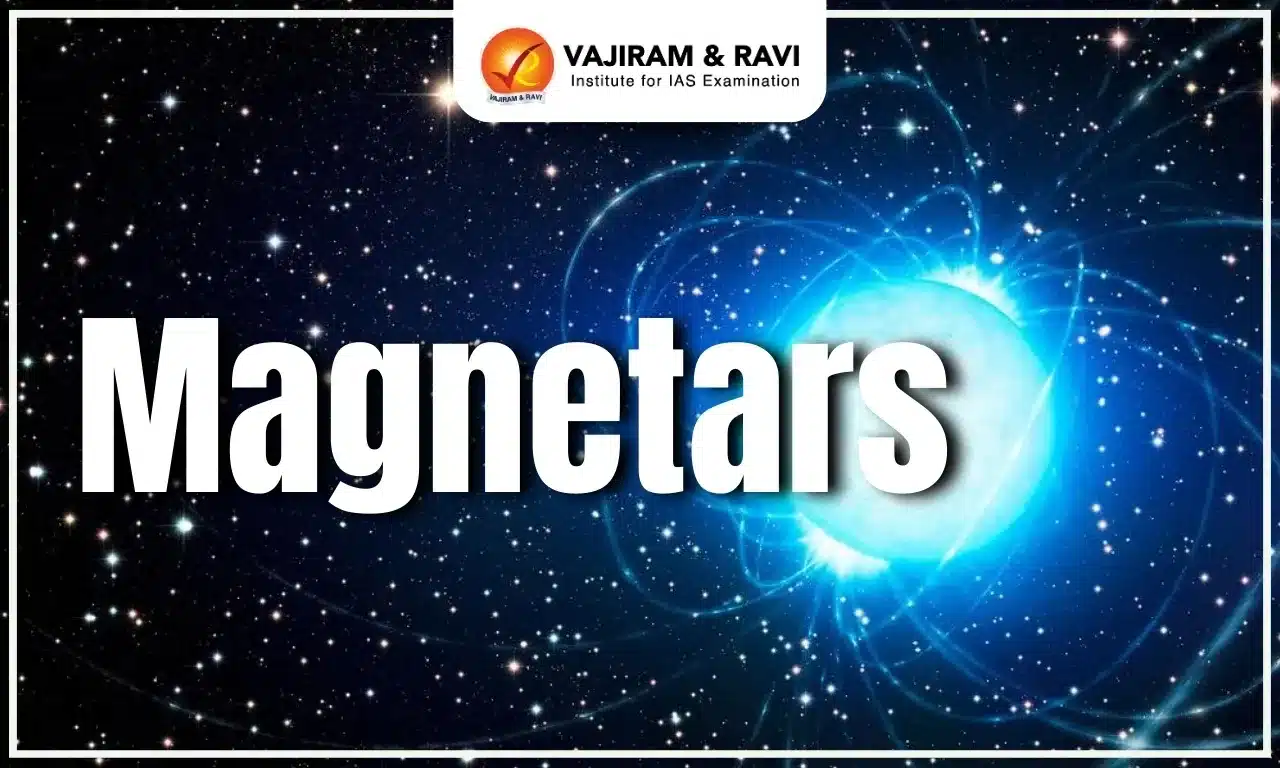
- Magnetars are neutron stars having an ultrahigh magnetic field that are much stronger than the terrestrial magnetic field.
- They are formed in the same way as all neutron stars, through the core-collapse of a massive star in a supernova explosion.
- The idea of a magnetar was first proposed in 1987 and used to successfully explain soft gamma repeaters (SGR) in 1992.


Characteristics Magnetar
- They are characterised by exceptionally strong magnetic fields, estimated to be a thousand times stronger than typical neutron stars.
- The magnetic field of a magnetar is over one quadrillion times stronger than the magnetic field of Earth.
- What powers the emission of high-energy electromagnetic radiation in them is the decay of magnetic fields in these objects.
- Besides, magnetars display strong temporal variability, typically including a slow rotation, a rapid spin-down, bright but short bursts going on upto months-long outbursts.
- Occasionally, they emit intense bursts of energy in the form of flares.
Source: TH

 Last updated on Oct, 2026
→ UPSC 2027 Notification will be released on 13 January 2027 at upsconline.nic.in.
→ Check Nobel Prize 2026 Winners List here.
→ Download PIB PRiSM Monthly Magazine 2026 here.
→ Check UPSC Monthly Current Affairs Magazine The Recitals here.
→ Check out the latest UPSC Syllabus here.
→ Download UPSC Model Answers for Mains 2026
→ UPSC Mains Question Paper 2026 is out now for Essay & GS Paper 1, 2, 3 & 4.
→ UPSC Calendar 2027 has been released.
→ Enroll in Vajiram & Ravi’s UPSC Mains Test Series 2027 for structured answer writing practice, expert evaluation, and exam-oriented feedback.
→ Join Vajiram & Ravi’s UPSC Mentorship Program 2027 for personalized guidance, strategy planning, and one-to-one support from experienced mentors.
→ Go through the UPSC Mains Previous Year Papers to enhance your preparation.
→ UPSC has released UPSC Toppers List 2025 with the Civil Services final result on its official website.
→ Also check Best UPSC Coaching in India
Magnetar FAQs
Q1. What are Magnetars?+
Q2. What are the characteristics of Magnetars?+
Tags: magnetar prelims pointers upsc current affairs upsc prelims current affairs