About VB_HmeY_H4907
- It is a new virus discovered nearly 11,000 metres below the surface of the Pacific Ocean.
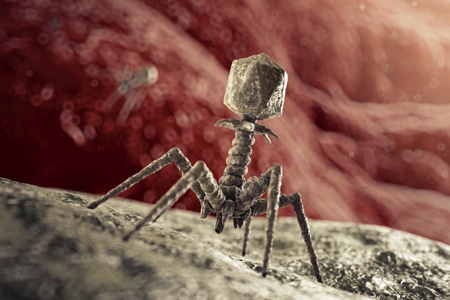
- The virus has been understood as a Bacteriophage, which means ‘bacteria eater’.
- It infects halophilic bacteria (bacteria that inhabit environments with high salt concentrations) from the genus Halomonas. Such bacteria are generally found in deep-sea hydrothermal vents.
- The virus is actually very genetically similar to its host and is a lysogenic phage, meaning that it inserts its genetic material into the bacteria but usually doesn’t kill it; instead, both virus and bacteria replicate at the same time.
What are Bacteriophages?
- Bacteriophages, also known as phages, are viruses that infect and replicate in bacterial cells.
- They also infect the single-celled prokaryotic organisms known as archaea.
- They were discovered independently by Frederick W. Twort in Great Britain (1915) and Félix d’Hérelle in France (1917).
- They are ubiquitous in the environment and are recognized as the most abundant biological agent on earth.
- They are extremely diverse in size, morphology, and genomic organization.
- Like all viruses, phages are simple organisms that consist of a core of genetic material (nucleic acid) surrounded by a protein capsid. The nucleic acid may be either DNA or RNA and may be double-stranded or single-stranded.
Q1) What are hydrothermal vents?
Hydrothermal vents are the result of seawater percolating down through fissures in the ocean crust in the vicinity of spreading centers or subduction zones (places on Earth where two tectonic plates move away or towards one another). The cold seawater is heated by hot magma and reemerges to form the vents. Seawater in hydrothermal vents may reach temperatures of over 700° Fahrenheit.
Source: ‘Not a threat’ What Is VB_HmeY_H4907? The New Virus Found In Pacific In Earth’s Oceans


 Last updated on Sep, 2026
→ UPSC 2027 Notification will be released on 13 January 2027 at upsconline.nic.in.
→ Asian Games 2026 are being held in Aichi-Nagoya, Japan, from 19 September to 4 October.
→ Check out the latest UPSC Syllabus here.
→ Download UPSC Model Answers for Mains 2026
→ UPSC Mains Question Paper 2026 is out now for Essay & GS Paper 1, 2, 3 & 4.
→ UPSC Calendar 2027 has been released.
→ Enroll in Vajiram & Ravi’s UPSC Mains Test Series 2027 for structured answer writing practice, expert evaluation, and exam-oriented feedback.
→ Join Vajiram & Ravi’s UPSC Mentorship Program 2027 for personalized guidance, strategy planning, and one-to-one support from experienced mentors.
→ Go through the UPSC Mains Previous Year Papers to enhance your preparation.
→ UPSC has released UPSC Toppers List 2025 with the Civil Services final result on its official website.
→ Also check Best UPSC Coaching in India