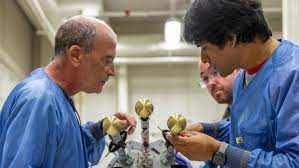
About Atmospheric Perturbations around the Eclipse Path (APEP) mission
- The mission will involve launching three rockets equipped with scientific instruments.
- Objective: To know how the upper atmosphere will change during the eclipse, especially the moment when there would be a sudden reduction in light.
- During an eclipse, the sudden drop in sunlight causes changes in the ionosphere, creating waves that ripple through this atmospheric layer.
- It will measure changes in electric and magnetic fields, density, and temperature.
- This launch will take place at the White Sands Missile Range in New Mexico, with a specific focus on the ionosphere.
- According to NASA, the ionosphere’s temperature and density are projected to decrease during the eclipse, resulting in a wave-like disturbance that has the potential to disrupt GPS and other satellite communications.
The process:
- The rockets will be positioned just outside the path of annularity, where the Moon moves directly in front of the Sun. Each rocket will deploy four small scientific instruments designed to record changes in electric and magnetic fields, density, and temperature.
- NASA’s goal is to achieve the first-ever simultaneous measurements from multiple locations in the ionosphere during a solar eclipse.
- Rockets can be launched precisely at the right moment and can investigate lower altitudes inaccessible to satellites.
- Sounding rockets were chosen by the team due to their ability to pinpoint and measure specific regions of space with great accuracy.
- These rockets can also record changes occurring at various altitudes as they ascend and descend from suborbital flights.
- The rockets will gather data at altitudes ranging from 45 to 200 miles (70 to 325 kilometres) above the Earth’s surface along their flight path.
Q1: What is ionosphere?
The ionosphere is a region of Earth’s upper atmosphere that contains a high concentration of ions and free electrons. It starts approximately 48 kilometers above the Earth’s surface and extends upwards to several hundred miles (about 1,000 kilometers). The ionosphere plays a crucial role in various atmospheric and radio propagation phenomena, including the reflection and refraction of radio waves.
Source: Indian-origin NASA scientist to lead rocket mission to‘ring of fire’ eclipse. Explained


 Last updated on Oct, 2026
→ UPSC 2027 Notification will be released on 13 January 2027 at upsconline.nic.in.
→ Check Nobel Prize 2026 Winners List here.
→ Download PIB PRiSM Monthly Magazine 2026 here.
→ Check UPSC Monthly Current Affairs Magazine The Recitals here.
→ Check out the latest UPSC Syllabus here.
→ Download UPSC Model Answers for Mains 2026
→ UPSC Mains Question Paper 2026 is out now for Essay & GS Paper 1, 2, 3 & 4.
→ UPSC Calendar 2027 has been released.
→ Enroll in Vajiram & Ravi’s UPSC Mains Test Series 2027 for structured answer writing practice, expert evaluation, and exam-oriented feedback.
→ Join Vajiram & Ravi’s UPSC Mentorship Program 2027 for personalized guidance, strategy planning, and one-to-one support from experienced mentors.
→ Go through the UPSC Mains Previous Year Papers to enhance your preparation.
→ UPSC has released UPSC Toppers List 2025 with the Civil Services final result on its official website.
→ Also check Best UPSC Coaching in India