

Osteoporosis Latest News
Osteoporosis is commonly associated with aging and postmenopausal women, but bone-health concerns are increasingly being noticed among younger adults in clinical practice.
About Osteoporosis
- It is a disease in which your bones become weak and are likely to fracture (break).
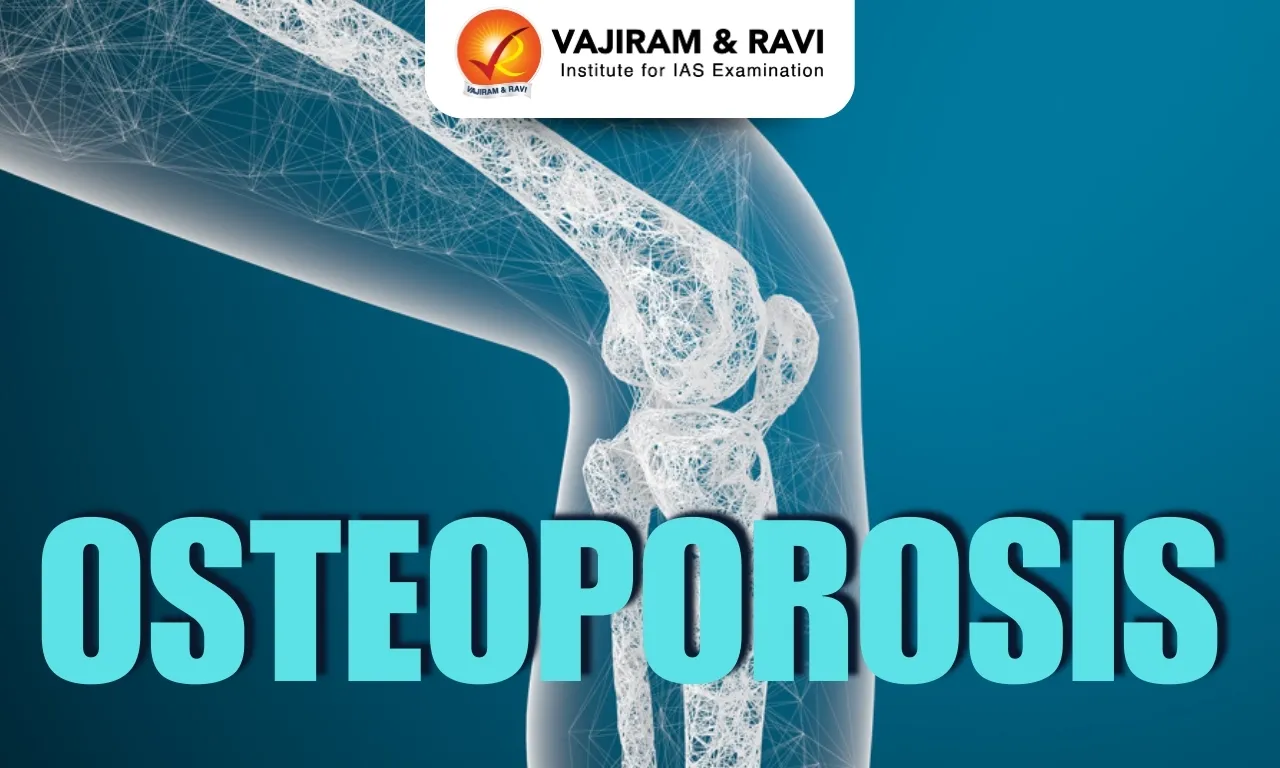
- Osteoporosis means “porous bone.” Viewed under a microscope, a healthy bone looks like a honeycomb. When osteoporosis occurs, the holes and spaces in the honeycomb are much larger than in healthy bone.
- Osteoporotic bones have lost density or mass and contain abnormal tissue structure. As bones become less dense, they weaken and are more likely to break (bone fractures).
- Fractures can occur in any bone but happen most often in bones of the hip, vertebrae in the spine, and wrist.


What Causes Osteoporosis?
- Your bones are made of living tissue. To keep them strong, your body breaks down old bone and replaces it with new bone.
- Osteoporosis develops when more bone is broken down than replaced.
- You lose bone mass, and changes happen in the structure of your bone tissue. This can happen as you get older.
- Some of the common risk factors for developing osteoporosis include:
- Are female
- Over the age of 50
- Are of white or Asian descent
- Have a family history of osteoporosis, especially if your mother or father fractured a hip
- Have low body weight
- Have low levels of sex hormones (low estrogen in women, low testosterone in men)
- Have too much thyroid hormone (hyperthyroidism)
- Are chronically on certain medications such as steroids
Osteoporosis Symptoms
- It is called a “silent” disease because it doesn’t usually cause symptoms.
- Although most people are not aware that they may have osteoporosis until they experience a fracture, there are some signs and symptoms that you may experience in later stages of the condition. They include:
- Back pain (in the presence of vertebral compression fracture)
- Loss of height over time (this will be gradual)
- A stooped posture
- Low-impact bone fracture
Osteoporosis Treatment
- Treatment for osteoporosis may involve:
- Making lifestyle changes, such as changing your diet and exercise routine
- Taking calcium and vitamin D supplements
- Using medicines to strengthen bones.
News: NDTV

 Last updated on Nov, 2026
→ UPSC 2027 Notification will be released on 13 January 2027 at upsconline.nic.in.
→ Check Nobel Prize 2026 Winners List here.
→ Download PIB PRiSM Monthly Magazine 2026 here.
→ Check UPSC Monthly Current Affairs Magazine The Recitals here.
→ Check out the latest UPSC Syllabus here.
→ Download UPSC Model Answers for Mains 2026
→ UPSC Mains Question Paper 2026 is out now for Essay & GS Paper 1, 2, 3 & 4.
→ UPSC Calendar 2027 has been released.
→ Enroll in Vajiram & Ravi’s UPSC Mains Test Series 2027 for structured answer writing practice, expert evaluation, and exam-oriented feedback.
→ Join Vajiram & Ravi’s UPSC Mentorship Program 2027 for personalized guidance, strategy planning, and one-to-one support from experienced mentors.
→ Go through the UPSC Mains Previous Year Papers to enhance your preparation.
→ UPSC has released UPSC Toppers List 2025 with the Civil Services final result on its official website.
→ Also check Best UPSC Coaching in India
Osteoporosis FAQs
Q1. What is osteoporosis?+
Q2. Why are bones more likely to fracture in osteoporosis?+
Q3. How does osteoporosis develop?+
Q4. Why is osteoporosis called a “silent disease”?+
Q5. What are the common symptoms of osteoporosis in its later stages?+