About Carbon nanoflorets
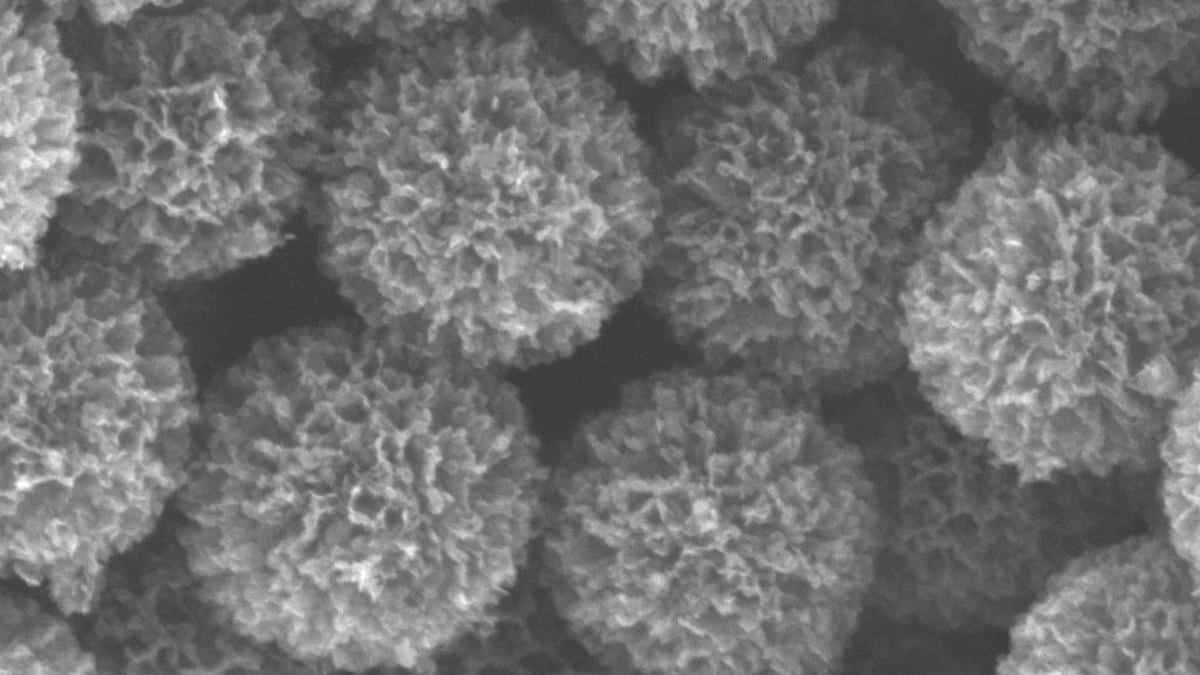
- These are like tiny marigold flowers made only of carbon which are called as the material carbon nanoflorets.
- Process of synthesis
- Researchers heated a special form of silicon dust called DFNS (for dendritic fibrous nanosilica) in a furnace.
- Once heated, she introduced acetylene gas into the chamber.
- The white powder turned black – a sign that carbon had been deposited on the DFNS.
- Then they collected the black powder and treated it with a strong chemical that dissolved the DFNS away, leaving carbon particles behind.
- The structure of the silicon particles – 50-1,200 nanometers in size – resembled spikes arranged around a sphere.
- Observation
- They reported that these nanoflorets could absorb sunlight at many frequencies and convert it to heat with an unprecedented efficiency.
- The nanoflorets also didn’t easily dissipate the heat generated into the environment, making the material a good candidate to heat.
- The nanoflorets converted the light energy they absorbed into thermal energy – a process called solar-thermal conversion – with a remarkable efficiency of 87%.
- The carbon nanoflorets’ high efficiency comes from three properties.
- The nanoflorets absorb three frequencies in sunlight – infrared, visible light, and ultraviolet while other common materials absorb only visible and ultraviolet light.
- Shape: As light falls on the material, the carbon cones ensure that very little is reflected back.
- Long-range disorder: Parts of the structure at some distance from each other possess different physical properties. As a result, heat waves in the material aren’t carried over long distances, reducing the amount of heat dissipated away.
Q1) What is Infrared (IR) radiation?
It is a part of the electromagnetic spectrum that lies between visible light and microwaves. It has wavelengths longer than those of visible light, ranging from approximately 0.7 micrometers (microns) to 1 millimeter. Infrared radiation is invisible to the human eye but can be detected and utilized in various scientific, industrial, and technological applications.
Source: Tiny carbon ‘flowers’ turn light to heat at unrivalled efficiency, IIT team finds


 Last updated on August, 2026
→ UPSC Mains Question Paper 2026 is out now for Essay & GS Paper 1, 2, 3 & 4.
→ UPSC Mains GS Paper 1 2026 is out now.
→ UPSC Mains GS Paper 2 2026 is out now.
→ UPSC Mains GS Paper 3 2026 is out now.
→ UPSC Mains GS Paper 4 2026 is out now.
→ UPSC Mains Indian Language Paper & English Compulsory Paper are out now.
→ Check out the latest UPSC Syllabus 2026 here.
→ UPSC Mains Admit Card 2026 is now out.
→ Enroll in Vajiram & Ravi’s UPSC Mains Test Series 2027 for structured answer writing practice, expert evaluation, and exam-oriented feedback.
→ Join Vajiram & Ravi’s UPSC Mentorship Program 2027 for personalized guidance, strategy planning, and one-to-one support from experienced mentors.
→ Go through the UPSC Mains Previous Year Papers to enhance your preparation.
→ Download UPSC Mains Essay Paper 2025, UPSC Mains GS Paper-I 2025, UPSC Mains GS Paper-II 2025, UPSC Mains GS Paper-III 2025, UPSC Mains GS Paper-IV 2025, UPSC Mains English (Compulsory) Paper 2025, UPSC Mains Hindi (Qualifying) Paper 2025 here.
→ UPSC has released UPSC Toppers List 2025 with the Civil Services final result on its official website.
→ UPSC Calendar 2027 has been released.
→ Also check Best UPSC Coaching in India