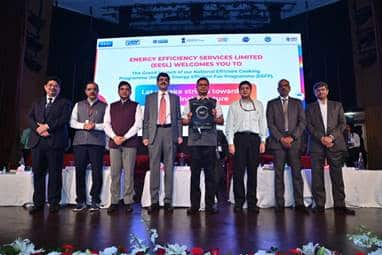
About National Efficient Cooking Programme
- It is a subset of the Clean Cooking Scheme.
- It focuses on Non-Solar/Electricity-based Induction Cookstoves, aligning with the Go- electric initiative by the Ministry of Power.
- This programme introduces induction-based cook-stoves.
- Target: To deploy 20 Lakh Induction cook-stoves across India.
- EESL seeks to reduce the environmental impact of cooking methods, ensuring cleaner air and improved health for citizens.
- EESL has also partnered with Modern Energy Cooking Services (MECS) for the large-scale deployment of induction cooktops.
- The deployment is expected to accelerate the acceptance and large-scale adoption of modern electric cooking devices in Indian kitchens.
- Benefit: It is offering a cost advantage of 25-30% over traditional cooking methods, promising both energy savings and cost-effective cooking solutions.
Key facts about Energy Efficiency Services Limited
- It is promoted by the Ministry of Power, Government of India, as a Joint Venture of four reputed public-sector undertakings NTPC Limited, Power Finance Corporation Limited, REC Limited and POWERGRID Corporation of India Limited.
- It was registered under the Companies Act, 1956 on 10th December 2009.
- It was formed to create and sustain market access to energy efficient technologies, particularly in public facilities like municipalities, buildings, agriculture, industry etc. and to implement several schemes of the Bureau of Energy Efficiency, Ministry of Power and Ministry of New & Renewable Energy, Government of India.
- It is also leading the market-related activities of the National Mission for Enhanced Energy Efficiency (NMEEE).
Q1) What is the National Mission for Enhanced Energy Efficiency?
It is one of the eight national missions launched under India’s National Action Plan on Climate Change (NAPCC). NAPCC was introduced by the Government of India in 2008 to outline the country’s strategy and action plans to address the challenges of climate change and enhance energy efficiency. NMEEE specifically focuses on improving energy efficiency and reducing greenhouse gas emissions in various sectors of the Indian economy.


 Last updated on Oct, 2026
→ UPSC 2027 Notification will be released on 13 January 2027 at upsconline.nic.in.
→ Check Nobel Prize 2026 Winners List here.
→ Download PIB PRiSM Monthly Magazine 2026 here.
→ Check UPSC Monthly Current Affairs Magazine The Recitals here.
→ Check out the latest UPSC Syllabus here.
→ Download UPSC Model Answers for Mains 2026
→ UPSC Mains Question Paper 2026 is out now for Essay & GS Paper 1, 2, 3 & 4.
→ UPSC Calendar 2027 has been released.
→ Enroll in Vajiram & Ravi’s UPSC Mains Test Series 2027 for structured answer writing practice, expert evaluation, and exam-oriented feedback.
→ Join Vajiram & Ravi’s UPSC Mentorship Program 2027 for personalized guidance, strategy planning, and one-to-one support from experienced mentors.
→ Go through the UPSC Mains Previous Year Papers to enhance your preparation.
→ UPSC has released UPSC Toppers List 2025 with the Civil Services final result on its official website.
→ Also check Best UPSC Coaching in India