About Geoglyph
- It is a large design or motif (generally longer than 4 metres) produced on the ground and typically formed by clastic rocks or similarly durable elements of the landscape, such as stones, stone fragments, gravel, or earth.
- A geoglyph is created by arranging or moving objects within a landscape.
- There are two types of geoglyphs; namely a positive and negative geoglyph.
- Positive geoglyph: It is formed by the arrangement and alignment of materials on the ground in a manner akin to petroforms (which are simply outlines created using boulders).
- Negative geoglyph: It is formed by removing part of the natural ground surface to create differently coloured or textured ground in a manner akin to petroglyphs.
- There is another variation of a geoglyph that involves seeding plants in a special design. The design usually takes years to see since it depends on the plants growing. This type of geoglyph is called an arborglyph.
- Another type of geoglyph often referred to as ‘chalk giants’ are those carved into hillsides exposing the bedrock beneath.
- Geoglyphs in History:
- From ancient times, the most widely known geoglyphs are the Nazca Lines of Peru, which have been a mystery to this day.
- Other geoglyphs from the past include the Megaliths in the Urals, the Uffington White Horse, the Long Man of Wilmington, and many others.
Features of the Geoglyph unearthed from Telangana
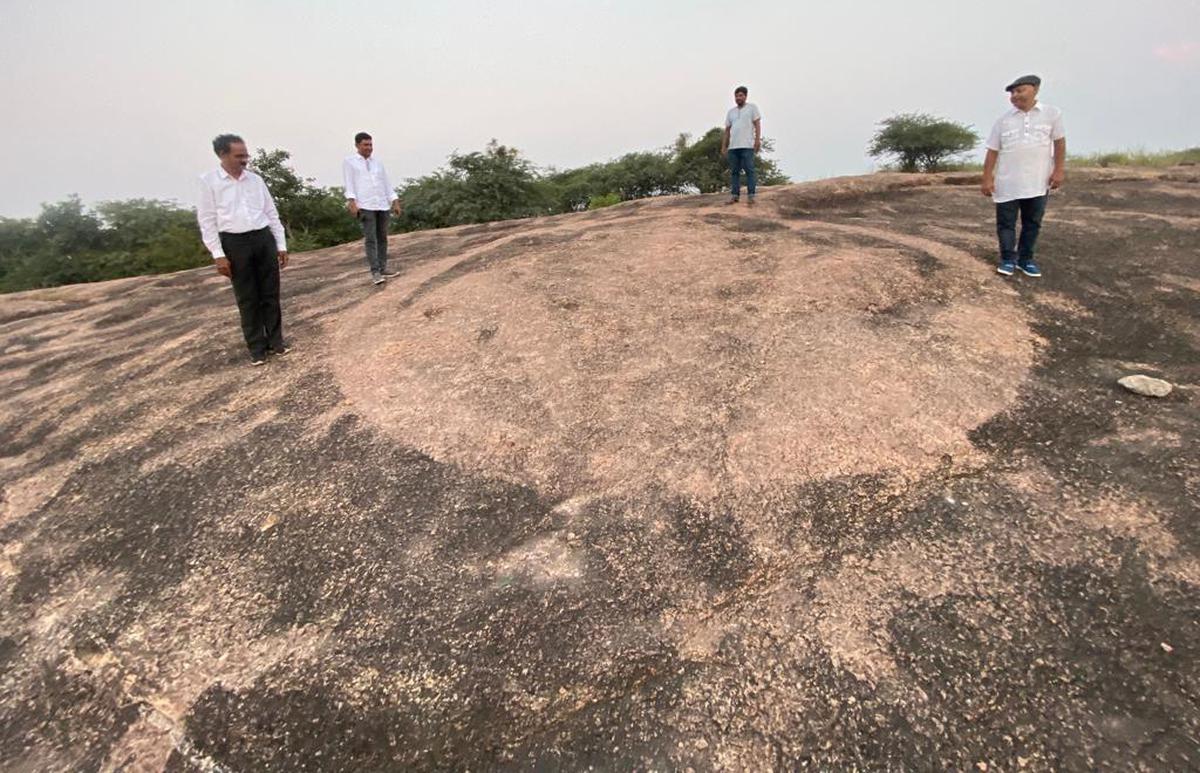
- Etched on a low-lying granitoid hillock, the geoglyph spans 7.5 metres in diameter and has a perfect circular shape.
- Surrounding the circle is a 30-centimetre-wide rim, and within the circle are two triangles.
- It is dated to the Iron Age, specifically around 1000 BCE.
- It is suggested that this circle might have served as a model for megalithic communities in planning their circular burial sites.


Key facts about Nazca Lines
- The lines are a group of massive geoglyphs in southern Peru’s Nazca Desert.
- Experts estimate that they were designed anywhere in the period from 500 BCE to 500 CE.
- Some of the lines are straight, while others depict designs of animals and plants.
- All the lines have a combined length of more than 808 miles, while they cover an area of around 19 square miles.
- An individual design has a width of between 0.2 and 0.7 miles.
- All the designs were made by removing the top layer of soil. The depth of a line is anywhere between four and six inches.
- Some of the shapes are visible from a height of as much as 1,500 feet.
- The preservation of the lines over the years can be attributed to the dry and windless climate of the region.
Q1) What are clastic rocks?
Clastic rocks are the broken bits and pieces of older rocks that lithified (turn to stone) and became new rocks. The broken bits and pieces of older rocks are clasts. Clasts can be as tiny as the dust on the sill of a window or large boulder.
Source: ‘3,000-year-old Iron Age’ geoglyph circle discovered in Telangana

 Last updated on Sep, 2026
→ UPSC 2027 Notification will be released on 13 January 2027 at upsconline.nic.in.
→ Check out the latest UPSC Syllabus here.
→ Download UPSC Model Answers for Mains 2026
→ UPSC Mains Question Paper 2026 is out now for Essay & GS Paper 1, 2, 3 & 4.
→ UPSC Calendar 2027 has been released.
→ Enroll in Vajiram & Ravi’s UPSC Mains Test Series 2027 for structured answer writing practice, expert evaluation, and exam-oriented feedback.
→ Join Vajiram & Ravi’s UPSC Mentorship Program 2027 for personalized guidance, strategy planning, and one-to-one support from experienced mentors.
→ Go through the UPSC Mains Previous Year Papers to enhance your preparation.
→ UPSC has released UPSC Toppers List 2025 with the Civil Services final result on its official website.
→ Also check Best UPSC Coaching in India