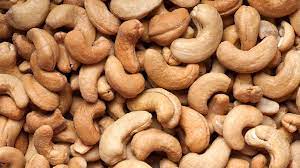
About Cashew Crop
- It is native to Brazil in Latin America and was introduced to India by the Portuguese in the 16th century (1570).
- Climatic condition
- Soil and climate: Well-drained deep sandy loam soils are the best for growing cashew. In general, all soils from sandy to laterite are well suited for this crop.
- It is very well adapted to Indian coastal area under hot humid conditions
- Temperature: In the range of 20 to38 o C, relative humidity in the range of 60 to 95%.
- Rainfall: Annual precipitation in the range of 2000 to 3500 mm.
- Extreme low temperature and frost are not conducive to raise cashew plantations.
- The cultivation of this crop is being extended to non-traditional areas in the plains of Karnataka, Madhya Pradesh, Chattisgarh and some parts of North East hill region.
- India, holds the second-largest share in the world’s cashew nut production and export
- The country’s top export destinations include the UAE, the Netherlands, Japan, and Saudi Arabia.
Key facts about Agricultural and Processed Food Products Export Development Authority (APEDA)
- It was established by the Government of India under the Agricultural and Processed Food Products Export Development Authority Act of 1985.
- It works under the Ministry of Commerce and Industry.
- Objective: To develop and promote the export of scheduled products.
- The products specified under the APEDA ACT are called scheduled products, and exporters of such scheduled products are required to register under APEDA.
- It provides financial assistance, information, and guidelines for the development of scheduled products.
Q1) What Is Sandy Loam Soil?
It is a type of soil that is made up of sand, silt, and clay. The sand comprises the largest amount, followed by silt, with a smaller part of clay.Sand particles are generally more solid and larger than other types of soil particles, and this allows water to move through them more freely. Silt and clay retain water long enough for the plants to receive nutrients.
Source: APEDA gears up to bring back India’s glory in cashew export


 Last updated on Oct, 2026
→ UPSC 2027 Notification will be released on 13 January 2027 at upsconline.nic.in.
→ Asian Games 2026 are being held in Aichi-Nagoya, Japan, from 19 September to 4 October.
→ Check Nobel Prize 2026 Winners List here.
→ Download PIB PRiSM Monthly Magazine 2026 here.
→ Check UPSC Monthly Current Affairs Magazine The Recitals here.
→ Check out the latest UPSC Syllabus here.
→ Download UPSC Model Answers for Mains 2026
→ UPSC Mains Question Paper 2026 is out now for Essay & GS Paper 1, 2, 3 & 4.
→ UPSC Calendar 2027 has been released.
→ Enroll in Vajiram & Ravi’s UPSC Mains Test Series 2027 for structured answer writing practice, expert evaluation, and exam-oriented feedback.
→ Join Vajiram & Ravi’s UPSC Mentorship Program 2027 for personalized guidance, strategy planning, and one-to-one support from experienced mentors.
→ Go through the UPSC Mains Previous Year Papers to enhance your preparation.
→ UPSC has released UPSC Toppers List 2025 with the Civil Services final result on its official website.
→ Also check Best UPSC Coaching in India