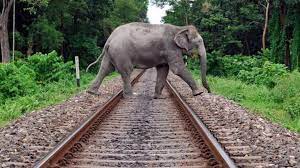
About Gajraj Suraksha
- It uses an AI-based algorithm and a network of sensitive optical fibre cables to detect elephants getting close to railway tracks.
- It aims to address the issue of elephant fatalities resulting from train accidents.
- Working
- Gajraj Suraksha senses pressure waves generated by the movement of elephants along the tracks.
- As elephants move, the optical fibres detect vibrations caused by their footsteps.
- These vibrations trigger signals within the optical fibre network, enabling the system to identify the presence of elephants up to 200 meters ahead of their arrival on the track.
- The OFC-based Intrusion Detection System works by sending alarms to station masters whenever movement is detected along the tracks.
- The network is designed in such a way that it can track the movement of the elephant with great accuracy and report it to nearby station masters.
- This allows them to promptly inform locomotive drivers in the affected areas.
- This quick communication ensures that trains can be slowed down or stopped, preventing potential collisions with elephants.
- Indian railway is planning to introduce this system in West Bengal, Odisha, Jharkhand, Assam, Kerala, certain parts of Chhattisgarh, and Tamil Nadu.
Q1) What are optical fibres ?
These are made of thin, cylindrical strands of glass with a diameter of a typical fibre is close to the diameter of human hair. These fibres can carry information, such as text, images, voices, videos, telephone calls, and anything that can be encoded as digital information, across large distances almost at the speed of light. They are strong, light, and flexible, and ideal to be buried underground, drawn underwater, or bent around a spool.


 Last updated on Sep, 2026
→ UPSC 2027 Notification will be released on 13 January 2027 at upsconline.nic.in.
→ Check out the latest UPSC Syllabus here.
→ Download UPSC Model Answers for Mains 2026
→ UPSC Mains Question Paper 2026 is out now for Essay & GS Paper 1, 2, 3 & 4.
→ UPSC Calendar 2027 has been released.
→ Enroll in Vajiram & Ravi’s UPSC Mains Test Series 2027 for structured answer writing practice, expert evaluation, and exam-oriented feedback.
→ Join Vajiram & Ravi’s UPSC Mentorship Program 2027 for personalized guidance, strategy planning, and one-to-one support from experienced mentors.
→ Go through the UPSC Mains Previous Year Papers to enhance your preparation.
→ UPSC has released UPSC Toppers List 2025 with the Civil Services final result on its official website.
→ Also check Best UPSC Coaching in India