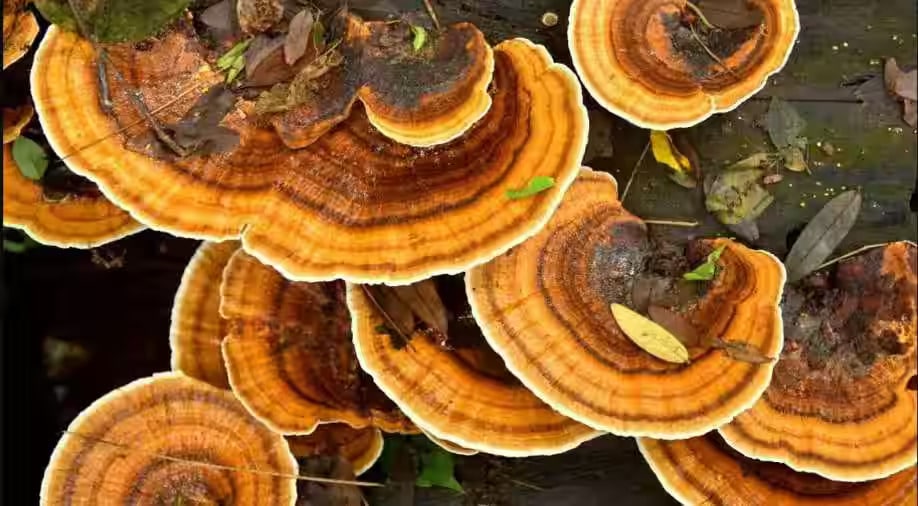
About Potteromyces asteroxylicola
- It was found infecting the ancient plant Asteroxylon mackiei, showcasing a predator-prey interaction that occurred while the plant was alive.
- The unique reproductive structures of Potteromyces, known as conidiophores, stood out with their unusual shape and formation, leading to its designation as a new species.
- Its reproductive structures, known as conidiophores, had an unusual shape and formation.
- Rhynie Chert site in Scotland is known for its well-preserved Early Devonian communities of plants and animals, including fungi and bacteria.
What is Devonian Period?
- It spans between about 419.2 million and 358.9 million years ago.
- It is sometimes called the “Age of Fishes” because of the diverse, abundant and in some cases, bizarre types of these creatures that swam Devonian seas.
- Forests and the coiled shell-bearing marine organisms known as ammonites first appeared early in the Devonian.
- Late in the period the first four-legged amphibians appeared, indicating the colonization of land by vertebrates.
- During the Devonian, there were three major continental masses: North America and Europe sat together near the equator, with much of their current area covered by shallow seas. To the north lay a portion of modern Siberia. A composite continent of South America, Africa, Antarctica, India, and Australia dominated the southern hemisphere.
Q1) Where do fungi grow?
Fungi grow in a wide variety of environments around the globe. Most fungi are terrestrial and are found in all temperate and tropical areas. A few species live in the Arctic and Antarctic regions, usually as part of lichens. Soil rich in organic matter is an ideal habitat for many species, and only a small number of fungi are found in drier areas or in habitats with little or no organic matter.
Source: 407-million year-old disease-causing fungus unveiled at Natural History Museum


 Last updated on Sep, 2026
→ UPSC 2027 Notification will be released on 13 January 2027 at upsconline.nic.in.
→ Asian Games 2026 are being held in Aichi-Nagoya, Japan, from 19 September to 4 October.
→ Check out the latest UPSC Syllabus here.
→ Download UPSC Model Answers for Mains 2026
→ UPSC Mains Question Paper 2026 is out now for Essay & GS Paper 1, 2, 3 & 4.
→ UPSC Calendar 2027 has been released.
→ Enroll in Vajiram & Ravi’s UPSC Mains Test Series 2027 for structured answer writing practice, expert evaluation, and exam-oriented feedback.
→ Join Vajiram & Ravi’s UPSC Mentorship Program 2027 for personalized guidance, strategy planning, and one-to-one support from experienced mentors.
→ Go through the UPSC Mains Previous Year Papers to enhance your preparation.
→ UPSC has released UPSC Toppers List 2025 with the Civil Services final result on its official website.
→ Also check Best UPSC Coaching in India