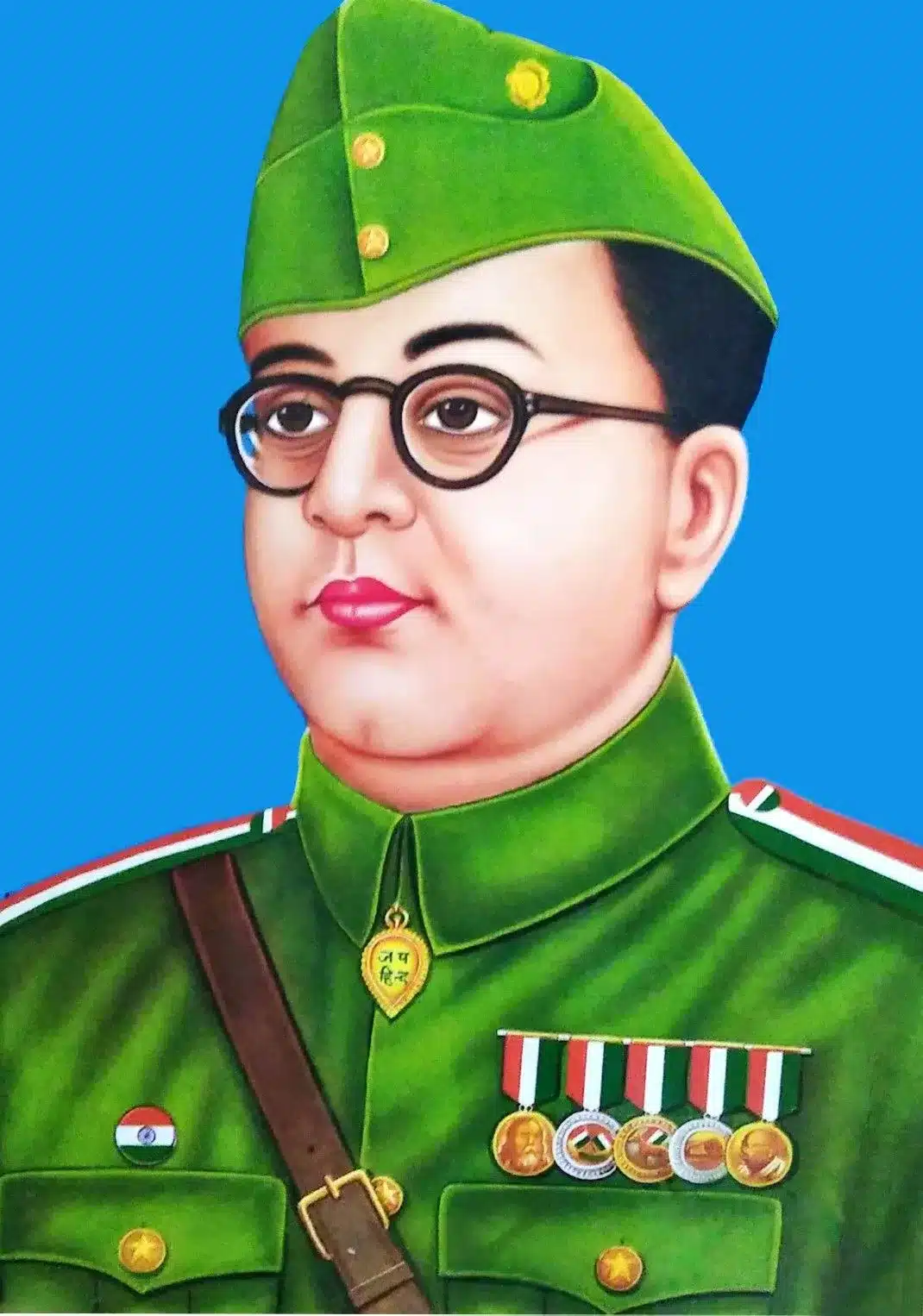
About Netaji Subhas Chandra Bose
- He was an Indian nationalist leader who was a key figure in the Indian independence movement against British colonial rule.
- He was born on January 23, 1897, in Cuttack, Orissa.
- In 1920, he passed the civil service examination, but in April 1921, after hearing of the nationalist turmoil in India, he resigned from his position.
- Bose then joined the Indian National Congress and actively participated in the Indian independence movement.
- Bose at first worked with C.R. Das in Bengal, under whose mentorship he flowered.
- He was a close associate of Mahatma Gandhi and Jawaharlal Nehru.
- Bose was elected president of the Indian National Congress for two consecutive terms but resigned from the post following ideological conflicts with Mahatma Gandhi.
- In 1939, he formed the Forward Bloc, an organization aimed at unifying all the anti-British forces in India.
- Netaji was strongly influenced by Swami Vivekananda’s teaching and was known for his patriotic zeal as a student.
- At the outset of the Second World War, he fled from India and traveled to the Soviet Union, Germany and Japan, seeking an alliance with the aim of attacking the British in India.
- With Japanese assistance, he reorganized and later led the Indian National Army, formed from Indian prisoners-of-war and plantation workers from Malaya, Singapore, and other parts of Southeast Asia, against British forces.
- With Japanese monetary, political, diplomatic, and military assistance, he formed the Azad Hind Government in exile, and regrouped, and led the Indian National Army in battle against the allies at Imphal and in Burma.
- He is believed to have died on August 18, 1945, in a plane crash over Taiwan. The exact circumstances of his death are still shrouded in mystery and controversy.
Q1) Who was Swami Vivekananda?
Swami Vivekananda (1863 – 1902), born Narendranath Datta,was a Hindu monk and one of the most celebrated spiritual leaders of India. He was the foremost disciple of Sri Ramakrishna Paramhamsa and a world spokesperson for Vedanta. He was hailed as a Dhyana Sidha, a meditation expert, by his guru Ramakrishna Paramhamsa. He attempted to combine Indian spirituality with Western material progress, maintaining that the two supplemented and complemented one another. He believed that the path to self-purification is through helping others. He encouraged people to engage in selfless service
Source: Supreme Court dismisses plea seeking to declare Netaji as ‘son of the nation’


 Last updated on Oct, 2026
→ UPSC 2027 Notification will be released on 13 January 2027 at upsconline.nic.in.
→ Asian Games 2026 are being held in Aichi-Nagoya, Japan, from 19 September to 4 October.
→ Check out the latest UPSC Syllabus here.
→ Download UPSC Model Answers for Mains 2026
→ UPSC Mains Question Paper 2026 is out now for Essay & GS Paper 1, 2, 3 & 4.
→ UPSC Calendar 2027 has been released.
→ Enroll in Vajiram & Ravi’s UPSC Mains Test Series 2027 for structured answer writing practice, expert evaluation, and exam-oriented feedback.
→ Join Vajiram & Ravi’s UPSC Mentorship Program 2027 for personalized guidance, strategy planning, and one-to-one support from experienced mentors.
→ Go through the UPSC Mains Previous Year Papers to enhance your preparation.
→ UPSC has released UPSC Toppers List 2025 with the Civil Services final result on its official website.
→ Download PIB PRiSM Monthly Magazine 2026 here.
→ Also check Best UPSC Coaching in India