About Sponge farming
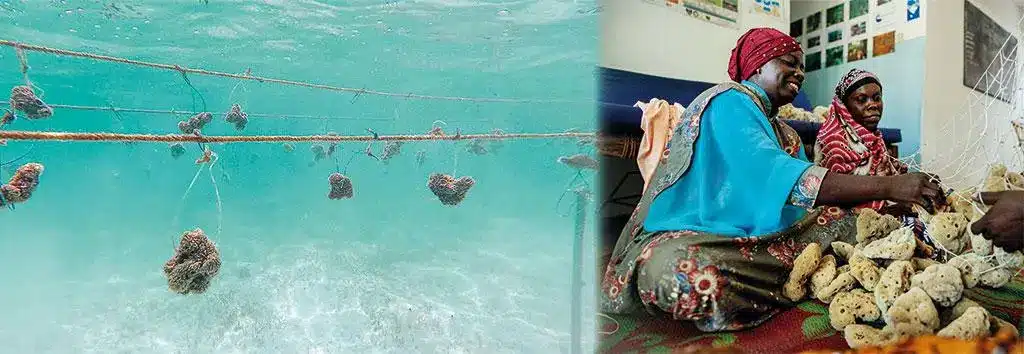
- Sponge farming is a relatively new business opportunity that does not harm the marine environment.
- A sponge is a living animal which is made of loosely arranged cells that surround a skeleton of fibres.
- The specialised cells nestled within thousands of tiny chambers act as microscopic pumps, and tirelessly drawing water into the sponge’s body with their whip-like tails.
- Sponges provide homes for many other animals, plants, and microorganisms. In many cases, they all work together in a mutual symbiotic relationship.
- Sea sponges exist in all oceans around the world and make up 20% of the global silicon biological sink.
- This unique pumping mechanism, which helps sponges extract nutrition and oxygen, also purifies the ocean water by removing impurities, including sewage.
- Uniqueness: Sponges, unlike seaweed, possess remarkable resilience to climate change, require minimal maintenance, and command premium market prices,
- Reproduction: Most sponges are hermaphrodites, harbouring both male and female reproductive organs, enabling them to self-propagate effortlessly.
- New sponges emerge from small buds that detach from the parent sponge and begin independent growth.
- Even damaged or fragmented sponges can regenerate into new individuals.
- This remarkable regenerative ability underpins the ease and feasibility of commercial sponge farming.
- Uses:
- These sponges are used for bathing and general hygiene because they are naturally antibacterial and antifungal and can resist odours.
- Research has also shown that the spongy creatures play an important role themselves in combating climate change.
- Their skeletons break down into microscopic pieces of silicon, which helps control the carbon cycle in the ocean and reduces the greenhouse effect.
- Dissolved silicon is critical for the growth of diatoms, tiny organisms which absorb large amounts of CO2 in the ocean using photosynthesis.
Q1) What is a Symbiotic relationship?
It is the close associations formed between pairs of species. They come in a variety of forms, such as parasitism (where one species benefits and the other is harmed) and commensalism (where one species benefits and the other is neither harmed nor helped).
Source: Saved by sponge


 Last updated on Oct, 2026
→ UPSC 2027 Notification will be released on 13 January 2027 at upsconline.nic.in.
→ Asian Games 2026 are being held in Aichi-Nagoya, Japan, from 19 September to 4 October.
→ Check Nobel Prize 2026 Winners List here.
→ Download PIB PRiSM Monthly Magazine 2026 here.
→ Check UPSC Monthly Current Affairs Magazine The Recitals here.
→ Check out the latest UPSC Syllabus here.
→ Download UPSC Model Answers for Mains 2026
→ UPSC Mains Question Paper 2026 is out now for Essay & GS Paper 1, 2, 3 & 4.
→ UPSC Calendar 2027 has been released.
→ Enroll in Vajiram & Ravi’s UPSC Mains Test Series 2027 for structured answer writing practice, expert evaluation, and exam-oriented feedback.
→ Join Vajiram & Ravi’s UPSC Mentorship Program 2027 for personalized guidance, strategy planning, and one-to-one support from experienced mentors.
→ Go through the UPSC Mains Previous Year Papers to enhance your preparation.
→ UPSC has released UPSC Toppers List 2025 with the Civil Services final result on its official website.
→ Also check Best UPSC Coaching in India