About Chittorgarh Fort
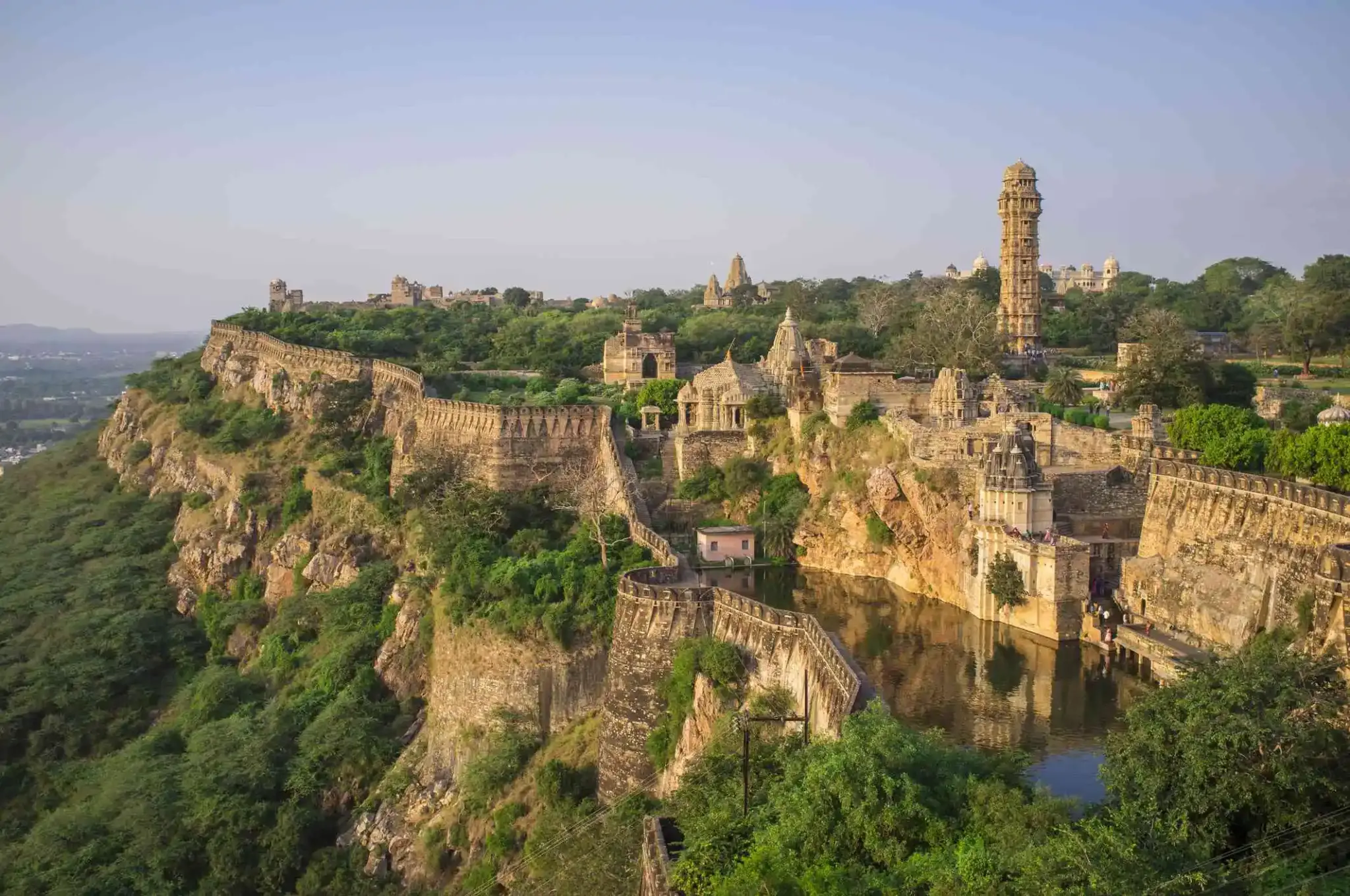
- Built by local Maurya rulers in the 7th century A.D., the Chittorgarh Fort in Rajasthan is one of the largest forts in India.
- The common belief is that Chitrangada Mori, the local Maurya ruler, developed the fort originally. Later, the fort was captured by the Mewar rulers in 728 CE.
- It used to be the capital of the Mewar rulers.
- It is situated on a 180-meter-high hill that rises from the banks of river Berach.
- The Fort has been witness to several legendary warriors in Indian history, including Badal, Gora, Maharana Pratap, Rana Kumbha, Patta, and Jaimal, among others.
- It was declared a UNESCO World Heritage Site in 2013.
- Features:
- The fort is known for its seven gates, namely Padan Gate, Ganesh Gate, Hanuman Gate, Bhairon Gate, Jodla Gate, Lakshman Gate, and the main gate, which is named after Lord Ram.
- These gates were built to protect the fort from the enemy attacks, and the arches even protect the elephants from entering.
- Sprawling across 700 acres and a circumference of 13 km, the fort has a kilometre-long road that takes up to the rampart after passing through the seven gates.
- The walls are made of lime mortar and rise up to 500 metres above ground level.
- The fort houses four palaces, 19 temples, including Jain and Hindu temples, 20 water bodies, and four memorials.
- Jauhar Mela:
- Every year, a Jauhar Mela is held in Chittorgarh.
- This Rajput festival celebrates the anniversary of one of the jauhars.
- Though there’s no specific name given, it is believed that the fair commemorates Rani Padmini’s jauhar and celebrates Rajputana valour.
What is Jauhar?
- Jauhar was a Hindu tradition practiced by Rajput women who wanted to avoid falling into the hands of the enemy.
- Instead of consuming poison, they preferred to burn in flames, as fire symbolised purity.
- It is said that the practice was performed only during wars. The women did this to avoid being enslaved and raped by the invaders.
Q1) What is a UNESCO World Heritage Site?
A World Heritage Site (WHS) is a landmark or area with legal protection by an international convention administered by UNESCO under the UNESCO World Heritage Convention, established in 1972. These sites are designated by UNESCO for having cultural, historical, scientific or other forms of significance.


 Last updated on Sep, 2026
→ UPSC 2027 Notification will be released on 13 January 2027 at upsconline.nic.in.
→ Asian Games 2026 are being held in Aichi-Nagoya, Japan, from 19 September to 4 October.
→ Check out the latest UPSC Syllabus here.
→ Download UPSC Model Answers for Mains 2026
→ UPSC Mains Question Paper 2026 is out now for Essay & GS Paper 1, 2, 3 & 4.
→ UPSC Calendar 2027 has been released.
→ Enroll in Vajiram & Ravi’s UPSC Mains Test Series 2027 for structured answer writing practice, expert evaluation, and exam-oriented feedback.
→ Join Vajiram & Ravi’s UPSC Mentorship Program 2027 for personalized guidance, strategy planning, and one-to-one support from experienced mentors.
→ Go through the UPSC Mains Previous Year Papers to enhance your preparation.
→ UPSC has released UPSC Toppers List 2025 with the Civil Services final result on its official website.
→ Also check Best UPSC Coaching in India