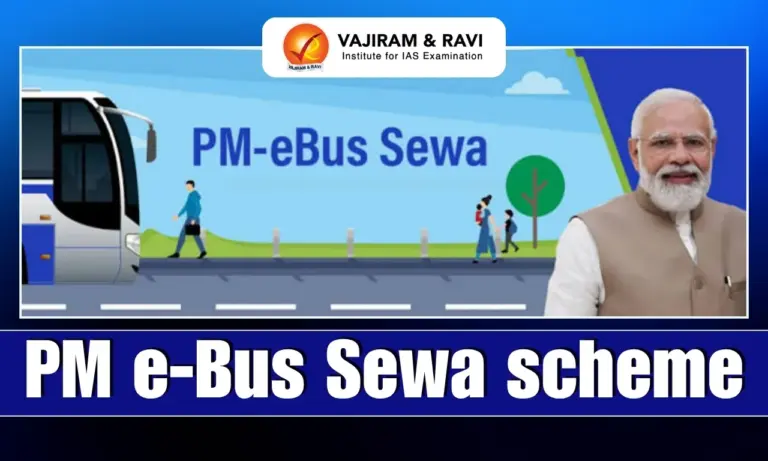
PM-eBus Sewa Scheme Latest News
The Centre’s PM e-Bus Sewa scheme is gathering pace, with more than 500 electric buses now operational across 23 cities and daily ridership crossing one lakh.
About PM-eBus Sewa Scheme
- It aims to strengthen the urban transport system by deployment of 10,000 air-conditioned electric buses to urban cities.
- Eligible Cities: Cities have a population ranging 3-40 lakh and state capitals including North Eastern and Hilly Regions below three lakh population as per 2011 census are eligible for the scheme.
- It is being implemented by the Ministry of Housing and Urban Affairs (MoHUA).


Features of PM-eBus Sewa Scheme
- It focuses on cities with limited public transport capacity and largely covers smaller cities including those where organised city bus services have either been absent or inadequate.
- Under this scheme, city bus operations will be done on a Public Private Partnership (PPP) model.
- This scheme will support bus operations for 10 years.
- States/Cities shall be responsible for running the bus services and making payments to the bus operators.
- The Central Government will support these bus operations by providing subsidies to the extent specified in the proposed scheme.
- It covers development of depots, charging infrastructure, green mobility initiatives including accessible bus stops, last mile connectivity Intelligent Transit Management System (ITMS) and National Common Mobility Card (NCMC)-based ticketing.
Source: NIE

 Last updated on Sep, 2026
→ UPSC 2027 Notification will be released on 13 January 2027 at upsconline.nic.in.
→ Asian Games 2026 are being held in Aichi-Nagoya, Japan, from 19 September to 4 October.
→ Check out the latest UPSC Syllabus here.
→ Download UPSC Model Answers for Mains 2026
→ UPSC Mains Question Paper 2026 is out now for Essay & GS Paper 1, 2, 3 & 4.
→ UPSC Calendar 2027 has been released.
→ Enroll in Vajiram & Ravi’s UPSC Mains Test Series 2027 for structured answer writing practice, expert evaluation, and exam-oriented feedback.
→ Join Vajiram & Ravi’s UPSC Mentorship Program 2027 for personalized guidance, strategy planning, and one-to-one support from experienced mentors.
→ Go through the UPSC Mains Previous Year Papers to enhance your preparation.
→ UPSC has released UPSC Toppers List 2025 with the Civil Services final result on its official website.
→ Also check Best UPSC Coaching in India
PM e-Bus Sewa scheme FAQs
Q1. What is the nodal ministry of PM e-Bus Sewa scheme?+
Q2. .What is th e PM e-Bus Sewa total cost and Central share?+
Tags: pm-ebus sewa scheme prelims pointers upsc current affairs upsc prelims current affairs