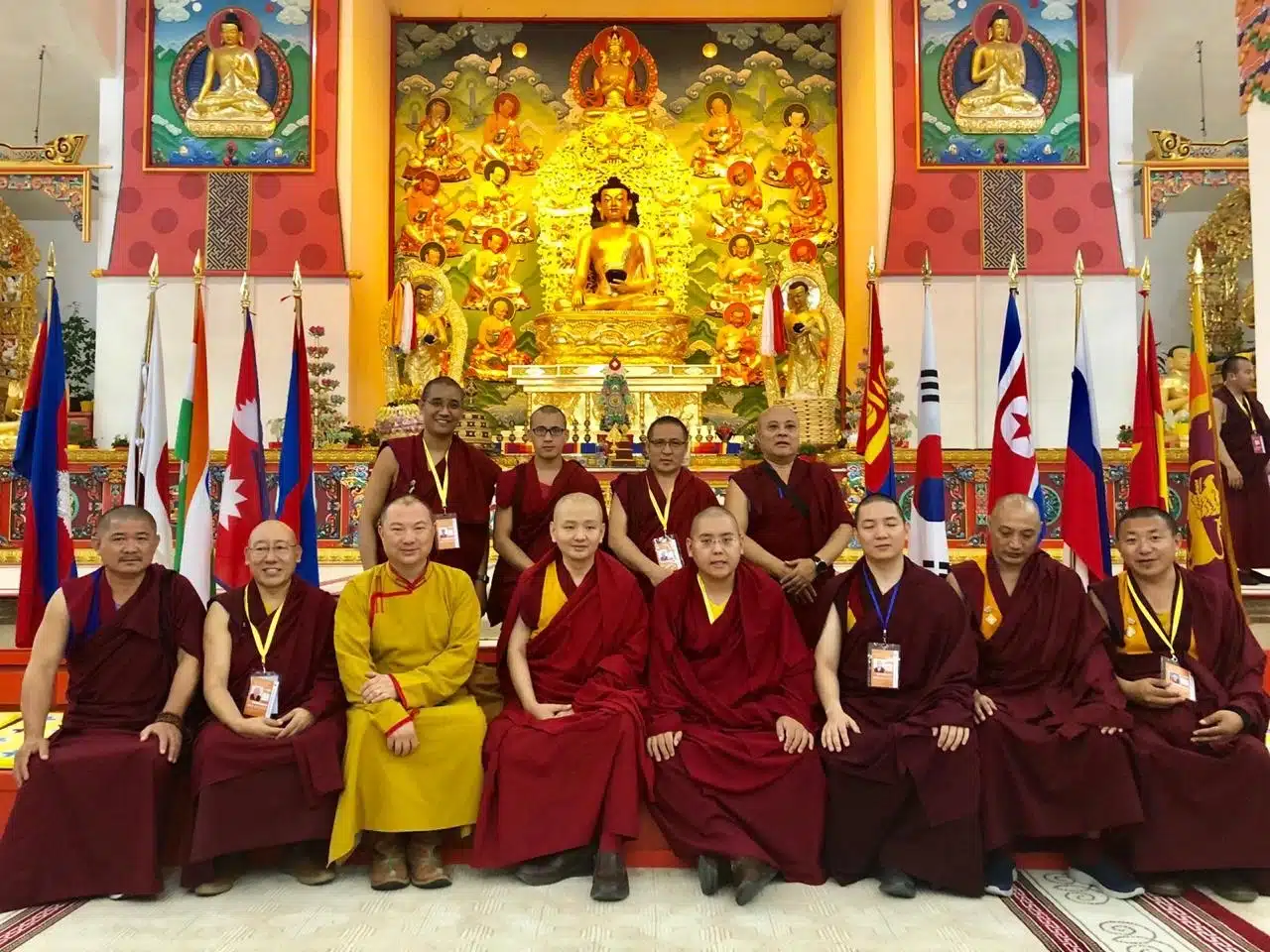
About Asian Buddhist Conference for Peace (ABCP)
- It was founded in 1970 in Ulaanbaatar, Mongolia, as a voluntary movement of followers of Buddhism with both monastic (monks) and lay members.
- Its aim is to bring together the efforts of Buddhists in support of consolidating universal peace, harmony, and cooperation among people in Asia.
- It is currently headquartered at the Gandanthegchenling Monastery in Ulaanbaatar, Mongolia, and the Supreme Head of Mongolian Buddhists is the ABCP President.
- The aims of ABCP: Striving to disseminate and implement the teachings of the Lord Buddha, ABCP aims to:
- Bring together the efforts of Buddhists in support of consolidating universal peace, harmony, and cooperation among the peoples of Asia.
- Furthering their economic and social advancement and promoting respect for justice and human dignity.
- Disseminating the Buddhist culture, tradition, and heritage.
- History:
- The roots of founding of ABCP lay in the Cold War politics of peace movements, and consolidation of allies, and building popular outreach among the masses through various organizations.
- Most Venerable Gabji Samaagiin Gombojav, Khambo Lama of Mongolia, Venerable J. Gomboyev from Buriat, Khambo Lama of the former Soviet Union, Venerable Kushok Bakula Rinpoche from India, and Buddhist leaders from Sri Lanka and Nepal came together and officially founded the Asian Buddhist Conference for Peace (ABCP) in 1970 with a permanent headquarters in Ulaanbaatar.
- It drew active participation from Mongolia, Japan, India, Laos, Vietnam, Cambodia, Bhutan, Russian Far East, Sri Lanka, Thailand, and other regional countries.
- ABCP was registered as an observer to the UN’s Economic and Social Council in 1988 in recognition of its contribution to the well-being of humanity.
Q1) What is the UN’s Economic and Social Council?
Economic and Social Council (ECOSOC) is one of the six principal organs of the United Nations (UN), responsible for the direction and coordination of the economic, social, humanitarian, and cultural activities carried out by the UN. It is the UN’s largest and most complex subsidiary body.


 Last updated on Sep, 2026
→ UPSC 2027 Notification will be released on 13 January 2027 at upsconline.nic.in.
→ Asian Games 2026 are being held in Aichi-Nagoya, Japan, from 19 September to 4 October.
→ Check out the latest UPSC Syllabus here.
→ Download UPSC Model Answers for Mains 2026
→ UPSC Mains Question Paper 2026 is out now for Essay & GS Paper 1, 2, 3 & 4.
→ UPSC Calendar 2027 has been released.
→ Enroll in Vajiram & Ravi’s UPSC Mains Test Series 2027 for structured answer writing practice, expert evaluation, and exam-oriented feedback.
→ Join Vajiram & Ravi’s UPSC Mentorship Program 2027 for personalized guidance, strategy planning, and one-to-one support from experienced mentors.
→ Go through the UPSC Mains Previous Year Papers to enhance your preparation.
→ UPSC has released UPSC Toppers List 2025 with the Civil Services final result on its official website.
→ Also check Best UPSC Coaching in India