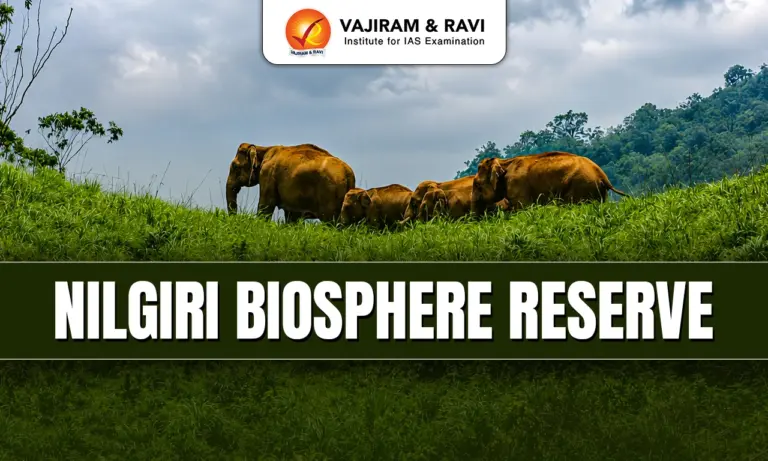
Nilgiri Biosphere Reserve Latest News
Recently, researchers warned that climate change is destabilising Western Ghats’ forest ecosystems in Nilgiri Biosphere Reserve.
About Nilgiri Biosphere Reserve
- Location: It is located in the Nilgiri Mountains of the Western Ghats.
- It encompasses parts of Tamil Nadu, Kerala, and Karnataka.
- It was the first biosphere reserve in India, established in 1986.
- Protected areas within this Reserve: Mudumalai Wildlife Sanctuary, Wyanaad Wildlife Sanctuary, Bandipur National Park, Nagarhole National Park, Mukurthi National Park, and Silent Valley are the
- Vegetation: It has tropical evergreen forests, Montane sholas and grasslands, semi-evergreen forests, moist deciduous forests, dry deciduous forests, and thorn forests.
- Tribal Population: Tribal groups like the Todas, Kotas, Irullas, Kurumbas, Paniyas, Adiyans, Edanadan Chettis, Cholanaickens, Allar, Malayan, etc., are native to the reserve.
- It is India’s first biosphere reserve under UNESCO’s Man and the Biosphere Programme.
- Flora: It mainly includes species of Adenoon, Calacanthus, Baeolepis, Frerea, Jarodina, Wagatea, Poeciloneuron, etc.
- Fauna: It mainly has namely the Nilgiri Tahr and the Lion-tailed macaque and the largest South Indian population of elephant, tiger, gaur, sambar, and chital.
Source: TH


 Last updated on Sep, 2026
→ UPSC 2027 Notification will be released on 13 January 2027 at upsconline.nic.in.
→ Asian Games 2026 are being held in Aichi-Nagoya, Japan, from 19 September to 4 October.
→ Check out the latest UPSC Syllabus here.
→ Download UPSC Model Answers for Mains 2026
→ UPSC Mains Question Paper 2026 is out now for Essay & GS Paper 1, 2, 3 & 4.
→ UPSC Calendar 2027 has been released.
→ Enroll in Vajiram & Ravi’s UPSC Mains Test Series 2027 for structured answer writing practice, expert evaluation, and exam-oriented feedback.
→ Join Vajiram & Ravi’s UPSC Mentorship Program 2027 for personalized guidance, strategy planning, and one-to-one support from experienced mentors.
→ Go through the UPSC Mains Previous Year Papers to enhance your preparation.
→ UPSC has released UPSC Toppers List 2025 with the Civil Services final result on its official website.
→ Also check Best UPSC Coaching in India
Nilgiri Biosphere Reserve FAQs
Q1. When was Nilgiri BR included in UNESCO World Network of Biosphere Reserves?+
Q2. Nilgiri Biosphere Reserve is located at trijunction of which states?+
Tags: Nilgiri Biosphere Reserve