About Manatees:
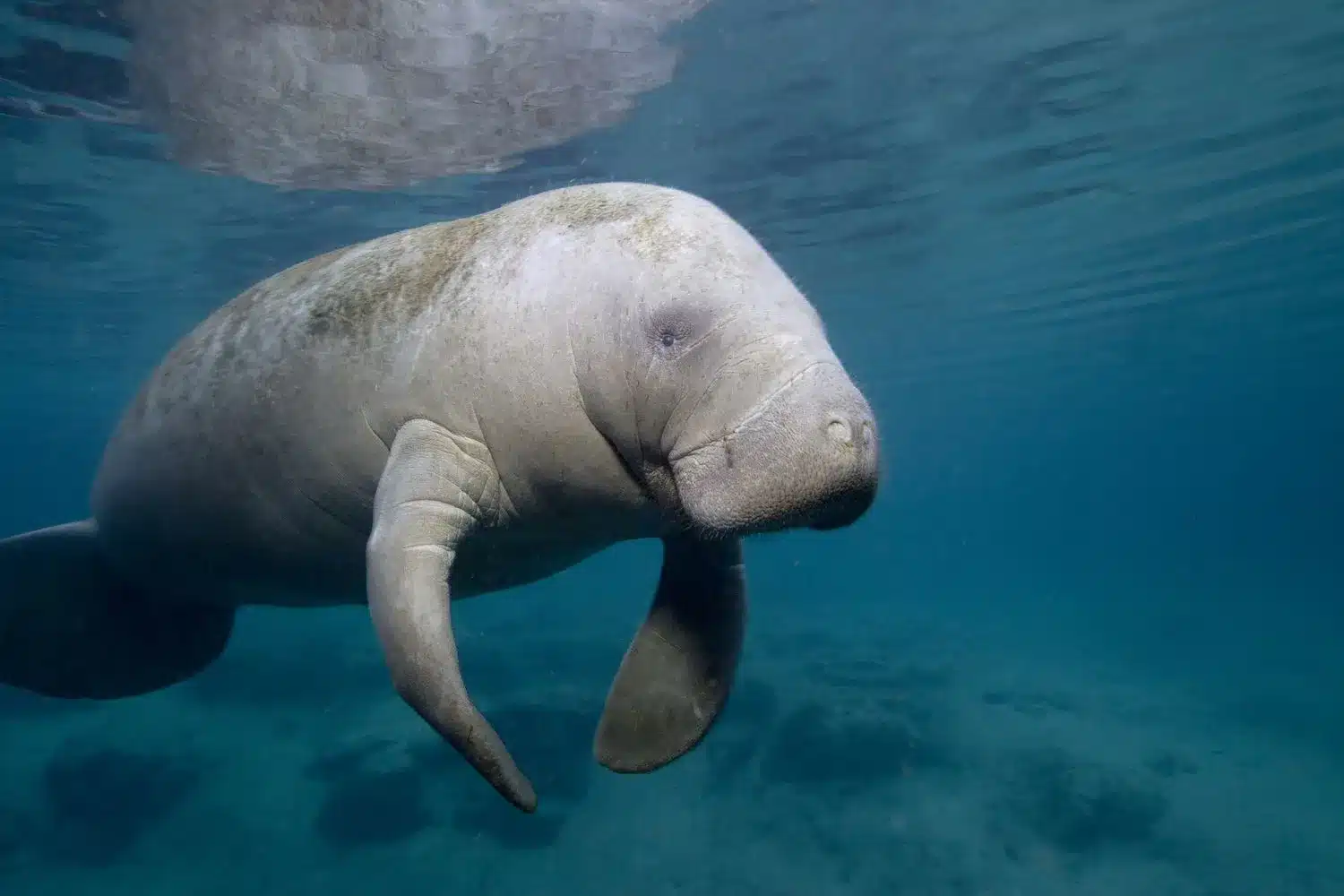
- Manatees are aquatic mammals that belong to a group of animals called Sirenia. This group also contains dugongs.
- Dugongs and manatees are very similar in appearance and behavior, but there is one key difference: their tails.
- Manatees have paddle-shaped tails, and dugongs have fluked tails, giving them a whale-like appearance.
- Habitat: Manatees inhabit shallow, marshy coastal areas and rivers.
- There are three species, or types, of manatee.
- The Amazonian manatee lives in the Amazon River and in fresh water in South America. This species is only found in freshwater.
- The African manatee lives in tropical West Africa.
- The Caribbean manatee is found in Florida and the West Indies.
- Features:
- Adult manatees may reach a length of 15 feet (4.6 meters) and a weight of 1,660 kilograms.
- Dull gray, blackish, or brown in colour, all three manatee species have stout tapered bodies ending in a flat rounded tail used for forward propulsion.
- The forelimbs are modified into flippers; there are no hind limbs.
- In order to breathe, they must swim to the water’s surface for air.
- Lifespan: 50 to 60 years
- They are herbivores. They graze along the seabed and eat seagrasses, giving them the nickname “sea cow”.
- They spend up to eight hours a day grazing and can consume 4 to 9 percent of their body weight in aquatic vegetation daily.
- Apart from mothers and their young, or males following a receptive female, manatees are generally solitary animals.
- Conservation Status: All three manatee species are listed as ‘Vulnerable’ by the IUCN’s Red List of Threatened Species.
Q1: What are Dugongs?
Dugong marine mammal that inhabits the warm coastal waters of the Indian and Pacific Oceans, feeds on seagrasses, and is similar to the manatee. Australia harbors the largest populations, but dugongs also occur along the western coast of Madagascar, along the eastern coast of Africa, in the Red Sea and Persian Gulf, around the Indian subcontinent, and through the western Pacific from Okinawa to northern Australia.
Source: Florida manatees rescued after being stranded on land by Hurricane Helene


 Last updated on Oct, 2026
→ UPSC 2027 Notification will be released on 13 January 2027 at upsconline.nic.in.
→ Asian Games 2026 are being held in Aichi-Nagoya, Japan, from 19 September to 4 October.
→ Check Nobel Prize 2026 Winners List here.
→ Download PIB PRiSM Monthly Magazine 2026 here.
→ Check UPSC Monthly Current Affairs Magazine The Recitals here.
→ Check out the latest UPSC Syllabus here.
→ Download UPSC Model Answers for Mains 2026
→ UPSC Mains Question Paper 2026 is out now for Essay & GS Paper 1, 2, 3 & 4.
→ UPSC Calendar 2027 has been released.
→ Enroll in Vajiram & Ravi’s UPSC Mains Test Series 2027 for structured answer writing practice, expert evaluation, and exam-oriented feedback.
→ Join Vajiram & Ravi’s UPSC Mentorship Program 2027 for personalized guidance, strategy planning, and one-to-one support from experienced mentors.
→ Go through the UPSC Mains Previous Year Papers to enhance your preparation.
→ UPSC has released UPSC Toppers List 2025 with the Civil Services final result on its official website.
→ Also check Best UPSC Coaching in India