About Fourier’s Law
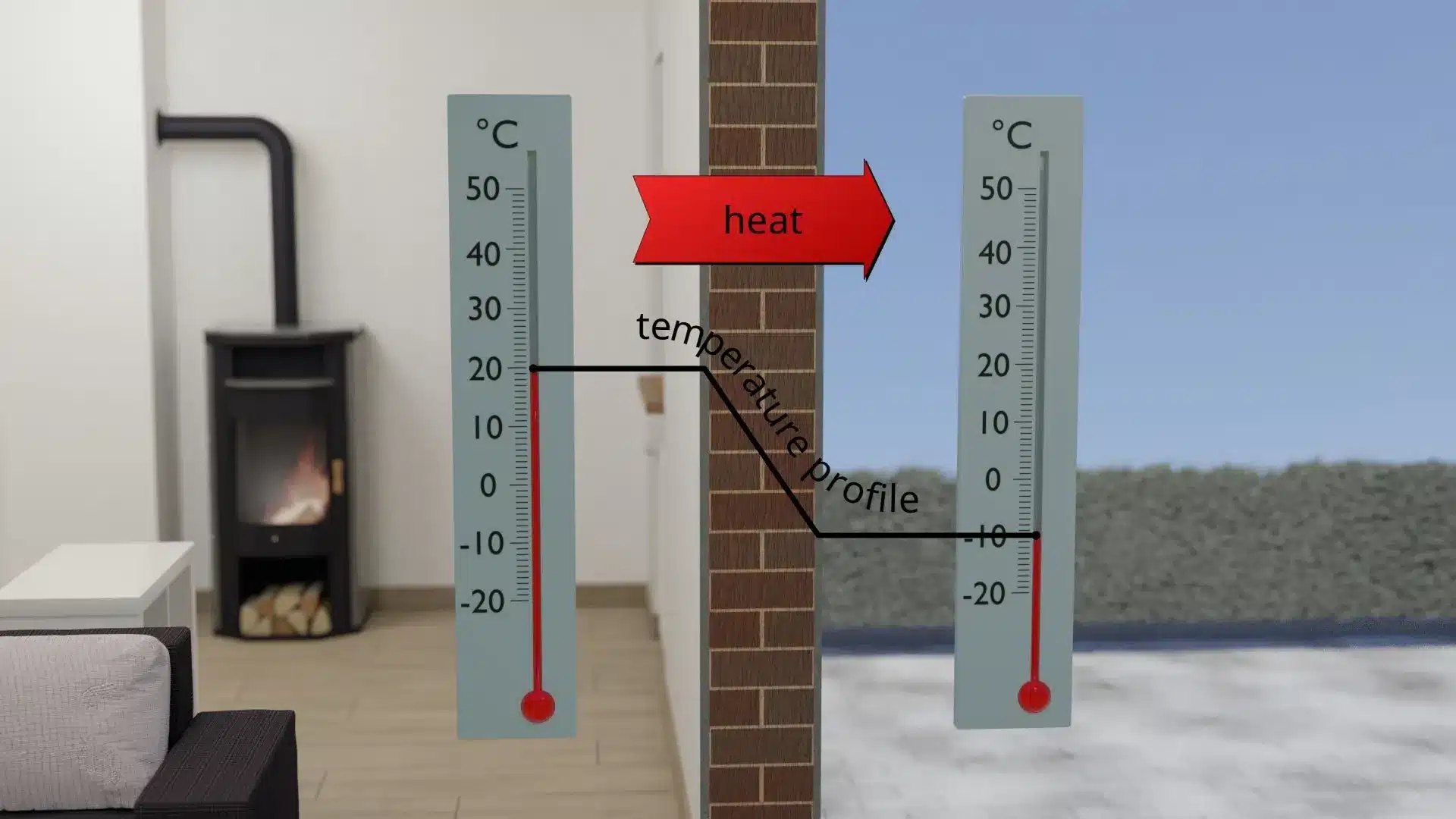
- Fourier’s law, or Law of Heat Conduction, describes how heat is transferred, or conducted, through solid materials.
- As molecules vibrate and electrons shuttle about, the heat diffuses from the hotter end of an object to the colder end.
- It states that the rate of heat conduction through a plane layer is proportional to the temperature gradient across the layer and the heat transfer area of the layer.
- Basically, it is an empirical relation between the rate of heat conduction, heat transfer, and temperature gradient in the direction of heat flow.
- Formula: q = – k▽T, where,
- q is the heat flux, which is expressed as energy per unit area per unit time.
- k is the heat conductivity coefficient (thermal conductivity). The dimension is area per unit time, so typical units for expressing it would be m2/s.
- ∇T is the temperature gradient (K/m).
- The thermal conductivity of the material (k) is also known as the proportionality constant that is obtained in the formula. A high value of k denotes that the material is a good thermal conductor, and easily transfers energy through it.
What is Conduction?
- Conduction is one of the three main ways that heat energy moves from place to place. The other two ways heat moves around are radiation and convection.
- Conduction is the process by which heat energy is transmitted through collisions between neighboring atoms or molecules.
- Conduction occurs more readily in solids and liquids, where the particles are closer together, than in gases, where particles are further apart.
- Anything that involves direct physical contact to transfer heat is an example of conduction.
Q1) What is convection?
Convection is a mode of heat transfer that occurs when heat is carried through a fluid (liquid or gas) due to its movement.In free convection, air or water moves away from the heated body as the warm air or water rises and is replaced by a cooler parcel of air or water. In forced convection, air or water is forcibly moved across the body surface (such as in wind or wind-generated water currents) and efficiently removes heat from the body.
Source: Startling Exception Discovered to 200-Year-Old Law of Physics


 Last updated on August, 2026
→ UPSC Mains 2026 commenced on 21st August 2026 and will continue through 30th August 2026, as per the official examination schedule.
→ UPSC Mains Question Paper 2026 is out now for Essay & GS Paper 1, 2, 3 & 4.
→ UPSC Mains GS Paper 1 2026 is out now.
→ UPSC Mains GS Paper 2 2026 is out now.
→ UPSC Mains GS Paper 3 2026 is out now.
→ UPSC Mains GS Paper 4 2026 is out now.
→ UPSC Mains Indian Language Paper & English Compulsory Paper are out now.
→ Check out the latest UPSC Syllabus 2026 here.
→ UPSC Mains Admit Card 2026 is now out.
→ Enroll in Vajiram & Ravi’s UPSC Mains Test Series 2027 for structured answer writing practice, expert evaluation, and exam-oriented feedback.
→ Join Vajiram & Ravi’s UPSC Mentorship Program 2027 for personalized guidance, strategy planning, and one-to-one support from experienced mentors.
→ Go through the UPSC Mains Previous Year Papers to enhance your preparation.
→ Download UPSC Mains Essay Paper 2025, UPSC Mains GS Paper-I 2025, UPSC Mains GS Paper-II 2025, UPSC Mains GS Paper-III 2025, UPSC Mains GS Paper-IV 2025, UPSC Mains English (Compulsory) Paper 2025, UPSC Mains Hindi (Qualifying) Paper 2025 here.
→ UPSC has released UPSC Toppers List 2025 with the Civil Services final result on its official website.
→ UPSC Calendar 2027 has been released.
→ Also check Best UPSC Coaching in India