PACE Satellite Latest News
Researchers recently found that NASA’s PACE satellite can now detect nitrogen dioxide pollution at a fine enough scale to isolate emissions from individual factories and highway corridors.
About PACE Satellite
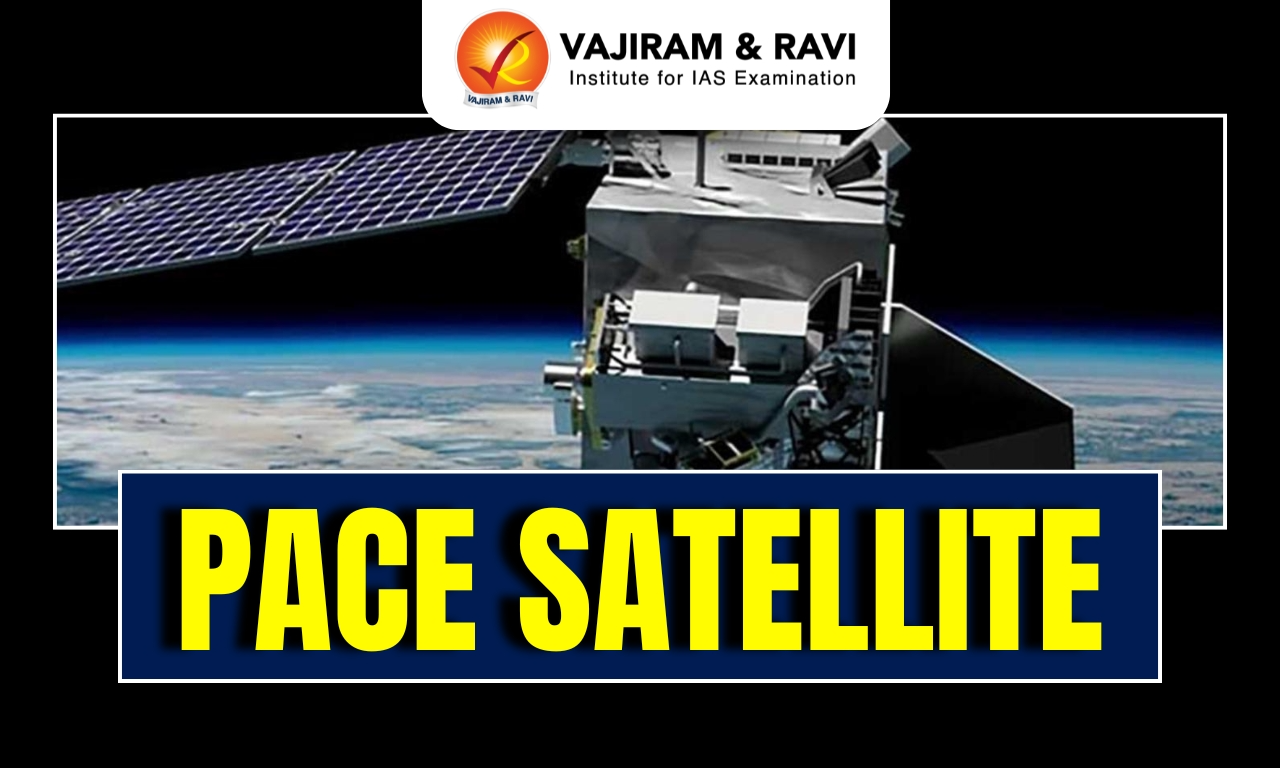
- The Plankton, Aerosol, Cloud, and ocean Ecosystem (PACE) is a NASA satellite mission that studies global ocean biology, aerosols, and clouds.
- It was launched in February 2024 into a Sun-synchronous orbit.
- It provides the world’s first and only hyperspectral coverage of the globe every 1-2 days.
- PACE’s primary instrument is the Ocean Color Instrument (OCI), a highly advanced optical spectrometer to measure the ocean’s colour across a spectrum from ultraviolet to shortwave infrared.
- It enables continuous measurement of light at finer wavelength resolution than previous NASA satellite instruments, extending key system ocean color data records for climate studies.
- It also features two polarimeters – the Spectro-polarimeter for Planetary Exploration (SPEXone) and the Hyper Angular Research Polarimeter (HARP2).
- These are used to measure how the oscillation of sunlight within a geometric plane – known as its polarization – is changed by passing through clouds, aerosols, and the ocean.
- The data from PACE allows researchers to study microscopic life in the ocean and particles in the air, advancing the understanding of issues including fisheries health, harmful algal blooms, air pollution, and wildfire smoke.
- With PACE, scientists also can investigate how the ocean and atmosphere interact with each other and are affected by a changing climate.
Source: EARTH


 Last updated on Oct, 2026
→ UPSC 2027 Notification will be released on 13 January 2027 at upsconline.nic.in.
→ Check Nobel Prize 2026 Winners List here.
→ Download PIB PRiSM Monthly Magazine 2026 here.
→ Check UPSC Monthly Current Affairs Magazine The Recitals here.
→ Check out the latest UPSC Syllabus here.
→ Download UPSC Model Answers for Mains 2026
→ UPSC Mains Question Paper 2026 is out now for Essay & GS Paper 1, 2, 3 & 4.
→ UPSC Calendar 2027 has been released.
→ Enroll in Vajiram & Ravi’s UPSC Mains Test Series 2027 for structured answer writing practice, expert evaluation, and exam-oriented feedback.
→ Join Vajiram & Ravi’s UPSC Mentorship Program 2027 for personalized guidance, strategy planning, and one-to-one support from experienced mentors.
→ Go through the UPSC Mains Previous Year Papers to enhance your preparation.
→ UPSC has released UPSC Toppers List 2025 with the Civil Services final result on its official website.
→ Also check Best UPSC Coaching in India
PACE Satellite FAQs
Q1. Which organization launched the PACE satellite?+
Q2. What is the primary objective of the PACE mission?+
Q3. What is the primary instrument onboard PACE?+
Q4. When was the PACE satellite launched?+
Tags: pace satellite prelims current affairs prelims pointer upsc prelims current affairs