About Tachyons
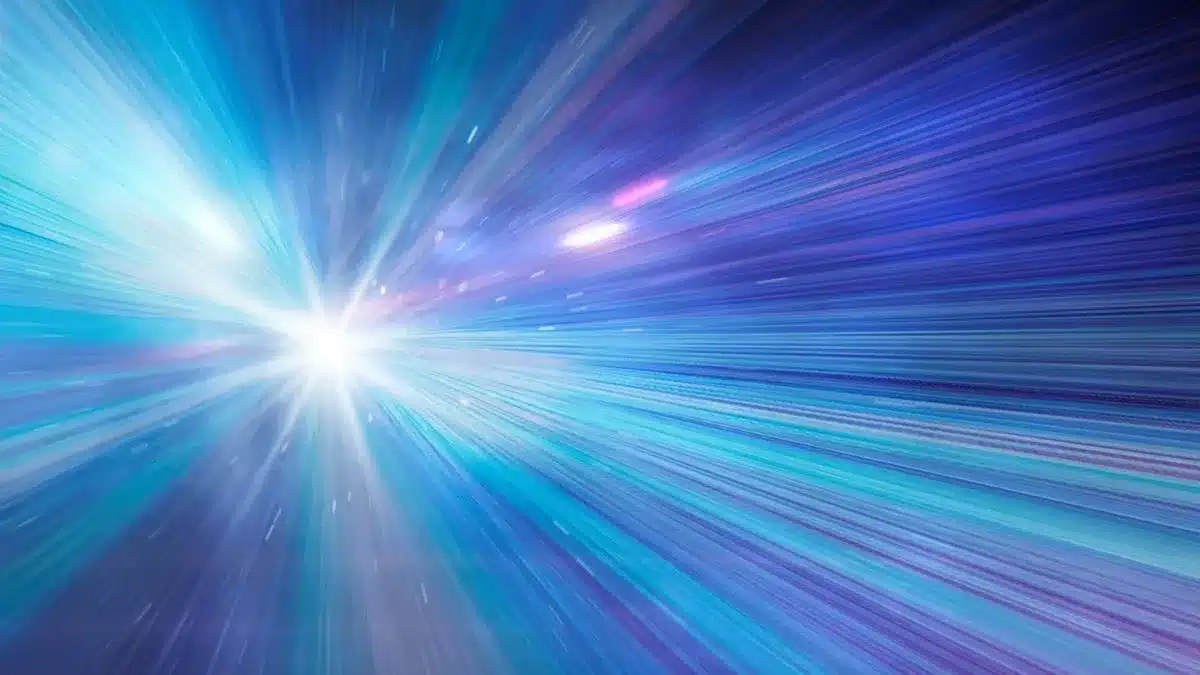
- Tachyons are hypothetical subatomic particles that move faster than the speed of light.
- The term “tachyon” was coined by physicist Gerald Feinberg in 1967.
- They are distinguished from “bradyons,” particles that travel at less than the speed of light.
- While bradyons are familiar and include protons, electrons, and neutrons, tachyons have never been observed.
- According to special relativity, particles with mass cannot reach or exceed the speed of light in a vacuum because their energy would become infinite.
- However, tachyons are thought to have imaginary mass, meaning their mass squared is a negative value. This implies that they could potentially travel faster than light without violating the laws of physics as we currently understand them.
- Tachyons would slow down if they gained energy, and accelerate if they lost energy.
- There have been a few experiments to find tachyons using a detector called a cerenkov detector.
- This detector is able to measure the speed of a particle traveling through a medium.
- Nothing can travel faster than the speed of light in a vacuum. However, in other mediums, particles can potentially move faster than light.
- If a particle travels through a medium at a speed that is greater than light for that medium, cerenkov radiation occurs.
- This is analogous to the sonic boom produced when an airplane travels faster than the speed of sound in air or the shock wave at the bow of a ship.
Q1: What are protons?
The proton is a subatomic particle with a positive electrical charge. They are found in every atomic nucleus of every element. In almost every element, protons are accompanied by neutrons. The only exception is the nucleus of the simplest element, hydrogen. Hydrogen contains only a single proton and no neutrons.


 Last updated on Sep, 2026
→ UPSC 2027 Notification will be released on 13 January 2027 at upsconline.nic.in.
→ Asian Games 2026 are being held in Aichi-Nagoya, Japan, from 19 September to 4 October.
→ Check out the latest UPSC Syllabus here.
→ Download UPSC Model Answers for Mains 2026
→ UPSC Mains Question Paper 2026 is out now for Essay & GS Paper 1, 2, 3 & 4.
→ UPSC Calendar 2027 has been released.
→ Enroll in Vajiram & Ravi’s UPSC Mains Test Series 2027 for structured answer writing practice, expert evaluation, and exam-oriented feedback.
→ Join Vajiram & Ravi’s UPSC Mentorship Program 2027 for personalized guidance, strategy planning, and one-to-one support from experienced mentors.
→ Go through the UPSC Mains Previous Year Papers to enhance your preparation.
→ UPSC has released UPSC Toppers List 2025 with the Civil Services final result on its official website.
→ Also check Best UPSC Coaching in India