


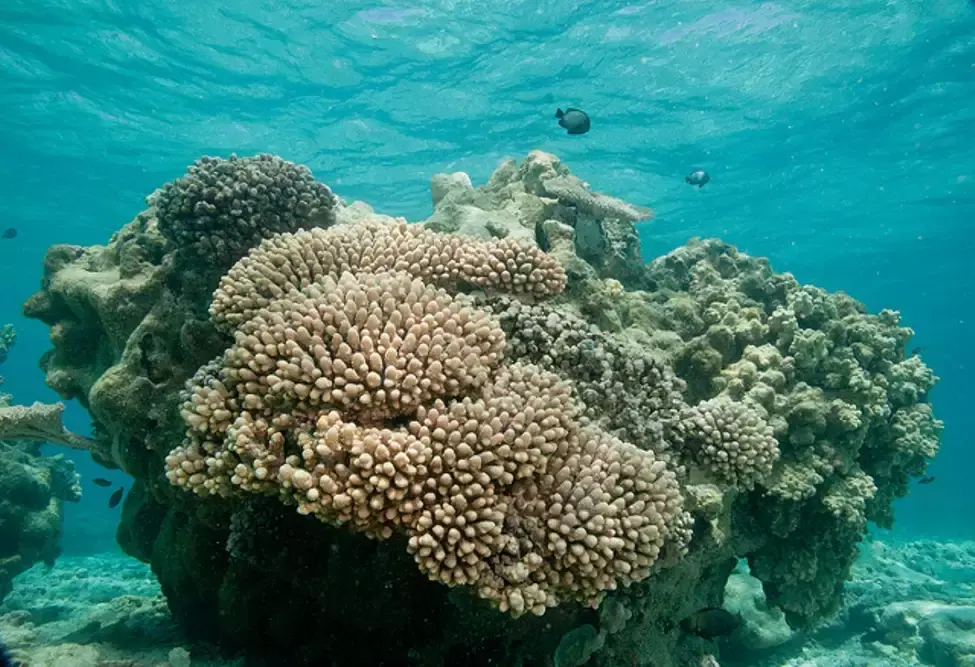
About Corals
- Corals are essentially animals, which are sessile, meaning they permanently attach themselves to the ocean floor.
- Corals share a symbiotic relationship with single-celled algae called zooxanthellae.
- The algae provide the coral with food and nutrients, which they make through photosynthesis, using the sun’s light.
- They use their tiny tentacle-like hands to catch food from the water and sweep into their mouth.
- Each individual coral animal is known as a polyp and it lives in groups of hundreds to thousands of genetically identical polyps that form a ‘colony’.
- Corals are largely classified as either hard coral or soft coral. It is the hard corals that are the architects of coral reefs — complex three-dimensional structures built up over thousands of years.
- Hard corals have stony skeletons made out of limestone that are produced by coral polyps. When polyps die, their skeletons are left behind and used as foundations for new polyps.
- Coral reefs, also referred to as “rainforests of the sea”, have existed on the Earth for nearly 450 million years.
- Significance of corals: Coral reefs have a crucial role in marine ecosystems. Thousands of marine species can be found living on one reef.
What is Coral Bleaching?
- It happens when corals experience stress in their environment due to changes in temperature, pollution or high levels of ocean acidity.
- Under stressed conditions, the zooxanthellae or food-producing algae living inside coral polyps start producing reactive oxygen species, which are not beneficial to the corals.
- So, the corals expel the colour-giving zooxanthellae from their polyps, which exposes their pale white exoskeleton, giving the corals a bleached appearance.
- This also ends the symbiotic relationship that helps the corals to survive and grow.
- Reasons for Coral Bleaching
- Change in Ocean Temperature: Increased Ocean temperature caused by climate change is the leading cause of coral bleaching.
- Runoff and Pollution: Storm generated precipitation can rapidly dilute ocean water and runoff can carry pollutants, which can bleach near shore corals.
- Overexposure to sunlight: When temperatures are high, high solar irradiance contributes to bleaching in shallow water corals.
- Extremely low tides: Exposure to the air during extremely low tides can cause bleaching in shallow corals.
Q1: What is Symbiosis?
It is defined as a close, prolonged association between two or more different biological species. This relationship can be symbiotic (mutualistic), where both parties involved benefit from the interaction, or it can be parasitic, where one party benefits while the other is harmed.
Source: Fourth global mass coral bleaching triggered: What are corals and why are they important?


 Last updated on Sep, 2026
→ UPSC 2027 Notification will be released on 13 January 2027 at upsconline.nic.in.
→ Check out the latest UPSC Syllabus here.
→ Download UPSC Model Answers for Mains 2026
→ UPSC Mains Question Paper 2026 is out now for Essay & GS Paper 1, 2, 3 & 4.
→ UPSC Calendar 2027 has been released.
→ Enroll in Vajiram & Ravi’s UPSC Mains Test Series 2027 for structured answer writing practice, expert evaluation, and exam-oriented feedback.
→ Join Vajiram & Ravi’s UPSC Mentorship Program 2027 for personalized guidance, strategy planning, and one-to-one support from experienced mentors.
→ Go through the UPSC Mains Previous Year Papers to enhance your preparation.
→ UPSC has released UPSC Toppers List 2025 with the Civil Services final result on its official website.
→ Also check Best UPSC Coaching in India








