


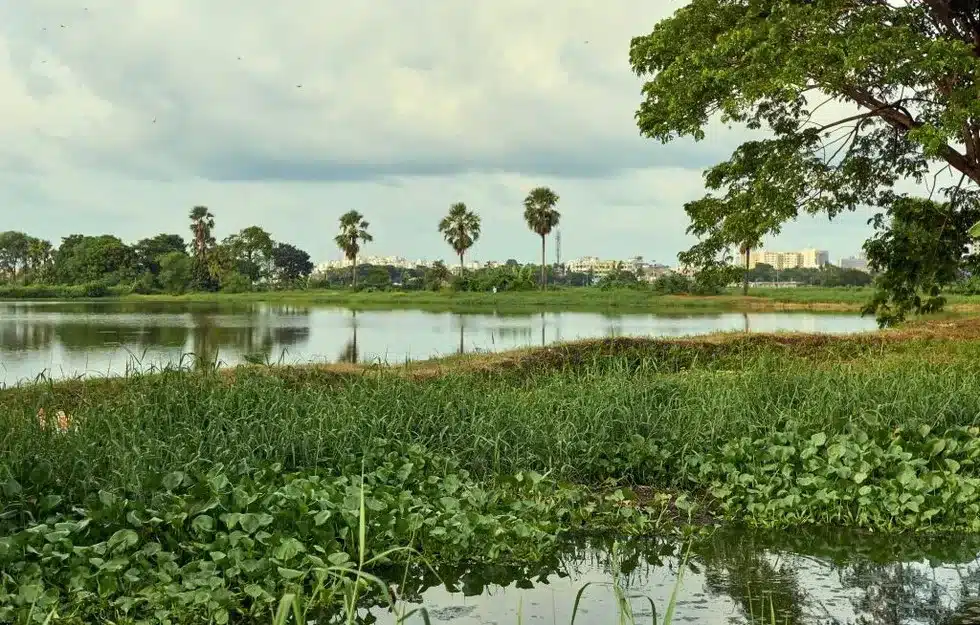
About Constructed wetlands:
- These are engineered structures designed to replicate the functions of natural wetlands.
- They are composed of meticulously chosen vegetation, soil and water, orchestrated to facilitate a seamless process of purification.
- Constructed wetlands are typically divided into two categories:
- Subsurface flow (SSF): These wetlands direct wastewater through gravel beds or porous media, promoting microbial activity that degrades organic matter.
- Surface flow (SF): These wetlands demonstrate their aesthetic appeal above the water’s surface, with gently flowing streams and lush vegetation.
- Objective: To convert pollutants into benign compounds through natural processes.
- Unlike conventional concrete tanks, these wetlands foster biodiversity, welcoming a diverse array of life forms — ranging from microorganisms to aquatic plants and even birds — to engage in the purification process.
- India boasts several remarkable locations where constructed wetlands are utilised for wastewater treatment.
- One such example is the Asola Bhatti Wildlife Sanctuary in Delhi, situated on the city’s outskirts.
- The Kolkata East Wetlands in West Bengal, designated as a Ramsar site, feature a vast network of natural and constructed wetlands.
- Benefits
- Cost-Effectiveness: In contrast to traditional treatment facilities, constructed wetlands frequently offer a more economical option for construction and upkeep.
- Environmental benefits: In addition to their primary role in wastewater treatment, constructed wetlands offer supplementary environmental advantages. They function as habitats for a wide array of plant and animal species, promoting biodiversity conservation.
- Scalability and adaptability: Constructed wetlands are flexible in their scalability, able to be adjusted to fit various industrial operations and spatial limitations.
Q1: What Are Microbes?
Microbes are organisms that are too small to be seen without using a microscope, so they include things like bacteria, archaea, and single cell eukaryotes — cells that have a nucleus, like an amoeba or a paramecium. Sometimes we call viruses microbes too.
Source: Constructed wetlands are nature’s ingenious solution for wastewater treatment in India


 Last updated on Sep, 2026
→ UPSC 2027 Notification will be released on 13 January 2027 at upsconline.nic.in.
→ Check out the latest UPSC Syllabus here.
→ Download UPSC Model Answers for Mains 2026
→ UPSC Mains Question Paper 2026 is out now for Essay & GS Paper 1, 2, 3 & 4.
→ UPSC Calendar 2027 has been released.
→ Enroll in Vajiram & Ravi’s UPSC Mains Test Series 2027 for structured answer writing practice, expert evaluation, and exam-oriented feedback.
→ Join Vajiram & Ravi’s UPSC Mentorship Program 2027 for personalized guidance, strategy planning, and one-to-one support from experienced mentors.
→ Go through the UPSC Mains Previous Year Papers to enhance your preparation.
→ UPSC has released UPSC Toppers List 2025 with the Civil Services final result on its official website.
→ Also check Best UPSC Coaching in India








