


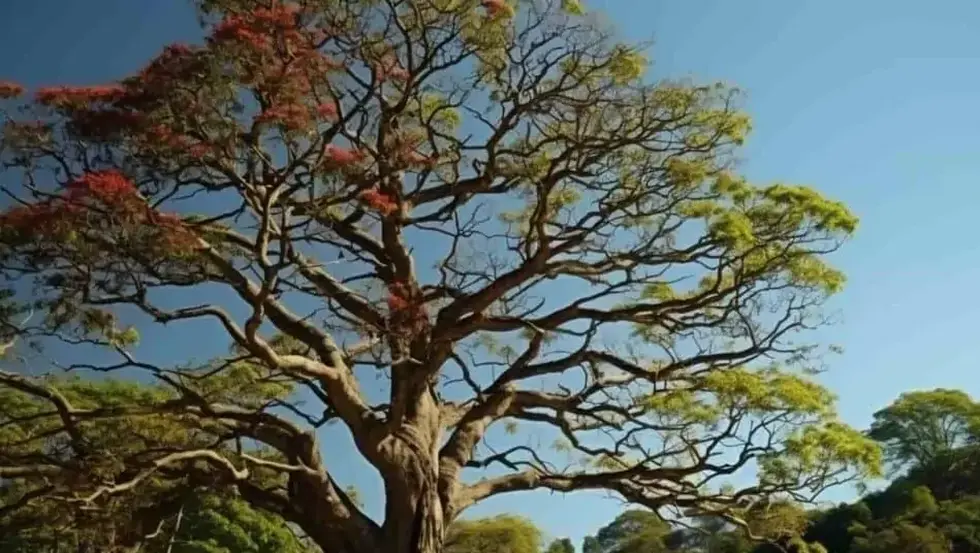
About Silk cotton tree:
- The silk cotton tree (Bombax ceiba L.) is locally known as semal tree.
- It is a lofty deciduous tree with buttressed base when old and the whole trunk is covered with large conical prickles.
- It is mainly found in moist deciduous and semi-evergreen forests, also in the plains
- Occasionally found in plains from the coast, on the deciduous belt of the hills to 1400 m.
- Members of the Garasia tribe in Rajasthan believe they are descended from semal trees.
- Distribution: In India it is seen in Andaman & Nicobar Island, Assam, Bihar, Kerala, Madhya Pradesh, Maharastra, Odisha, Punjab, Rajasthan, Uttar Pradesh.
- Significance of the tree
- It has multiple purposes and is useful to wild animals, insects, and even to tribal communities.
- It is a fire-resistant tree. It is also known for its cooling properties.
- It is considered a pioneer tree that generates a rich biomass every season, and has been used to reclaim wastelands.
- This tree fixes carbon and helps carbon sequestration by shedding all leaves before flowering.
- Many researchers believe the semal to be a bio indicator—a late flowering could mean a hot summer or a delayed monsoon.
- The rock bees nestle on its branches because the tree’s spikes keep its predator, the sloth bears, away.
- Members of tribal communities consume the tree’s reddish root for food during the monsoons.
- It provides opportunities for agroforestry and resources like food, fodder, and fuel wood.
- Members of the Kathodi tribe use its wood to craft musical instruments while those of the Bhil use it to make utensils.
Q1: What is a Bioindicator?
These are living organisms such as plants, planktons, animals, and microbes, which are utilized to screen the health of the natural ecosystem in the environment.
Source: For Udaipur’s Holi, Rajasthan’s semal trees are going up in flames


 Last updated on Sep, 2026
→ UPSC 2027 Notification will be released on 13 January 2027 at upsconline.nic.in.
→ Check out the latest UPSC Syllabus here.
→ Download UPSC Model Answers for Mains 2026
→ UPSC Mains Question Paper 2026 is out now for Essay & GS Paper 1, 2, 3 & 4.
→ UPSC Calendar 2027 has been released.
→ Enroll in Vajiram & Ravi’s UPSC Mains Test Series 2027 for structured answer writing practice, expert evaluation, and exam-oriented feedback.
→ Join Vajiram & Ravi’s UPSC Mentorship Program 2027 for personalized guidance, strategy planning, and one-to-one support from experienced mentors.
→ Go through the UPSC Mains Previous Year Papers to enhance your preparation.
→ UPSC has released UPSC Toppers List 2025 with the Civil Services final result on its official website.
→ Also check Best UPSC Coaching in India








