About Abyssal Plains:
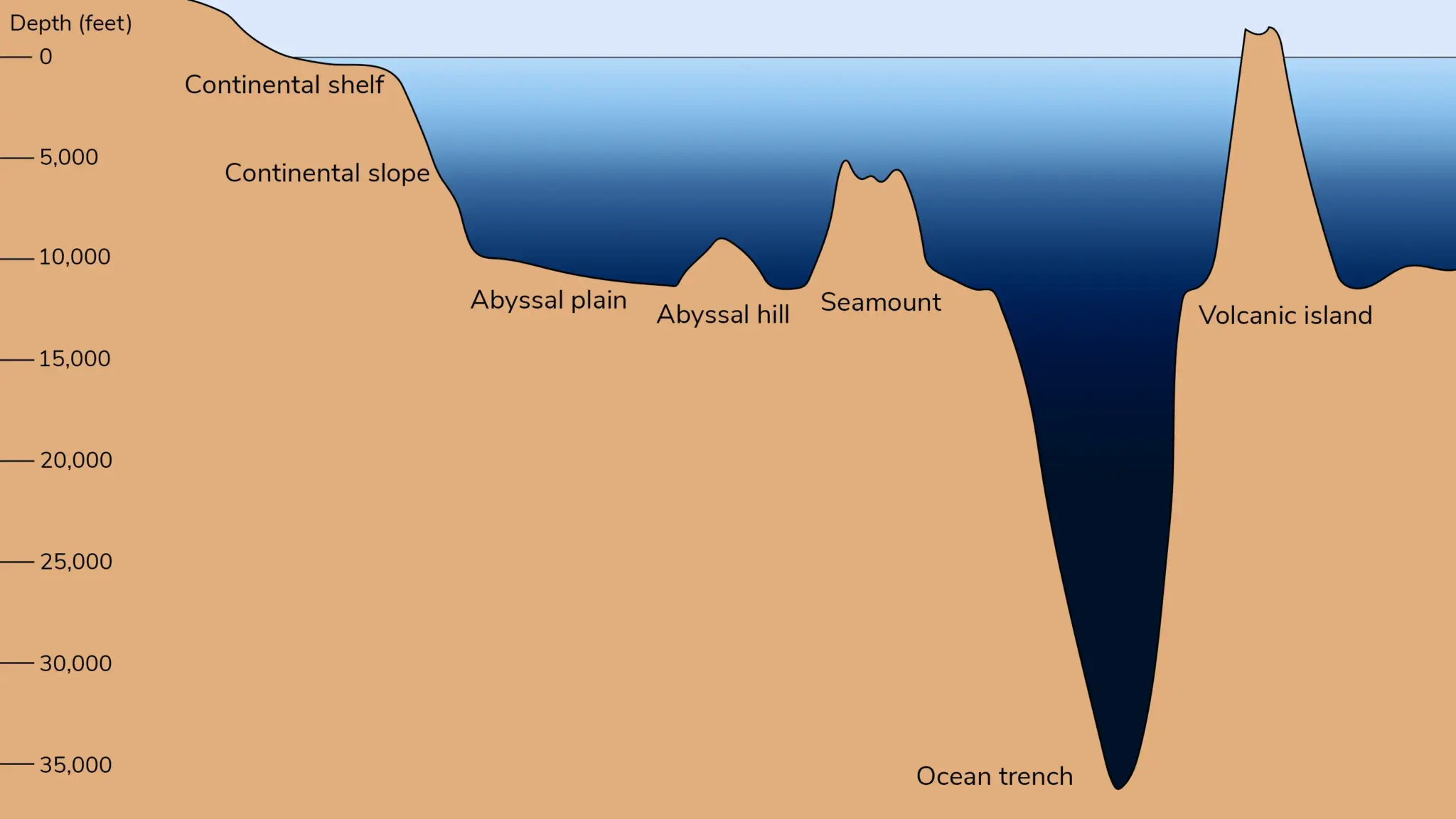
- The term ‘abyssal plain’ refers to a flat region of the ocean floor, usually at the base of a continental rise.
- Depth variation is usually only as much as 10 to 100 centimeters per kilometer of horizontal distance.
- They can range as far as thousands of kilometers, forming huge plateaus beneath the sea.
- Abyssal plains are found on the ocean floor, usually off the coast of major continental coastlines.
- However, there are significantly more abyssal plains in the Atlantic Ocean than in any other.
- Some can be found within the Indian Ocean, but very few exist in areas within the Pacific Ocean.
- Approximately 40% of Earth’s Ocean floor is covered by abyssal plains.
- The largest Abyssal plain on Earth is called the Sohm plain. This plain can be found in the North Atlantic Ocean. It is 900,000 square kilometres.
- Abyssal plains occur at depths greater than 6,500 feet (2,000 meters) below sea level and are underlain by oceanic crust composed primarily of basalt, a dark-colored volcanic rock rich in iron- and magnesium-silicate minerals.
- The basalt is covered by layers of sediment deposited by deep ocean turbidity currents, the shells of marine plants and animals that have fallen down from the ocean’s upper levels, or a combination of both.
- Other minor components of abyssal plain sediment include wind-blown dust, volcanic ash, chemical precipitates, and occasional meteorite fragments.
- Scattered across abyssal plains are abyssal hillsand underwater volcanic peaks called seamounts.
- On the other side of the plain is usually an oceanic trench, where the seafloor dramatically plummets.
Q1: What is continental rise?
Continental rise is a major depositional regime in oceans made up of thick sequences of continental material that accumulate between the continental slope and the abyssal plain. Continental rises form as a result of three sedimentary processes: mass wasting, the deposition from contour currents, and the vertical settling of clastic and biogenic particles.
Source: Mysterious Unknown Deep-Sea Creatures Discovered on Abyssal Expedition


 Last updated on Sep, 2026
→ UPSC 2027 Notification will be released on 13 January 2027 at upsconline.nic.in.
→ Asian Games 2026 are being held in Aichi-Nagoya, Japan, from 19 September to 4 October.
→ Check out the latest UPSC Syllabus here.
→ Download UPSC Model Answers for Mains 2026
→ UPSC Mains Question Paper 2026 is out now for Essay & GS Paper 1, 2, 3 & 4.
→ UPSC Calendar 2027 has been released.
→ Enroll in Vajiram & Ravi’s UPSC Mains Test Series 2027 for structured answer writing practice, expert evaluation, and exam-oriented feedback.
→ Join Vajiram & Ravi’s UPSC Mentorship Program 2027 for personalized guidance, strategy planning, and one-to-one support from experienced mentors.
→ Go through the UPSC Mains Previous Year Papers to enhance your preparation.
→ UPSC has released UPSC Toppers List 2025 with the Civil Services final result on its official website.
→ Also check Best UPSC Coaching in India