Diatoms Latest News
A team of Indian and international researchers discovered a new species of diatom, named Climaconeis heteropolaris.
About Diatoms
- These are photosynthetic, single-celled organisms.
- These are microscopic algae and serve as the base of the aquatic food chain.
- They are a major group of algae and form one of the most common forms of phytoplankton.
- Habitat:
- They are found in almost all aquatic habitats, including lakes, ponds, streams, rivers, and the ocean.
- Most diatoms live as free-floating cells in the open water, but some live on the bottom (benthos), attached to surfaces such as plants or rocks, or in the bottom sediment.
- These surface-attached diatoms represent a significant part of the periphyton, which is a mixture of algae, cyanobacteria, microbes, and detritus that is attached to submerged surfaces.
- Due to their sensitivity towards any water chemistry changes, they are excellent indicators of aquatic health.
- Like other algae, diatoms have no leaves, stems, roots, or flowers, but the cell of every diatom contains chlorophyll, the substance that is responsible for the green color of leafy plants.
- They are the only organism on the planet with cell walls composed of transparent, opaline silica.
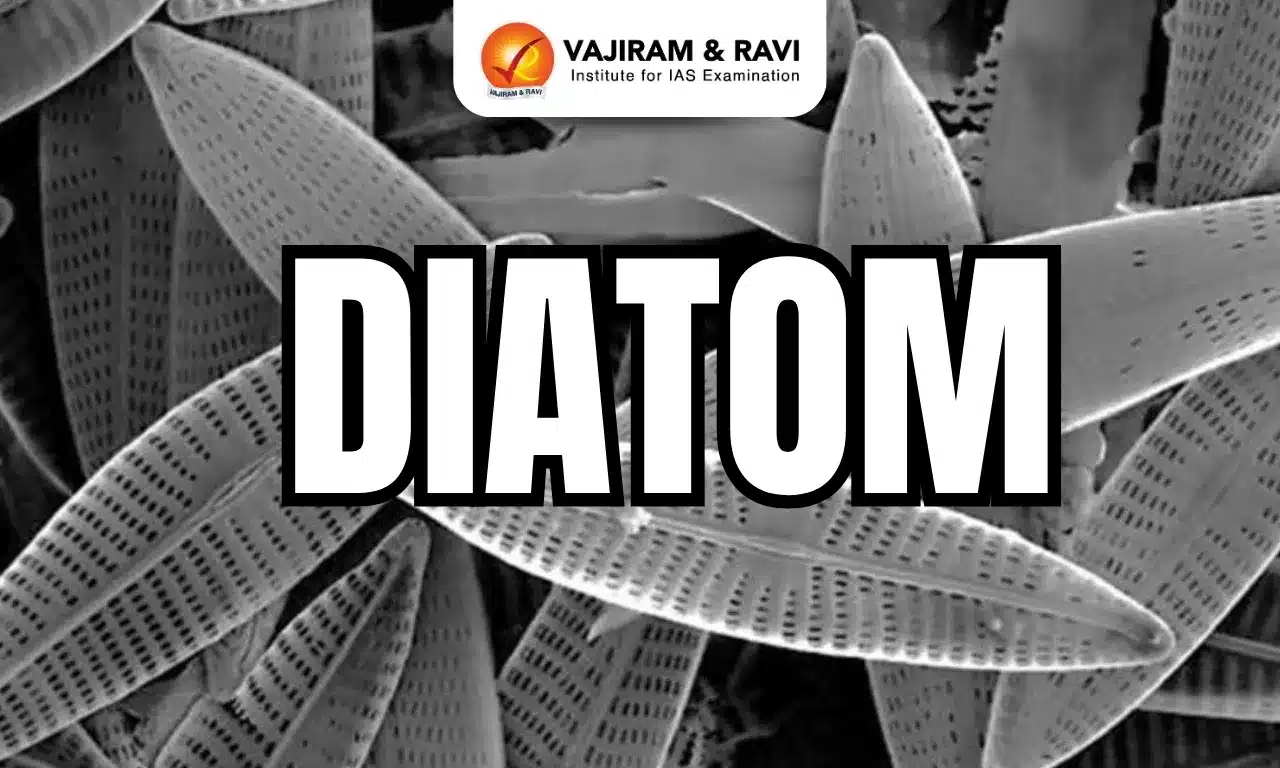
- Diatom cell walls are ornamented by intricate and striking patterns of silica.
- Each species has a distinct pattern of tiny holes in the cell wall (frustule) through which they absorb nutrients and get rid of waste.
- Diatoms can photosynthesize which means they can convert dissolved carbon dioxide in the water into oxygen that is essential for the survival of fish and other aquatic organisms.
- They also serve as a major source of atmospheric oxygen for the planet, and a key food source for higher organisms in the food chain, such as zooplankton, molluscs, and fish.
- Collectively, they are responsible for generating up to 50% of the oxygen produced globally each year.
- Diatoms also play a crucial role in the nutrient cycling of marine and lake waters.
Source: TOI


 Last updated on Sep, 2026
→ UPSC 2027 Notification will be released on 13 January 2027 at upsconline.nic.in.
→ Check out the latest UPSC Syllabus here.
→ Download UPSC Model Answers for Mains 2026
→ UPSC Mains Question Paper 2026 is out now for Essay & GS Paper 1, 2, 3 & 4.
→ UPSC Calendar 2027 has been released.
→ Enroll in Vajiram & Ravi’s UPSC Mains Test Series 2027 for structured answer writing practice, expert evaluation, and exam-oriented feedback.
→ Join Vajiram & Ravi’s UPSC Mentorship Program 2027 for personalized guidance, strategy planning, and one-to-one support from experienced mentors.
→ Go through the UPSC Mains Previous Year Papers to enhance your preparation.
→ UPSC has released UPSC Toppers List 2025 with the Civil Services final result on its official website.
→ Also check Best UPSC Coaching in India
Diatoms FAQs
Q1. What are diatoms?+
Q2. In which type of habitats are diatoms commonly found?+
Q3. What is the cell wall of diatoms made of?+
Q4. Do diatoms have leaves, stems, or roots like higher plants?+
Tags: diatoms prelims pointers upsc current affairs upsc prelims current affairs