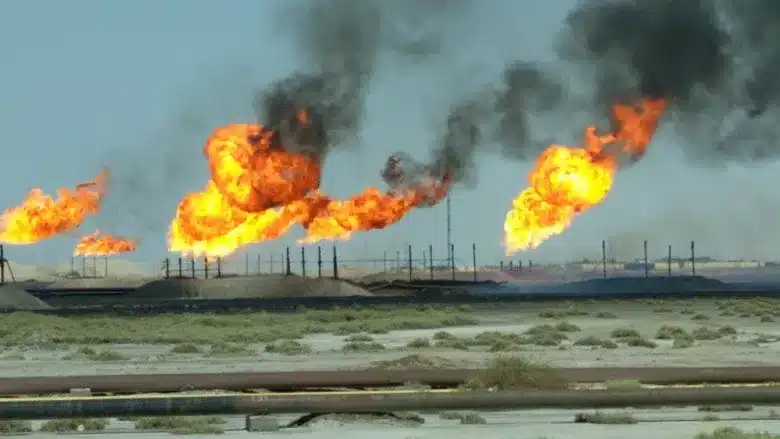
About Gas flaring:
- It is the burning of the natural gas associated with oil extraction.
- The practice has persisted from the beginning of oil production over 160 years ago.
- It takes place due to a range of issues, from market and economic constraints, to a lack of appropriate regulation and political will.
- Flaring and venting are a waste of a valuable natural resource that should either be used for productive purposes, such as generating power, or conserved.
- Why is gas flared?
- Flaring persists to this day because it is a relatively safe, though wasteful and polluting, method of disposing of the associated gas that comes from oil production.
Impacts on environment
- The flare’s combustion converts hydrocarbons to carbon dioxide and water, which lessens the climate impact and reduces the safety concerns of the natural gas on site but also produces nitrogen oxides, or NOx.
- NOx—which includes the highly reactive gases nitric oxide and nitrogen dioxide—directly and indirectly impacts air quality.
- How to reduce gas flaring? Oil producers can either re-inject associated gas or use it for productive purposes.
Q1:What is Natural Gas?
It is a mixture of gases which are rich in hydrocarbons. It is a colorless and odorless gas composed of 70-90% methane (CH4). Its other ingredients include ethane (C2 H6) and propane (C3 H8).
Source: Fossil Fuel Firms Flared Most Gas Since 2019, Says World Bank


 Last updated on Sep, 2026
→ UPSC 2027 Notification will be released on 13 January 2027 at upsconline.nic.in.
→ Check out the latest UPSC Syllabus here.
→ Download UPSC Model Answers for Mains 2026
→ UPSC Mains Question Paper 2026 is out now for Essay & GS Paper 1, 2, 3 & 4.
→ UPSC Calendar 2027 has been released.
→ Enroll in Vajiram & Ravi’s UPSC Mains Test Series 2027 for structured answer writing practice, expert evaluation, and exam-oriented feedback.
→ Join Vajiram & Ravi’s UPSC Mentorship Program 2027 for personalized guidance, strategy planning, and one-to-one support from experienced mentors.
→ Go through the UPSC Mains Previous Year Papers to enhance your preparation.
→ UPSC has released UPSC Toppers List 2025 with the Civil Services final result on its official website.
→ Also check Best UPSC Coaching in India