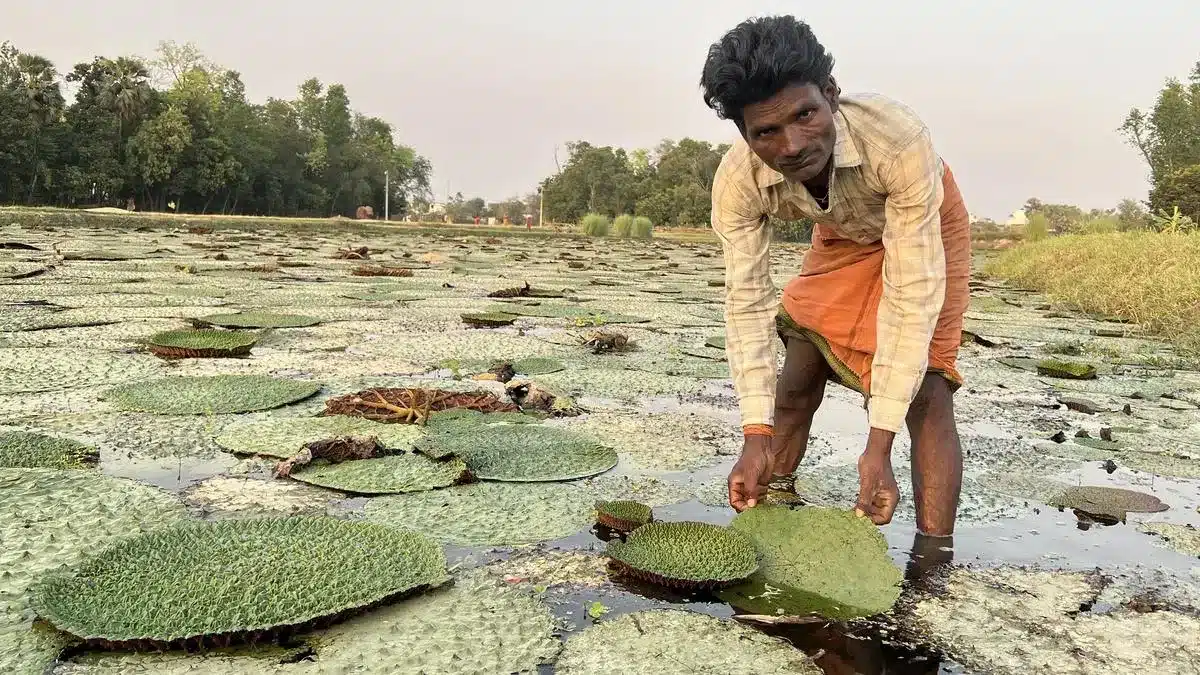
About Makhana Cultivation:
- Foxnut, commonly known as Makhana, is an important aquatic crop.
- It is grown in stagnant perennial water bodies like ponds, land depressions, oxbow lakes, swamps and ditches.
- It is a plant of tropical and subtropical climate.
- Makhana plant is considered as native of South-East Asia and China, but distributed to almost every part of the world.
- Required climatic conditions
- Temperature: 200C to 350 C
- Relative humidity :50% to 90%
- Annual rainfall: 100 cm to 250 cm
- Soil: Smooth loamy soil
- In India it is mainly distributed in the states of Bihar, West Bengal, Manipur, Tripura, Assam, Jammu & Kashmir, Odisha, Rajasthan, Madhya Pradesh & Uttar Pradesh but commercially produced in few states only.
- Bihar in India is the leading state in its production and processing. It is estimated that Bihar accounts for more than 80 percent of total Makhana production in the country.
- Makhana is a product approved under the Union government’s One District One Product scheme, under which subsidies are provided to food processors for branding, marketing, and developing infrastructure.
- Benefits of Makhana
- It is a kind of hydrophyte used both as drug and food which exhibits much application and development prospect in the fields of medicine, food and economy.
- Makhana is the seed of a cash aquatic crop, which was popularly used as herb and food in China. Makhana possessed high nutritional value and many medical and health protection effects.
Q1: What is One District One Product scheme?
It was launched by the Ministry of Food Processing Industries, to help districts reach their full potential, foster economic and socio-cultural growth, and create employment opportunities, especially, in rural areas. This initiative is carried out with the ‘Districts as Exports Hub’ initiative by the Directorate General of Foreign Trade (DGFT), Department of Commerce.
Source: Makhana cultivation in Bihar | Running on vegetable protein


 Last updated on Oct, 2026
→ UPSC 2027 Notification will be released on 13 January 2027 at upsconline.nic.in.
→ Check Nobel Prize 2026 Winners List here.
→ Download PIB PRiSM Monthly Magazine 2026 here.
→ Check UPSC Monthly Current Affairs Magazine The Recitals here.
→ Check out the latest UPSC Syllabus here.
→ Download UPSC Model Answers for Mains 2026
→ UPSC Mains Question Paper 2026 is out now for Essay & GS Paper 1, 2, 3 & 4.
→ UPSC Calendar 2027 has been released.
→ Enroll in Vajiram & Ravi’s UPSC Mains Test Series 2027 for structured answer writing practice, expert evaluation, and exam-oriented feedback.
→ Join Vajiram & Ravi’s UPSC Mentorship Program 2027 for personalized guidance, strategy planning, and one-to-one support from experienced mentors.
→ Go through the UPSC Mains Previous Year Papers to enhance your preparation.
→ UPSC has released UPSC Toppers List 2025 with the Civil Services final result on its official website.
→ Also check Best UPSC Coaching in India