


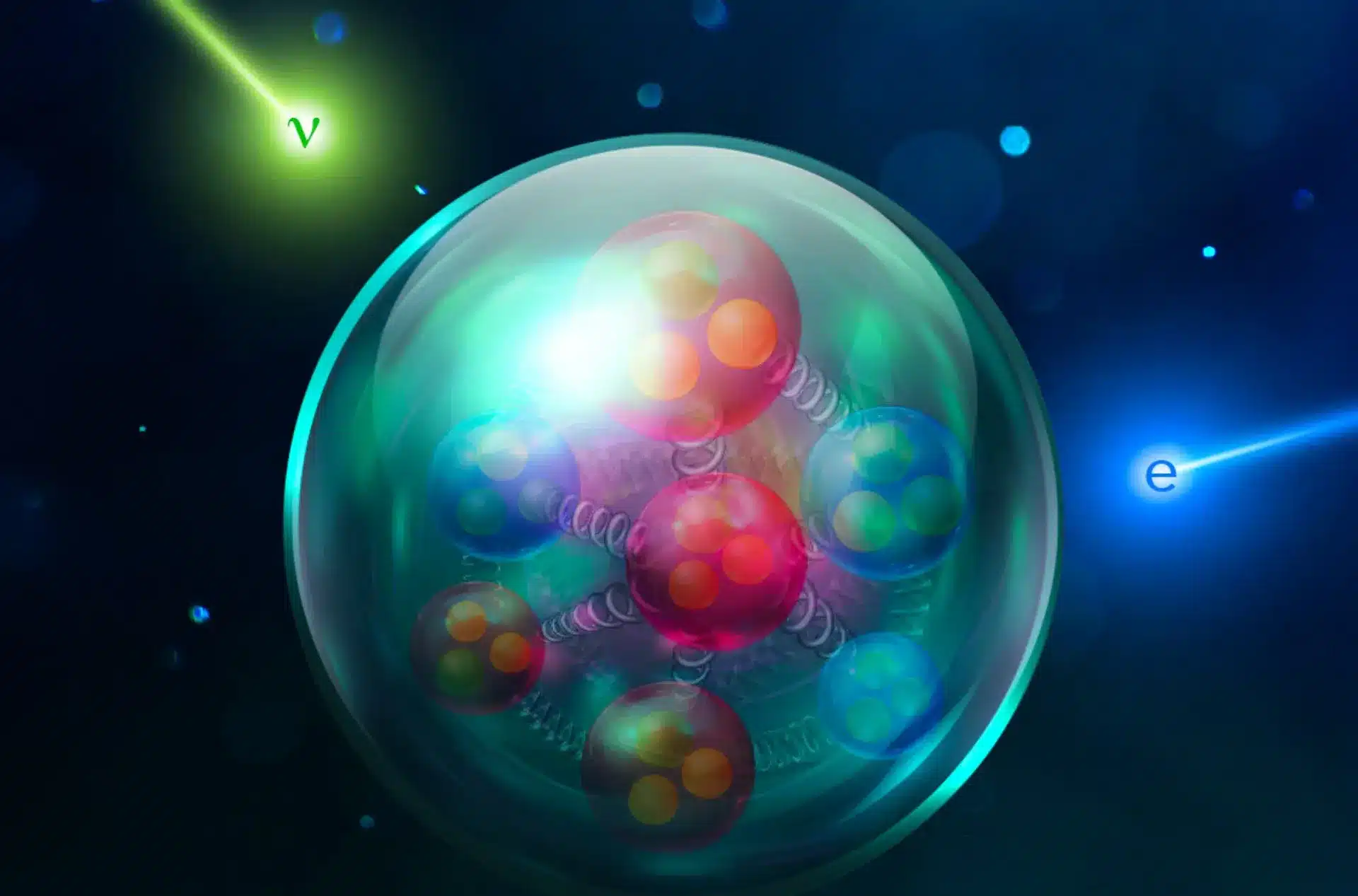
About NOvA (NuMI Off-axis νe Appearance):
- It is an experiment to study one of nature’s most elusive particles: neutrinos.
- It is managed by the U.S. Department of Energy’s Fermi National Accelerator Laboratory, located outside of Chicago, United States.
- Fermilab sends a beam of neutrinos500 miles north toa 14,000-ton detector in Ash River, Minnesota.
- By measuring the neutrinos and their antimatter partners, antineutrinos, in both locations, physicists can study how these particles change their type as they travel, a phenomenon known as neutrino oscillation.
- NOvA aims to learn more about the ordering of neutrino masses.
What are Neutrinos?
- They are elementary subatomic particles with no electric charge, very little mass, and 1/2 unit of spin.
- They travel at near lightspeeds.
- Neutrinos belong to the family of particles called leptons, which are not subject to the strong force.
- They are often called ‘ghost particles’ because they barely interact with anything else.
- Neutrinos are, however, the most common particle in the universe. Approximately 100 trillion neutrinos pass completely harmlessly through your body every second.
- Every time atomic nuclei come together (like in the sun) or break apart (like in a fission reactor or particle accelerator), they produce neutrinos.
Q1: What is Antimatter?
Antimatter is the same as ordinary matter except that it has the opposite electric charge. It is also known as “mirror” matter. The antimatter particles corresponding to electrons, protons, and neutrons are called positrons, antiprotons, and antineutrons; collectively they are referred to as antiparticles. These anti-particles can combine to form anti-atoms and, in principle, could even form antimatter regions of our universe. Matter and antimatter cannot coexist at close range for more than a small fraction of a second because they collide with and annihilate each other, releasing large quantities of energy in the form of gamma rays or elementary particles. Antimatter was created along with matter after the Big Bang.
Source: New NOvA data deepens mystery of subatomic particle’s mass


 Last updated on Oct, 2026
→ UPSC 2027 Notification will be released on 13 January 2027 at upsconline.nic.in.
→ Check Nobel Prize 2026 Winners List here.
→ Download PIB PRiSM Monthly Magazine 2026 here.
→ Check UPSC Monthly Current Affairs Magazine The Recitals here.
→ Check out the latest UPSC Syllabus here.
→ Download UPSC Model Answers for Mains 2026
→ UPSC Mains Question Paper 2026 is out now for Essay & GS Paper 1, 2, 3 & 4.
→ UPSC Calendar 2027 has been released.
→ Enroll in Vajiram & Ravi’s UPSC Mains Test Series 2027 for structured answer writing practice, expert evaluation, and exam-oriented feedback.
→ Join Vajiram & Ravi’s UPSC Mentorship Program 2027 for personalized guidance, strategy planning, and one-to-one support from experienced mentors.
→ Go through the UPSC Mains Previous Year Papers to enhance your preparation.
→ UPSC has released UPSC Toppers List 2025 with the Civil Services final result on its official website.
→ Also check Best UPSC Coaching in India








