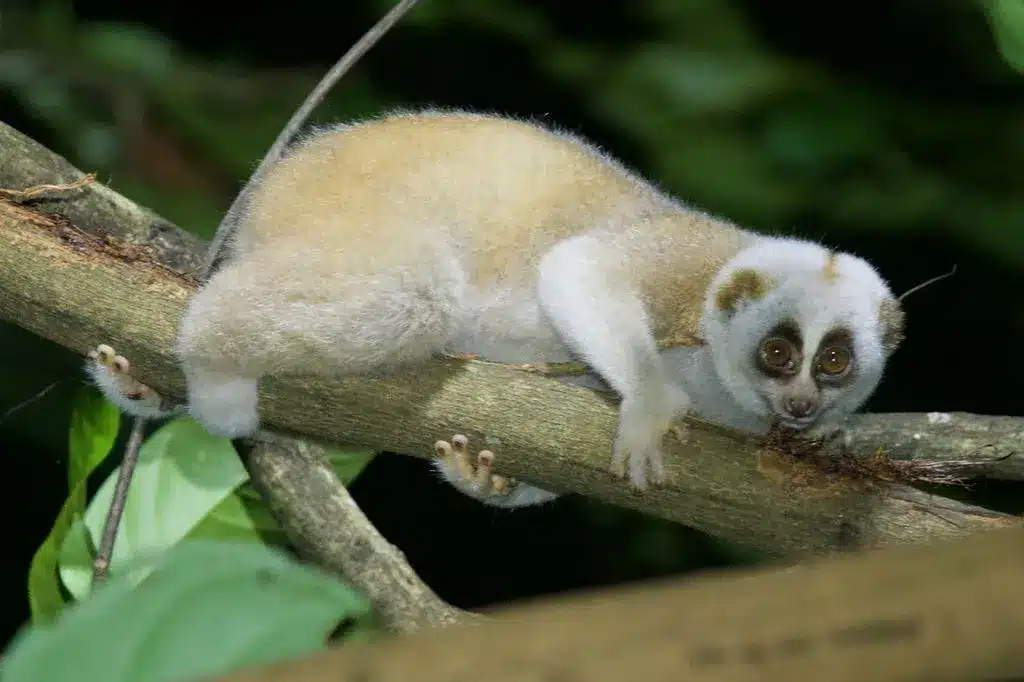
About Slow Loris:
- Found exclusively in South and Southeast Asia, slow lorises are the world’s only venomous primates.
- They’re arboreal—meaning they live in trees—and can be spotted curling up to sleep in branches or using vines and leaves to get around.
- They typically only come down to the forest floor when they need to defecate.
- There are nine species of slow loris. They all belong to the same genus, with each species sharing many similar characteristics and behaviours.
- The nine species include the Philippine slow loris, Bengal slow loris, greater slow loris, Kayan slow loris, Bangka slow loris, Bornean slow loris, Sumatran slow loris, Javan slow loris, and pygmy slow loris.
- Bengal slow loris (Nycticebus bengalensis) is listed as Endangered in the IUCN Red List. It is also legally protected under the Wildlife Protection Act, 1972.
- The range of the Bengal slow loris extends from Vietnam to China, but in India, it is confined to India’s northeast.
- Features of Slow Lorises:
- These small, nocturnal creatures are characterised by their large, round eyes, which are adapted for night vision.
- They have compact bodies, short snouts, dense fur, and distinctive facial markings.
- On average, they measure 20 to 37 centimetres (or 10 to 15 inches) long.
- Slow lorises each have a small bare patch under their arm that secretes oil. When they feel threatened, they lick this oil, which combines with their saliva tocreate a venom strong enough to kill small arthropods and mammals.
- Slow lorises are skilled hunters; they use their slow and deliberate movements to catch prey like insects and small vertebrates.
- They also have a specialised toothcomb—a unique structure created by their bottom front teeth—that they use for groomingand extracting gum from trees.
- Slow lorises are generally solitary and territorial animals. They have the ability to stay motionless for long periods.
- They are omnivores.
Q1: What is IUCN?
The International Union for Conservation of Nature is a global organization composed of governments, NGOs, scientists, and experts dedicated to conserving nature and promoting sustainability. Its primary role involves assessing the conservation status of species, providing data and analysis on the state of biodiversity worldwide, and offering guidance and frameworks for conservation efforts.


 Last updated on Sep, 2026
→ UPSC 2027 Notification will be released on 13 January 2027 at upsconline.nic.in.
→ Asian Games 2026 are being held in Aichi-Nagoya, Japan, from 19 September to 4 October.
→ Check out the latest UPSC Syllabus here.
→ Download UPSC Model Answers for Mains 2026
→ UPSC Mains Question Paper 2026 is out now for Essay & GS Paper 1, 2, 3 & 4.
→ UPSC Calendar 2027 has been released.
→ Enroll in Vajiram & Ravi’s UPSC Mains Test Series 2027 for structured answer writing practice, expert evaluation, and exam-oriented feedback.
→ Join Vajiram & Ravi’s UPSC Mentorship Program 2027 for personalized guidance, strategy planning, and one-to-one support from experienced mentors.
→ Go through the UPSC Mains Previous Year Papers to enhance your preparation.
→ UPSC has released UPSC Toppers List 2025 with the Civil Services final result on its official website.
→ Also check Best UPSC Coaching in India