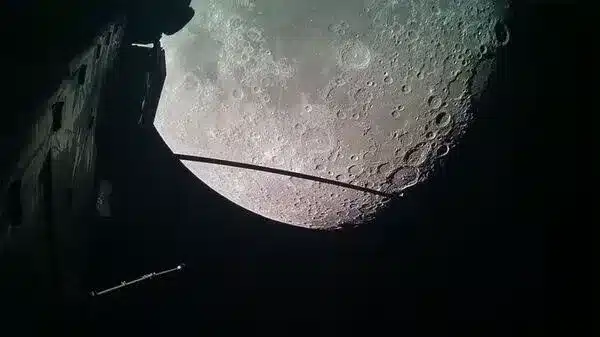
Chandrayaan-3’s discovery:
- Chandrayaan-3’s Pragyan rover identified a rock type known as ferroan anorthosite in the lunar south pole region.
- This discovery is significant as it aligns with earlier observations made by the Apollo and Luna missions, confirming the theory that these rocks are remnants of an ancient magma ocean that once covered the moon.
What is the Lunar Magma Ocean (LMO)?
The Lunar Magma Ocean is a hypothesized early stage in the moon’s history when its surface was entirely molten. This ocean of magma is believed to have formed following a catastrophic impact between the early Earth and a Mars-sized body, leading to the formation of the moon.
- Ferroan Anorthosite: This rock type is crucial evidence of the LMO. As the magma began to cool and solidify, different minerals crystallized at various depths. Ferroan anorthosite, rich in calcium and aluminium, floated to the surface, forming the moon’s initial crust.
- Importance of the LMO: LMO helps scientists decipher the moon’s geologic history, including its differentiation process, where heavier materials sank, and lighter materials floated, leading to the layered structure we observe today.
Scientific implications:
- The presence of ferroan anorthosite supports the theory that the moon’s early crust was formed from a global magma ocean.
- This discovery also suggests that the moon has not experienced significant volcanic activity or plate tectonics, unlike Earth, preserving its ancient surface.
- General Relativity and Time Dilation: The discovery also ties into broader concepts like Einstein’s theory of general relativity, which explains how the moon’s lower gravity causes time to tick slightly faster than on Earth.
Key points:
- Impact hypothesis: The theory that the moon was formed from debris following a collision between the early Earth and a rogue planetary body.
- South Pole-Aitken basin: The largest impact crater in the solar system, near which Chandrayaan-3’s Pragyan rover conducted its studies.
Alpha Particle X-ray Spectrometer (APXS): The instrument used by Pragyan to identify the chemical composition of lunar soil.
Q1. What arе thе objеctivеs of Chandrayaan-3?
The primary objectives of Chandrayaan-3 include furthеr еxploration of thе moon’s surfacе, studying its minеral composition, analysing its gеology, and conducting experiments to gain a bеttеr understanding of the lunar environment.
Source: Chandrayaan’s Pragyan rover offers evidence of magma ocean on young moon – The Hindu


 Last updated on Sep, 2026
→ UPSC 2027 Notification will be released on 13 January 2027 at upsconline.nic.in.
→ Asian Games 2026 are being held in Aichi-Nagoya, Japan, from 19 September to 4 October.
→ Check out the latest UPSC Syllabus here.
→ Download UPSC Model Answers for Mains 2026
→ UPSC Mains Question Paper 2026 is out now for Essay & GS Paper 1, 2, 3 & 4.
→ UPSC Calendar 2027 has been released.
→ Enroll in Vajiram & Ravi’s UPSC Mains Test Series 2027 for structured answer writing practice, expert evaluation, and exam-oriented feedback.
→ Join Vajiram & Ravi’s UPSC Mentorship Program 2027 for personalized guidance, strategy planning, and one-to-one support from experienced mentors.
→ Go through the UPSC Mains Previous Year Papers to enhance your preparation.
→ UPSC has released UPSC Toppers List 2025 with the Civil Services final result on its official website.
→ Also check Best UPSC Coaching in India