


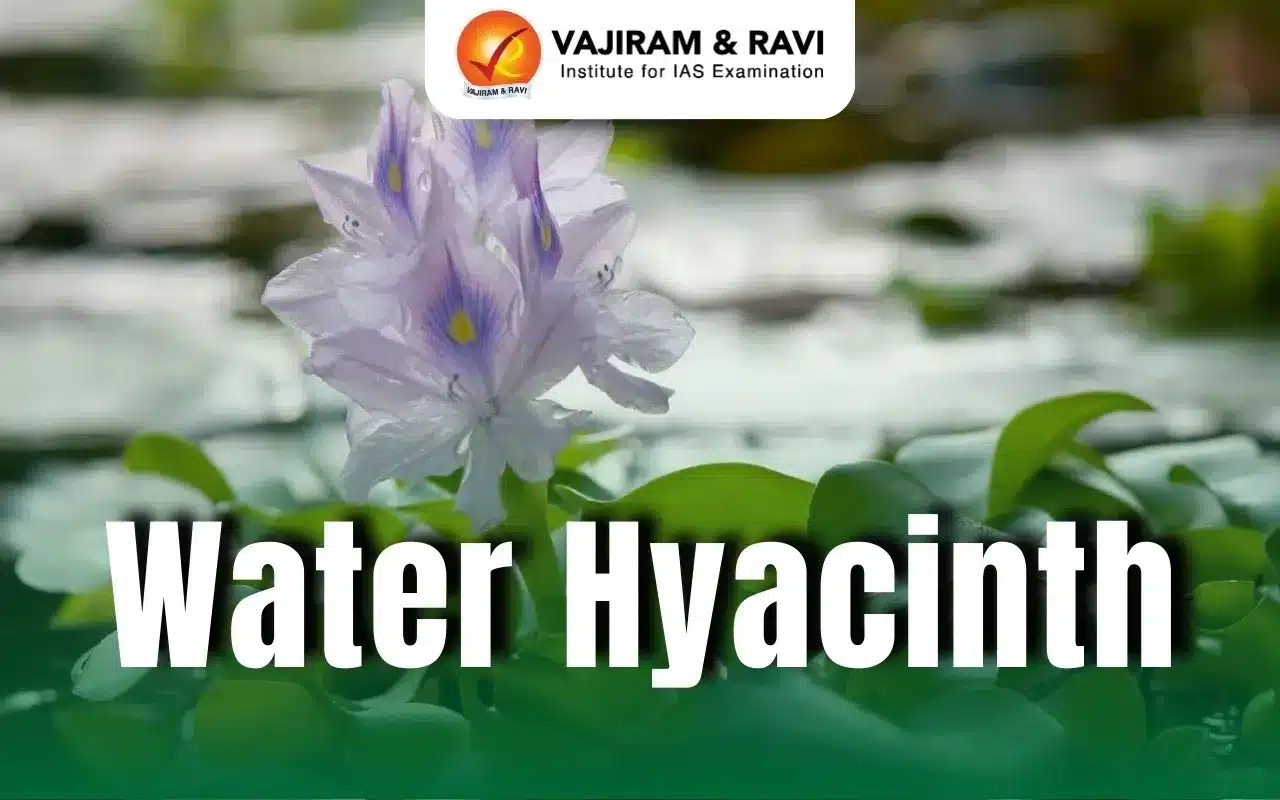
Water Hyacinth Latest News
The rapid return of water hyacinth in the Mula-Mutha River, barely weeks after clean-up drives, has renewed concerns over the lack of a long-term solution.
About Water Hyacinth
- It is a free-floating, aquatic plant in the pickerelweed family.
- Scientific Name: Eichhornia crassipes
- It is native to tropical regions of South America and is now present on all continents except Antarctica.
- It is one of the world’s most serious water weeds because of its aggressive, fast-growing nature.
- Water hyacinth grows in tropical, subtropical, and warm temperate climates. It grows best in still or slow-flowing fresh water with high nutrient levels.
- Under favourable conditions it can double its mass every 5 days.
- It can form dense mats that reduce the water quality, change water flows, and increase sediment.
- It crowds out native aquatic plants and animals, altering ecosystems, destroying habitats, and blocking irrigation systems.
- Cutting a water hyacinth plant into pieces will not kill it. The plants can reproduce using a process called fragmentation. Each plant also produces thousands of seeds each year.
- This plant varies in size from a few inches to over three feet tall.
- They have showy lavender flowers, and the leaves are rounded and leathery, attached to spongy and sometimes inflated stalks.
- It was introduced to India during the British colonial rule as an ornamental aquatic plant from South America.
- Uses:
- The plant has been used as a biofertilizer in some organic agriculture practices.
- The plant produces beautiful purple flowers that have high aesthetic value.
- It is rich in fibrous stems that can be processed into a wide array of handbags, interior decorative material, table mats, baskets, and other products.
- It has been reported that this plant is a good phytoremediation species, suggesting it has the ability to trap and remove toxic metabolites and harmful heavy metals from water.


Key Facts about Mula-Mutha River
- The River Mula and Mutha are very important rivers passing through the centre of Pune city.
- The Mula and Mutha Rivers originate in the Sahyadri ranges.
- River Mula originates from Mulshi Dam, which forms Mulshi Lake. River Mutha originates from Panshet Dam via Khadakwasla Dam.
- They traverse across Pune city and form the Mula-Mutha River, which eventually joins the Bhima River.
Source: HT

 Last updated on Sep, 2026
→ UPSC 2027 Notification will be released on 13 January 2027 at upsconline.nic.in.
→ Check out the latest UPSC Syllabus here.
→ Download UPSC Model Answers for Mains 2026
→ UPSC Mains Question Paper 2026 is out now for Essay & GS Paper 1, 2, 3 & 4.
→ UPSC Calendar 2027 has been released.
→ Enroll in Vajiram & Ravi’s UPSC Mains Test Series 2027 for structured answer writing practice, expert evaluation, and exam-oriented feedback.
→ Join Vajiram & Ravi’s UPSC Mentorship Program 2027 for personalized guidance, strategy planning, and one-to-one support from experienced mentors.
→ Go through the UPSC Mains Previous Year Papers to enhance your preparation.
→ UPSC has released UPSC Toppers List 2025 with the Civil Services final result on its official website.
→ Also check Best UPSC Coaching in India
Water Hyacinth FAQs
Q1. What is water hyacinth?+
Q2. Where is water hyacinth native to?+
Q3. Why is water hyacinth considered a harmful aquatic plant?+
Q4. In what type of water does water hyacinth grow best?+
Tags: water hyacinth








