About Hwasong-19:
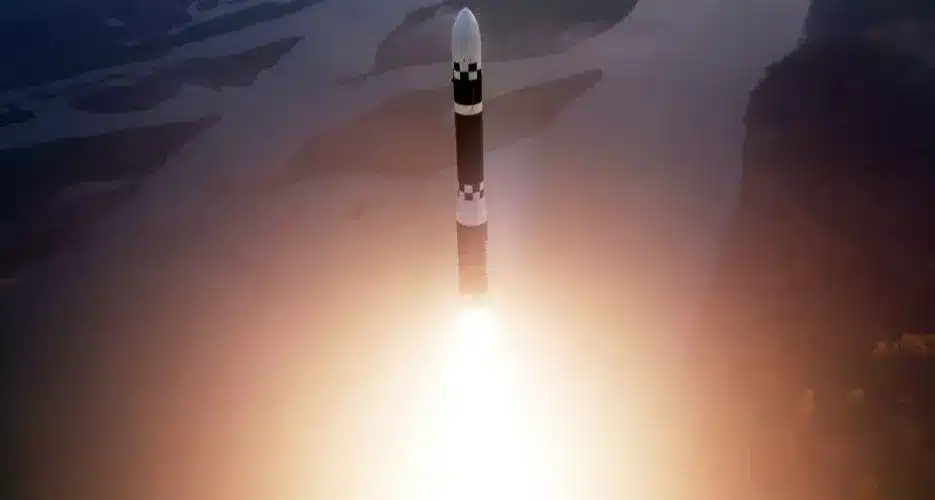
- It is a North Korean intercontinental ballistic missile (ICBM).
- As the latest addition to the Hwasong series, the Hwasong-19 incorporates solid-fuel propulsion, which allows it to be deployed more rapidly than liquid-fueled missiles, making it harder to detect and intercept.
- It is estimated to be at least 28 meters long (92 feet), while advanced U.S. and Russian ICBMs are less than 20 meters long (66 feet).
- Analysts estimate that if launched on a standard trajectory, the Hwasong-19 could cover distances exceeding 13,000 kilometers, enough to target the U.S. mainland.
What is an intercontinental ballistic missile (ICBM)?
- An ICBM is a long-range missile that is designed to deliver nuclear warheads, although it could also deliver other payloads.
- According to the Federation of American Scientists, ICBMs have a minimum range of 5,500 kilometres (3,400 miles), with maximum ranges varying from 7,000 to 16,000 kilometres.
- ICBMs are much faster and have a greater range than other types of ballistic missiles.
- Designed primarily for strategic purposes, ICBMs are usually launched from land or submarines and travel through space before re-entering the Earth’s atmosphere to reach distant targets.
- Agni-V is an Indian ICBM with a range of over 5,000 km.
Q1: What is a Ballistic Missile?
A ballistic missile is a rocket-propelled, self-guided strategic-weapons system that follows a ballistic trajectory to deliver a payload from its launch site to a predetermined target. They are powered initially by a rocket or series of rockets in stages, but then follow an unpowered trajectory that arches upwards before descending to reach its intended target. They can carry conventional high explosives as well as chemical, biological, or nuclear munitions.
News: ‘Hwasong-19’: North Korea test-fires new solid-fuel missile; Know its implications and significance


 Last updated on Sep, 2026
→ UPSC 2027 Notification will be released on 13 January 2027 at upsconline.nic.in.
→ Asian Games 2026 are being held in Aichi-Nagoya, Japan, from 19 September to 4 October.
→ Check out the latest UPSC Syllabus here.
→ Download UPSC Model Answers for Mains 2026
→ UPSC Mains Question Paper 2026 is out now for Essay & GS Paper 1, 2, 3 & 4.
→ UPSC Calendar 2027 has been released.
→ Enroll in Vajiram & Ravi’s UPSC Mains Test Series 2027 for structured answer writing practice, expert evaluation, and exam-oriented feedback.
→ Join Vajiram & Ravi’s UPSC Mentorship Program 2027 for personalized guidance, strategy planning, and one-to-one support from experienced mentors.
→ Go through the UPSC Mains Previous Year Papers to enhance your preparation.
→ UPSC has released UPSC Toppers List 2025 with the Civil Services final result on its official website.
→ Also check Best UPSC Coaching in India