Unified Complex Radio Antenna Latest News
Japan recently called on India to fast-track internal official processing of the agreement on the UNICORN (Unified Complex Radio Antenna) naval radar system.
About Unified Complex Radio Antenna
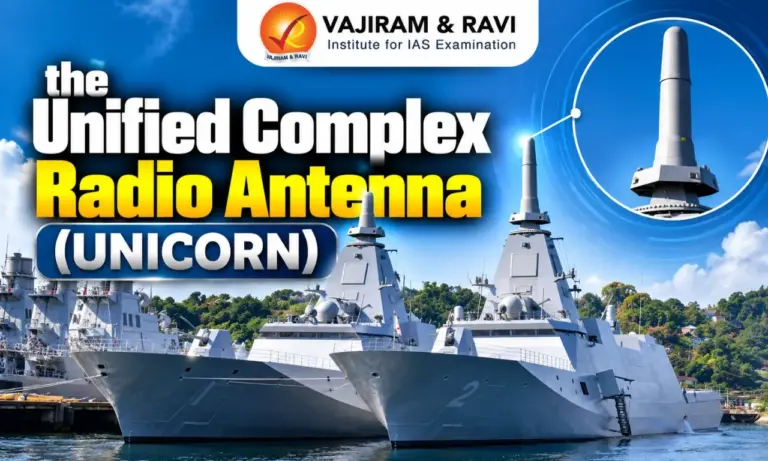
- UNICORN, also known as NORA-50, is a shipborne integrated antenna system.
- It is a mast with integrated communication systems that is engineered to dramatically enhance a warship’s stealth and situational awareness.
- Developed jointly by three Japanese companies (NEC Corporation, Sampa Kogyo K.K., and The Yokohama Rubber Co., Ltd.), the system is already in service aboard Japan’s Mogami-class frigates.
- What does UNICORN do?
- Conventional warships typically carry several exposed antennas – for radar, communications, and electronic warfare – bolted onto a mast.
- Each of these surfaces adds to a ship’s radar cross-section, making it easier for an adversary to detect.
- UNICORN does away with that arrangement by consolidating multiple antennas into a single enclosed radome mounted on one mast, cutting down the number of reflective surfaces a hostile radar can pick up.
- Its design stacks the antennas vertically inside a bar-shaped dome, moving components such as the tactical air navigation antenna from an exposed position at the top of the mast to a more sheltered spot lower down.
- A lightning diverter strip runs across the mast’s surface as a safety measure, given the exposure of ships at sea to lightning strikes.
- Inside this unified mast are several vital subsystems, including those for tactical data links, Tactical Air Navigation Systems (TACAN), Identification Friend or Foe (IFF), Electronic Support Measures (ESM), and general communications.
- This innovation significantly reduces the cross-section of naval platforms, thereby enhancing their stealth characteristics and enabling them to operate with reduced electronic signatures.
- Beyond stealth, the system is also designed to reduce mutual interference between closely packed antennas, improve the range at which external radio signals can be detected, and simplify installation and maintenance.
- India-Japan Agreement:
- India and Japan signed a Memorandum of Implementation (MOI) on 15 November 2024 for the co-development of UNICORN masts.
- It is the first military hardware co-development pact between the two countries.
- Japan will provide the design and engineering support, while India will handle integration, adaptation, and co-production through Bharat Electronics Limited (BEL).
- The integrated mast is expected to gradually replace existing communication and sensor mast systems across the Navy’s fleet.
News: TH


 Last updated on Sep, 2026
→ UPSC 2027 Notification will be released on 13 January 2027 at upsconline.nic.in.
→ Asian Games 2026 are being held in Aichi-Nagoya, Japan, from 19 September to 4 October.
→ Check out the latest UPSC Syllabus here.
→ Download UPSC Model Answers for Mains 2026
→ UPSC Mains Question Paper 2026 is out now for Essay & GS Paper 1, 2, 3 & 4.
→ UPSC Calendar 2027 has been released.
→ Enroll in Vajiram & Ravi’s UPSC Mains Test Series 2027 for structured answer writing practice, expert evaluation, and exam-oriented feedback.
→ Join Vajiram & Ravi’s UPSC Mentorship Program 2027 for personalized guidance, strategy planning, and one-to-one support from experienced mentors.
→ Go through the UPSC Mains Previous Year Papers to enhance your preparation.
→ UPSC has released UPSC Toppers List 2025 with the Civil Services final result on its official website.
→ Also check Best UPSC Coaching in India
Unified Complex Radio Antenna FAQs
Q1. What is Unified Complex Radio Antenna (UNICORN)?+
Q2. What type of system is UNICORN?+
Q3. Which country developed the UNICORN integrated mast system?+
Q4. What is the main stealth advantage of UNICORN?+
Q5. When did India and Japan sign the agreement for co-development of UNICORN masts?+
Tags: prelims pointers unified complex radio antenna upsc current affairs upsc prelims current affairs