About UJALA Scheme:
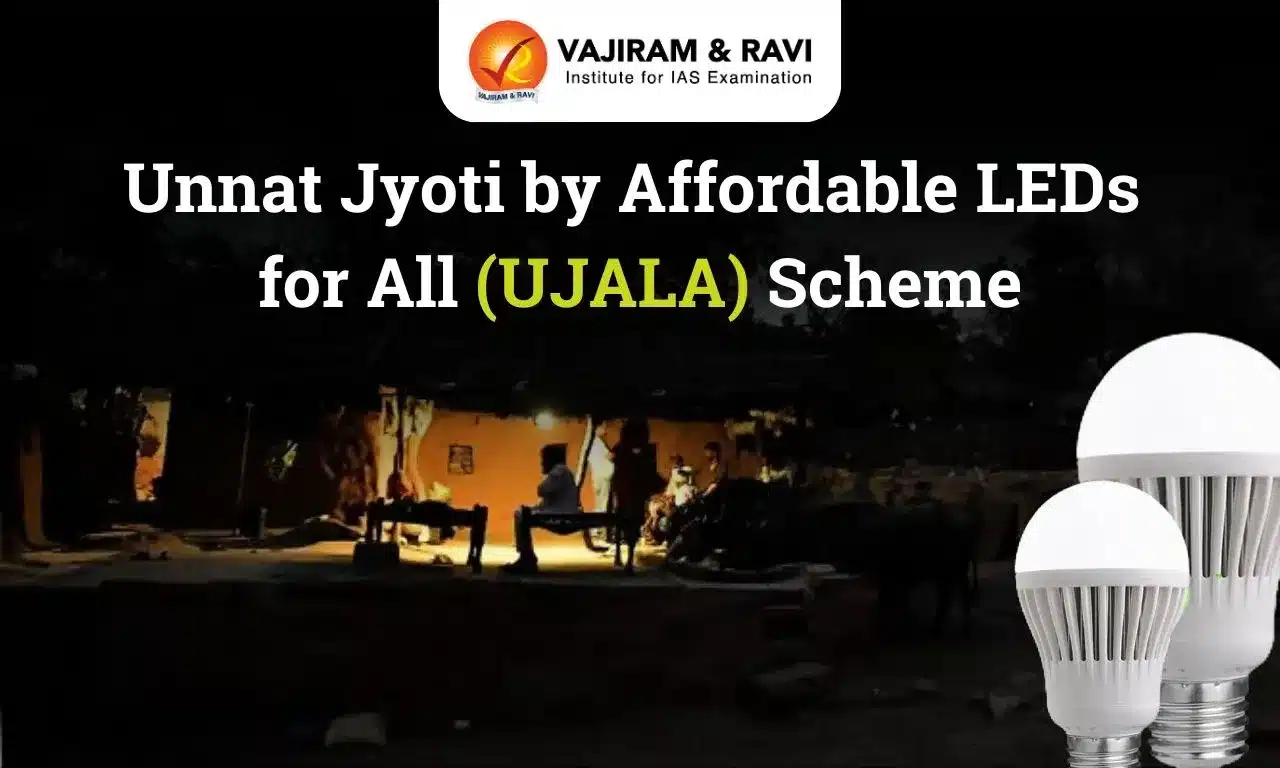
- In May 2015, the Indian government introduced the UJALA scheme, which is also known as the LED-based Domestic Efficient Lighting Programme (DELP), to promote energy efficiency in all households.
- The UJALA scheme is the world’s largest zero-subsidy LED lamp distribution scheme.
- It is implemented by Energy Efficiency Services Limited (EESL) under the Ministry of Power.
- Through the UJALA scheme, the government aims to save 85 lakh kWh of electricity and 15,000 tonnes of CO2 by replacing 77 crore traditional bulbs & CFLs and 3.5 crore streetlights with LEDs.
- Eligible Households:
- Every domestic household having a metered connection from their respective Electricity Distribution Company is eligible to get the LED bulbs under the UJALA Scheme.
- The consumer can purchase the LED on EMI payment (monthly/bimonthly instalments in the electricity bill) or on upfront payment by paying the full amount.
- As part of its inclusive growth strategy to enable growth in lower-income communities, EESL has also enrolled Self-Help Groups (SHGs) for the distribution of LED bulbs under the UJALA programme.
- The annual energy savings from the scheme stand at 47,883 million kWh, with a reduction in peak demand by 9,586 MW and an annual reduction of 3.87 crore tonnes in carbon dioxide emissions.
- These savings were achieved through e-procurement and bulk purchasing, which allowed LED bulbs to be made affordable for millions of households.
- UJALA succeeded in bringing down the retail price of LED bulbs from INR 300-350 per bulb to INR 70-80 per bulb.
Q1: What is an LED?
In the simplest terms, a light-emitting diode (LED) is a semiconductor device that emits light when an electric current is passed through it. Light is produced when the particles that carry the current (known as electrons and holes) combine together within the semiconductor material. Since light is generated within the solid semiconductor material, LEDs are described as solid-state devices. The term solid-state lighting, which also encompasses organic LEDs (OLEDs), distinguishes this lighting technology from other sources that use heated filaments (incandescent and tungsten halogen lamps) or gas discharge (fluorescent lamps).
Source: ET


 Last updated on Oct, 2026
→ UPSC 2027 Notification will be released on 13 January 2027 at upsconline.nic.in.
→ Check Nobel Prize 2026 Winners List here.
→ Download PIB PRiSM Monthly Magazine 2026 here.
→ Check UPSC Monthly Current Affairs Magazine The Recitals here.
→ Check out the latest UPSC Syllabus here.
→ Download UPSC Model Answers for Mains 2026
→ UPSC Mains Question Paper 2026 is out now for Essay & GS Paper 1, 2, 3 & 4.
→ UPSC Calendar 2027 has been released.
→ Enroll in Vajiram & Ravi’s UPSC Mains Test Series 2027 for structured answer writing practice, expert evaluation, and exam-oriented feedback.
→ Join Vajiram & Ravi’s UPSC Mentorship Program 2027 for personalized guidance, strategy planning, and one-to-one support from experienced mentors.
→ Go through the UPSC Mains Previous Year Papers to enhance your preparation.
→ UPSC has released UPSC Toppers List 2025 with the Civil Services final result on its official website.
→ Also check Best UPSC Coaching in India