Polar Vortex Latest News
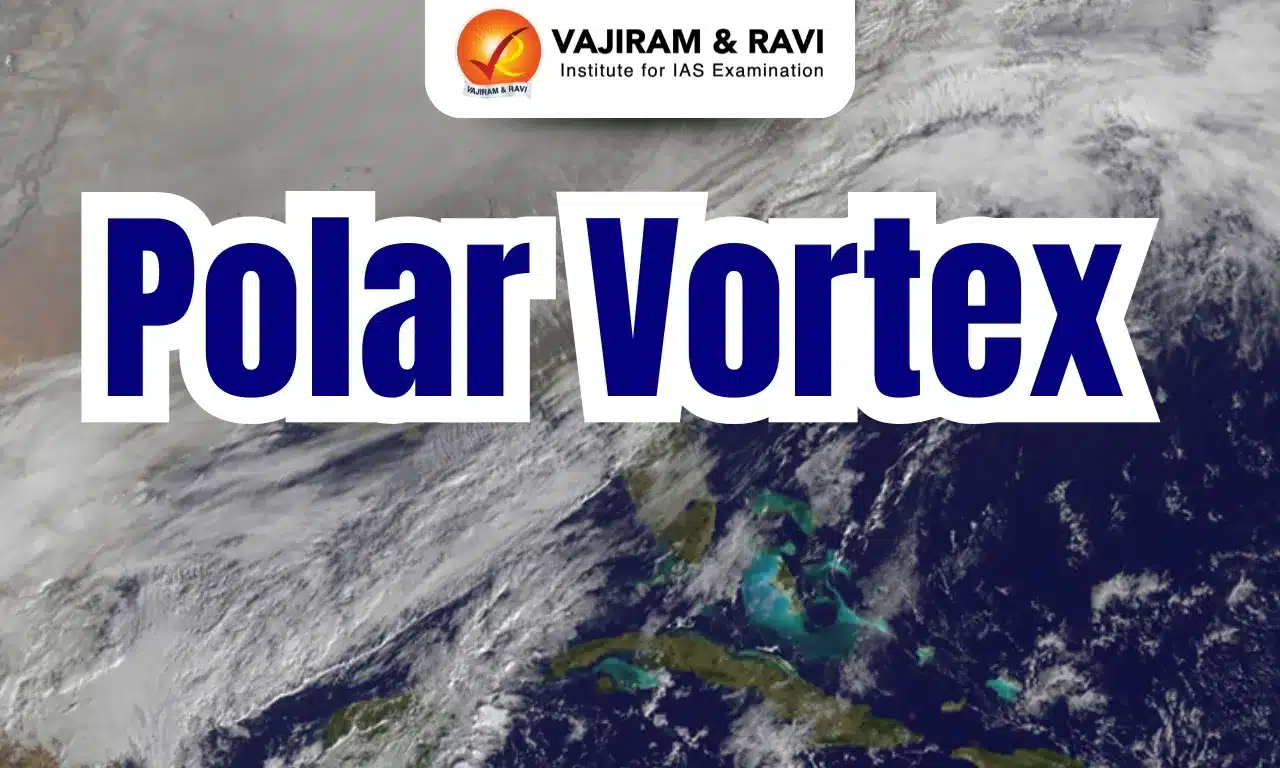
A severe winter storm impacting the U.S. from Texas to New England recently highlights the dynamic role of the stratospheric polar vortex.
About Polar Vortex
- The polar vortex is a large area of low pressure and cold air surrounding both of the Earth’s poles.
- The polar vortex extends from the tropopause (the dividing line between the stratosphere and troposphere) through the stratosphere and into the mesosphere (above 50 km).
- The term “vortex” refers to the counter-clockwise flow of air that helps keep the colder air near the Poles.
- These winds circulate and form a vortex near the North and South Poles of the planet.
- The polar vortex contains some of the coldest air on Earth.
- The strength of the polar vortex varies with the season, but it is strongest during the winter season in each hemisphere, when the temperature contrast between the pole and the Equator is greatest.
- It may weaken or disappear entirely during the warmer months of the year.
- Many times, during winter in the northern hemisphere, the polar vortex will expand, sending cold air southward with the jet stream.
- Jet streams are relatively narrow bands of strong wind in the upper levels of the atmosphere, typically occurring around 30,000 feet (9,100 meters) in elevation.
- This occurs fairly regularly during wintertime and is often associated with large outbreaks of Arctic air in the United States.
- This is not confined to the United States. Portions of Europe and Asia also experience cold surges connected to the polar vortex.
- By itself, the only danger to humans is the magnitude of how cold temperatures will get when the polar vortex expands, sending Arctic air southward into areas that are not typically that cold.
- The Antarctic polar-front jet stream is more uniform and constant than its Arctic counterpart, because Antarctica is surrounded by ocean rather than a mix of land and water.
- Cold-air outbreaks, however, do occur in the Southern Hemisphere, but they are less frequent and strike heavily populated areas less frequently.
Source: DEVD


 Last updated on Sep, 2026
→ UPSC 2027 Notification will be released on 13 January 2027 at upsconline.nic.in.
→ Asian Games 2026 are being held in Aichi-Nagoya, Japan, from 19 September to 4 October.
→ Check out the latest UPSC Syllabus here.
→ Download UPSC Model Answers for Mains 2026
→ UPSC Mains Question Paper 2026 is out now for Essay & GS Paper 1, 2, 3 & 4.
→ UPSC Calendar 2027 has been released.
→ Enroll in Vajiram & Ravi’s UPSC Mains Test Series 2027 for structured answer writing practice, expert evaluation, and exam-oriented feedback.
→ Join Vajiram & Ravi’s UPSC Mentorship Program 2027 for personalized guidance, strategy planning, and one-to-one support from experienced mentors.
→ Go through the UPSC Mains Previous Year Papers to enhance your preparation.
→ UPSC has released UPSC Toppers List 2025 with the Civil Services final result on its official website.
→ Also check Best UPSC Coaching in India
Polar Vortex FAQs
Q1. What is the polar vortex?+
Q2. Where is the polar vortex located in the atmosphere?+
Q3. What does the term “vortex” in polar vortex signify?+
Q4. During which season is the polar vortex strongest?+
Q5. What phenomenon occurs when the polar vortex expands in winter?+
Tags: polar vortex