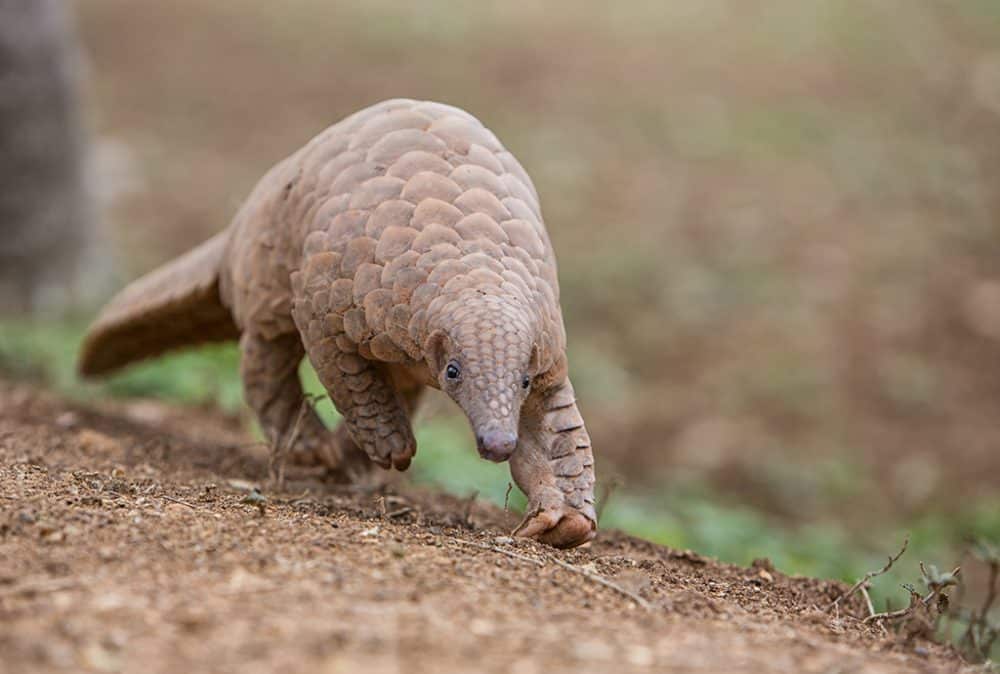
Key facts about Indian Pangolin:
- The Indian pangolin, also called thick-tailed pangolin and scaly anteater is native to the Indian subcontinent.
- It is one of the eight species of pangolins found.
- They are one of the most trafficked mammals in the world, despite an international ban on their trade.
- Scientific name: Manis crassicaudata
- Distribution: It lives in India (south of the Himalayas), Bangladesh, Southern Nepal, Sri Lanka, and small parts of Pakistan.
- Habitat: It occurs in tropical forests, open land, grasslands, and degraded habitat, including in close proximity to villages.
- Features:
- Like other pangolins, it has large, overlapping scales on its body, which act as armor.
- The Indian pangolin’s armor is amongst the most effective in the mammalian world. It has about 13 rows of moveable sharp scales covering its body, which are shed periodically.
- The colour of its scales varies depending on the colour of the earth in its surroundings.
- It can also curl itself into a ball as self-defense against predators.
- It is an insectivore feeding on ants and termites.
- It is nocturnal and rests in deep burrows during the day.
- Conservation status:
- IUCN Red List: Endangered
- Wildlife (Protection) Act, 1972: Schedule I
- CITES: Appendix I
Q1) What is TRAFFIC (wildlife trade monitoring network)?
TRAFFIC is an organization that was established in 1976 by WWF and IUCN as a wildlife trade monitoring network to undertake data collection, analysis, and provision of recommendations to inform decision making on wildlife trade.TRAFFIC is renowned globally for its expertise and influence in the wildlife trade and conservation arena, as a provider of objective and reliable information.
Source: Over 1,000 pangolins poached and trafficked in India between 2018 and 2022


 Last updated on Sep, 2026
→ UPSC 2027 Notification will be released on 13 January 2027 at upsconline.nic.in.
→ Check out the latest UPSC Syllabus here.
→ Download UPSC Model Answers for Mains 2026
→ UPSC Mains Question Paper 2026 is out now for Essay & GS Paper 1, 2, 3 & 4.
→ UPSC Calendar 2027 has been released.
→ Enroll in Vajiram & Ravi’s UPSC Mains Test Series 2027 for structured answer writing practice, expert evaluation, and exam-oriented feedback.
→ Join Vajiram & Ravi’s UPSC Mentorship Program 2027 for personalized guidance, strategy planning, and one-to-one support from experienced mentors.
→ Go through the UPSC Mains Previous Year Papers to enhance your preparation.
→ UPSC has released UPSC Toppers List 2025 with the Civil Services final result on its official website.
→ Also check Best UPSC Coaching in India