


Lapis Lazuli Latest News
Lapis Lazuli: The Earth’s Best Blue
What is Lapis Lazuli?
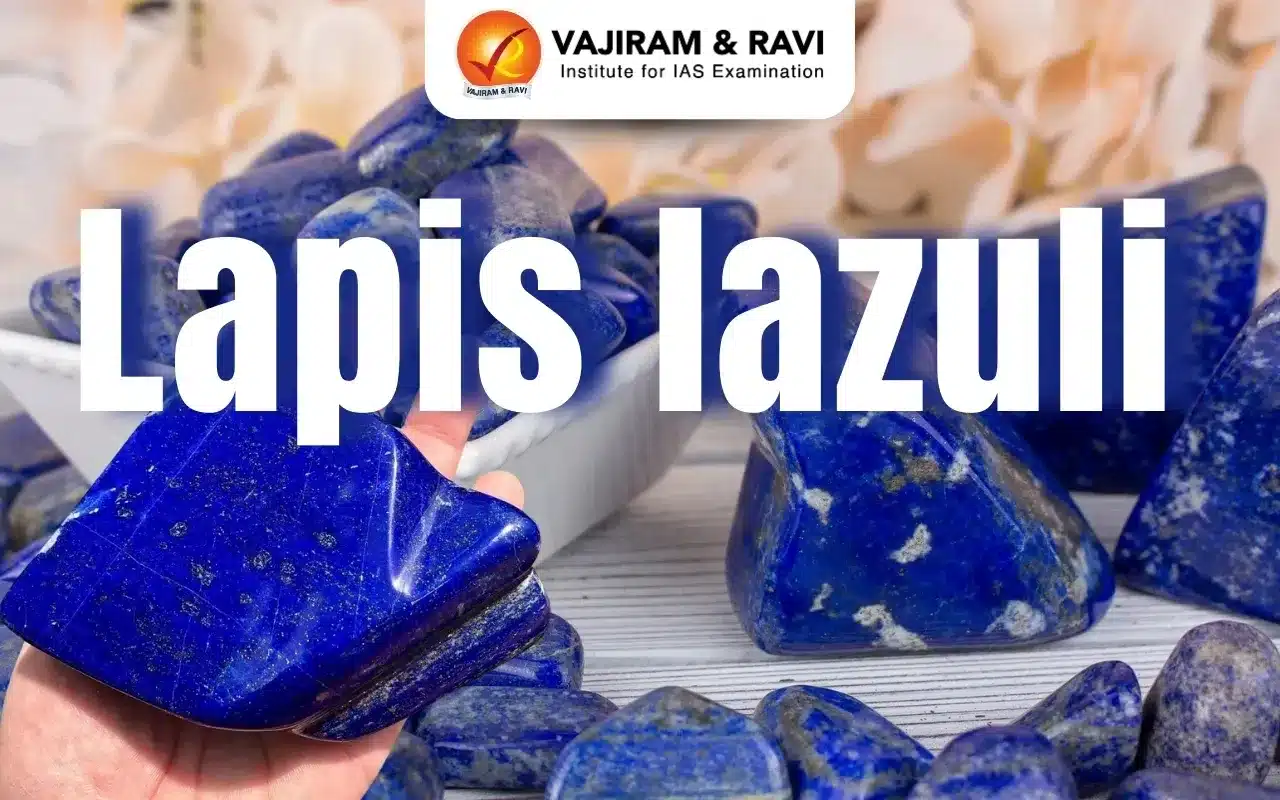
- Lapis lazuli is a vivid blue metamorphic rock, known for its striking colour and semi-precious gemstone value.
- It has been highly valued for thousands of years for use in jewellery, ornaments, and pigments.
- Etymology:
- “Lapis” (Latin) means stone.
- “Lazuli” (Persian – Lazward) means blue.


Composition of Lapis Lazuli
- The blue colour comes from lazurite (25-40%), a rare mineral.
- The shade of blue depends on the amount and structure of sulphur in lazurite.
- Other minerals present:
- Pyrite (gives golden streaks and sparkle).
- Calcite (reduces the blueness).
- Diopside and Sodalite (found in smaller quantities).
Where is Lapis Lazuli Found?
- Major sources include Afghanistan, Chile, Russia, and the United States.
- The highest-quality lapis lazuli is mined in Badakhshan province, Afghanistan, where it has been extracted for over 6,000 years.
Lapis Lazuli in History
- Ancient Trade and Use in India: Imported to India from Badakhshan as early as 1000 BCE.
- Ornaments made of lapis lazuli have been discovered at Indus Valley Civilization sites (Mohenjo-daro & Harappa).
- Ancient Egypt: Used in jewellery and ground into powder for eye shadow.
- Renaissance Europe: Ground into ultramarine, a rare and expensive blue pigment used by painters.
Lapis Lazuli FAQs
Q1: What is the Lapis Lazuli Corridor?
Ans: The Lapis Lazuli Corridor is an international transit route inaugurated in 2018, connecting Afghanistan to Turkey via Turkmenistan, Azerbaijan, and Georgia. This corridor facilitates trade and transportation between South Asia and Europe, enhancing regional economic integration.
Q2: Why is it called the “Lapis Lazuli” Corridor?
Ans: The name “Lapis Lazuli” is derived from the historic trade route through which lapis lazuli and other semi-precious stones were exported from Afghanistan over the past 2,000 years to regions like the Caucasus, Russia, the Balkans, and North Africa via the Silk Road.
Q3: Which countries does the Lapis Lazuli Corridor traverse?
Ans: The corridor begins in Afghanistan and passes through Turkmenistan, Azerbaijan, and Georgia, before reaching Turkey
Source: TH

 Last updated on Oct, 2026
→ UPSC 2027 Notification will be released on 13 January 2027 at upsconline.nic.in.
→ Check Nobel Prize 2026 Winners List here.
→ Download PIB PRiSM Monthly Magazine 2026 here.
→ Check UPSC Monthly Current Affairs Magazine The Recitals here.
→ Check out the latest UPSC Syllabus here.
→ Download UPSC Model Answers for Mains 2026
→ UPSC Mains Question Paper 2026 is out now for Essay & GS Paper 1, 2, 3 & 4.
→ UPSC Calendar 2027 has been released.
→ Enroll in Vajiram & Ravi’s UPSC Mains Test Series 2027 for structured answer writing practice, expert evaluation, and exam-oriented feedback.
→ Join Vajiram & Ravi’s UPSC Mentorship Program 2027 for personalized guidance, strategy planning, and one-to-one support from experienced mentors.
→ Go through the UPSC Mains Previous Year Papers to enhance your preparation.
→ UPSC has released UPSC Toppers List 2025 with the Civil Services final result on its official website.
→ Also check Best UPSC Coaching in India








